
Slurry Injection Saves Nitrogen - but What Does It Cost Elsewhere?
Cattle slurry contains valuable nitrogen, but its agronomic value depends heavily on what happens during and immediately after application.
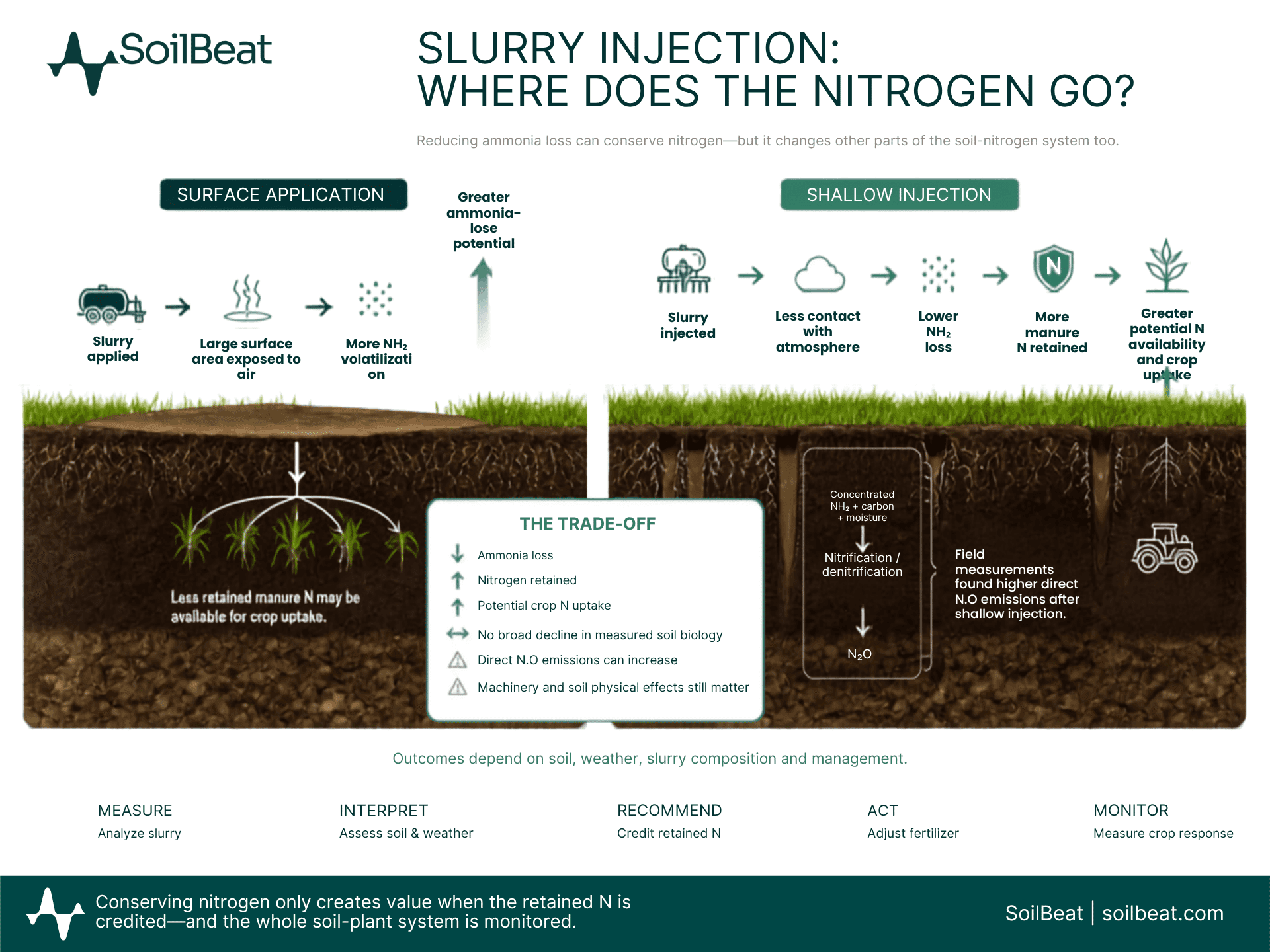
A substantial fraction may be present as ammonium. When slurry is left exposed on the surface, ammonium can shift toward gaseous ammonia and escape before the crop uses it. Incorporating or injecting slurry reduces that contact with the atmosphere and generally preserves more nitrogen for plant uptake.
That seems like an uncomplicated efficiency gain. In practice, changing placement also changes where water, ammonium, organic carbon, microorganisms, roots, and machinery interact.
A five-year Dutch research program found that low-emission slurry placement reduced ammonia loss and improved grass nitrogen uptake and production. It found little evidence for the frequently raised concern that shallow injection broadly damages soil biology.
The research also identified real tradeoffs: higher direct nitrous-oxide emissions in field measurements, possible compaction from heavy machinery, weaker rooting on farms with a long injection history, and increased cracking along injection slots in clay-containing soil during drought.
The useful conclusion is therefore not that one method is universally good and another bad. Manure placement changes several parts of the nitrogen and soil system simultaneously.
Research finding
Wageningen Environmental Research and the Louis Bolk Institute conducted the program between 2021 and 2025 for the Dutch Ministry of Agriculture, Fisheries, Food Security and Nature.
The work combined several evidence streams:
A review of manure-placement research
Long-term soil measurements on 40 dairy farms using contrasting application systems
Laboratory incubation experiments using slurry from those farms and ten additional conventional farms
A field experiment examining crack formation
Two-year field trials at two grassland sites on sandy soil in Friesland
Treatments included surface-broadcast cattle slurry and low-emission placement, particularly shallow injection into slots in the grass sward. The experiments also considered slurry composition, mineral fertilizer, clover-based extensive systems, grass yield, nitrogen uptake, postharvest nitrate residue, soil physical and chemical measurements, soil organisms, and gaseous emissions.
Low-emission placement consistently reduced ammonia loss relative to surface application. Dutch agricultural coverage of the research quantified the incubation reduction at approximately 75% and the field grass-yield advantage at approximately 12%. The original report’s broader conclusion was that lower ammonia loss left more manure nitrogen available for uptake, improving nitrogen recovery and grass production.
The expected biological damage was not detected. The researchers found few or no consistent differences in earthworm numbers and biomass, nematodes, bacteria, fungi, or the soil chemical properties examined. Sequencing and other biological measurements in the field trials likewise did not show a broad decline attributable to injection.
However, field measurements recorded higher direct nitrous-oxide emissions after shallow injection. The incubation experiment was more variable and did not produce a significant average difference, illustrating how strongly gaseous losses depend on soil and weather conditions.
Application method did not change postharvest nitrate residue sufficiently to indicate a different nitrate-leaching risk.
Why ammonia retention improves nitrogen supply
Cattle-slurry nitrogen includes organic N and total ammoniacal nitrogen, predominantly ammonium in the liquid.
The balance between dissolved ammonium and gaseous ammonia is influenced by pH, temperature, concentration, wind, and the area exposed to air. Warm, windy conditions and higher slurry pH generally increase volatilization potential.
Surface broadcasting distributes slurry over a large exposed area. Shallow injection places it below or within the sward, reducing air contact and protecting more ammoniacal nitrogen from immediate loss.
Retained ammonium may bind to negatively charged soil surfaces. Roots can absorb it directly, or nitrifying organisms can convert it first to nitrite and then nitrate. Nitrate moves readily with soil water and often supplies a large part of grass nitrogen demand.
This is an important distinction in plant nutrition: the amount of nitrogen applied is not necessarily the amount of nitrogen that remains available to the crop.
This explains why lower ammonia loss can raise nitrogen uptake and yield without applying more total slurry. It also means that a previously calibrated mineral-fertilizer program may oversupply nitrogen if the extra conserved manure N is ignored. Getting that balance right requires looking at both nutrient supply and plant demand rather than fertilizer rate alone—an issue also explored in SoilBeat's article on achieving the right nitrogen balance for crop productivity.
The fertilizer-saving opportunity must be calculated from slurry composition and measured crop response. Slurry from the farms varied widely, and farms using surface application were generally more extensive, used less mineral fertilizer, and produced manure with lower nitrogen and ammonium concentrations.
A cubic meter of slurry was therefore not an agronomically identical input across farms.
Why nitrous oxide can move in the opposite direction
Reducing one nitrogen loss does not guarantee that every other loss declines.
Injection concentrates ammonium, readily decomposable organic carbon, and water inside narrow soil slots. Microorganisms consume oxygen while decomposing the carbon. At the same time, ammonium may be nitrified and nitrate may accumulate.
These conditions can produce nitrous oxide through both nitrification and denitrification. Denitrification becomes particularly important when pores remain wet and oxygen supply is restricted. Soil texture, moisture, temperature, compaction, rainfall after application, carbon availability, and injection depth can all change the response.
Some of the apparent climate tradeoff also depends on accounting boundaries. Surface-applied ammonia can later deposit elsewhere and contribute indirectly to nitrous-oxide formation. When both direct and indirect emissions are considered, the difference between placement methods may be smaller than the direct field measurements alone suggest.
The study nevertheless shows why ammonia reduction should not serve as the only performance metric.
What happened below ground?
The findings do not support a general claim that shallow injection destroys soil biology.
Little consistent difference was found in the measured earthworms, nematodes, fungi, bacteria, or chemical soil properties. That is important because visible cutting of the sward can easily be mistaken for evidence of persistent biological harm.
Physical effects require more caution.
Farms with a history of surface broadcasting had better measured soil structure and deeper rooting. The researchers considered machinery a plausible explanation: surface applicators were generally lighter than slurry injectors. Because those farms also differed in intensity, fertilizer use, manure composition, and other management, the farm comparison cannot prove that injection alone caused the rooting difference.
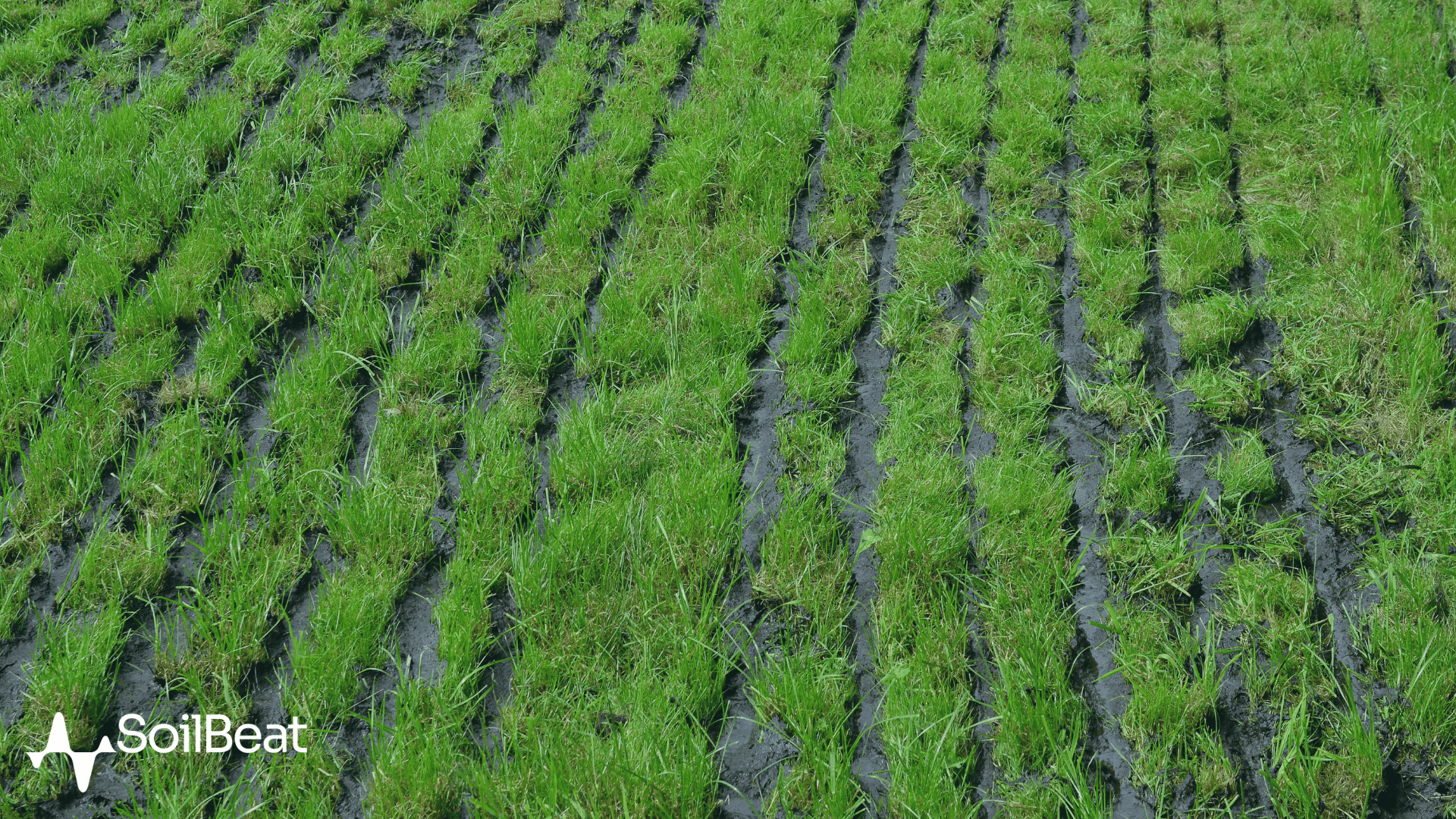
The separate cracking study identified another context-specific risk. During prolonged drought, injection slots in clay-containing soils produced more pronounced cracking. Average soil moisture was not detectably changed, but cracks could still influence roots, preferential water flow, and subsequent field traffic.
This is a useful distinction: the biological concern was not confirmed, while machinery and soil physical condition remain legitimate management concerns.
It also demonstrates why nutrient management cannot be separated completely from the physical and biological condition of the soil. Soil chemistry tells only part of the story. Soil structure, rooting, microbial processes, moisture, and nutrient availability ultimately interact to determine whether applied nutrients reach the plant. SoilBeat discusses this broader relationship in its guide to plant nutrition for regenerative agriculture.
Possible management implications
The immediate opportunity is to recognize the additional nitrogen retained by low-emission placement.
A defensible evaluation should integrate:
Slurry total N, ammonium-N, dry matter, pH, and carbon
Application rate and placement depth
Air temperature, wind, humidity, rainfall, and soil moisture
Soil texture, structure, load-bearing capacity, and traffic pattern
Mineral fertilizer applied before and after slurry
Grass dry-matter yield, tissue N, and forage protein
Clover contribution where relevant
Post-harvest mineral N
Fuel, labor, contractor, and machinery costs
Compaction, nitrous oxide, and ammonia indicators where measurement is feasible
Manure analysis is especially important. A fixed volume-based “slurry credit” can be misleading when ammonium concentration varies among storage systems, diets, dilution levels, and farms.
The same principle applies to the soil. A fertilizer or manure input only becomes agronomically meaningful when it is interpreted alongside what the soil can supply. Different analytical methods reveal different parts of that nutrient pool; SoilBeat's discussion of total digestion soil testing and hidden nutrient reserves provides one example.
Timing also matters. Applying into wet or compacted soil may reduce ammonia yet increase rutting, smearing, oxygen limitation, and nitrous oxide. Application during hot, dry, windy weather may protect soil structure but increase ammonia loss if manure remains exposed. The practical decision is a balance among placement, weather, trafficability, and crop demand.
Measure what reaches the plant
One of the most important consequences of conserving manure nitrogen is that the fertilizer program may need to change.
If injection makes more manure N available but the same amount of mineral nitrogen is subsequently applied, some of the efficiency gain can be lost through unnecessary nutrient surplus.
Soil and manure analyses establish potential supply. Plant measurements provide another piece of the feedback loop by showing what the crop is actually taking up.
Tissue and plant sap analysis can therefore complement soil and manure measurements during the season. Rather than assuming that retained nitrogen has become plant-available, crop measurements can help determine whether nitrogen status is increasing, remaining deficient, or moving toward excess.
This is particularly useful where the objective is to reduce purchased fertilizer without sacrificing production. SoilBeat discusses how plant sap analysis can support higher nutrient-use efficiency and lower fertilizer inputs, as well as how soil and plant sap analysis can be combined when managing nitrogen losses.
The principle is straightforward: conserving nitrogen only creates economic value if that retained nitrogen replaces another input or contributes to additional productive crop uptake.
Limitations and unknowns
The controlled field trials lasted two years and were conducted at two sandy grassland sites. The long-term component compared commercial farms rather than randomly assigning application systems, so machinery, stocking intensity, fertilizer use, clover, and slurry composition were partly confounded.
The findings should not be transferred automatically to arable crops, solid manure, digestate, highly diluted slurry, deep injection, acidic slurry, or different climates.
The study also did not produce a universal mineral-fertilizer reduction for injected slurry. That credit depends on manure analysis, application conditions, soil supply, expected yield, and local response data.
Finally, measuring no average change in a biological group does not prove that every species, microbial function, or field condition is unaffected. It does show that claims of broad, inevitable biological damage are not supported by this extensive dataset.
Recommendation
Use manure-placement methods that meet local regulations and have validated ammonia-reduction performance, but manage them as part of a complete nitrogen and soil system.
Analyze slurry before application. Credit the nitrogen conserved through effective placement when calculating supplemental fertilizer. Avoid traffic when soil is vulnerable to compaction, and monitor rooting or structure where heavy equipment repeatedly follows the same pattern.
Then check whether the retained nitrogen appears in the crop through yield, forage analysis, tissue N, and reduced need for purchased fertilizer.
Where plant measurements are available, monitoring crop nutrient status during the season can add another feedback point between application and final yield. In nitrogen management specifically, monitoring excess nitrate and ammonium in plant sap can help identify situations where N supply may be moving beyond crop demand.
This is a clear application of Measure → interpret → recommend → act → monitor.
Placement determines where manure enters the system. Weather and soil determine its transformations. Plant measurements show how much was captured. Yield, fertilizer savings, physical soil condition, and loss indicators determine whether the complete outcome improved.
That same evidence-based workflow sits at the heart of SoilBeat: bringing soil, plant, field, laboratory, management, and agronomic information together so that recommendations remain connected to the evidence behind them.
The practical insight is that preventing ammonia loss can make slurry more valuable—but only if the extra nitrogen is credited and the machinery, soil, and emission tradeoffs are managed at the same time.
Sources
Velthof et al. — Effect of manure-application technique on soil biology and gaseous emissions, June 2026.
Wageningen University & Research — Institutional summary of the five-year manure-placement program, Sept. 11, 2026.
Nieuwe Oogst — Dutch industry coverage with yield and emission figures, Sept. 14, 2026.
Singh et al. — Organic bok-choy N rates, SPAD, and sap nitrate, Sept. 10, 2026.
Souza Junior et al. — Controlled-release fertilizer programs in HLB-affected citrus, accepted Sept. 11, 2026.
Mohan Kumar et al. — Soil and foliar N management in rainfed castor, accepted Sept. 11, 2026.
Conner et al. — Biochar feedstock, organic N, carbon pools, and soil nitrate, Sept. 10, 2026.
Soil nutrient dynamics under organic and inorganic chile amendments, September 2026.
Balanced ammonium–nitrate supply during wheat tillering, 2026.
Rhizosphere organic acids and nutrient release from silicate rock powders, Aug. 15, 2026.
San Bautista — Framework for diagnosing limiting crop-growth processes, Sept. 9, 2026.
Zhang et al. — Mycorrhizal regulation of plant–bacteria interactions in contaminated soil, Sept. 14, 2026.
Embrapa — Economic assessment of biological phosphate solubilization in Brazil, August 2026.
UF/IFAS — Standardized nutrient recommendations for Florida vegetables, updated 2026.

Written by
Buse Soysal
Related
Other Articles.
Can Vetch Catch Crops Improve Greenhouse Vegetables and Reduce Fertilizer

by
Buse Soysal
Best Practices
Fertiliser Recommendation
Nutrient Interactions
Soil Health
The New Global Fertilizer Map

by
Buse Soysal
Fertiliser Recommendation
Fertilizers
Data Analytics
Climate Change
Turning lab report into a fertiliser recommendation

by
Buse Soysal
Fertiliser Recommendation
Unlocking Hidden Nutrients with Total Digestion Soil Tests
by
Buse Soysal
How to Balance a High Bacterial to Fungal Ratio in your Soil

by
Buse Soysal
Soil Health
Magnesium: The Unsung Hero of Photosynthesis
by
Buse Soysal
Nutrient Interactions
Nitrogen: The Builder
by
Buse Soysal
Plantsap
Unlocking Smarter Farming with Weather + Nutrient Analytics

by
Buse Soysal
Nutrient Interactions
Water Meets Nutrient Strategy

by
Buse Soysal
Nutrient Interactions
Calcium: The Architect
by
Buse Soysal
Plantsap
Potassium: The Logistics Manager

by
Buse Soysal
Plantsap
Phosphorus: The Strategist
by
Buse Soysal
Plantsap
Unit Conversion Meets Crop Intelligence

by
Buse Soysal
Soil Testing
Soil Biology Testing—What Are Your Options?
by
Buse Soysal
Soil Testing
Predict Problems Before They Hit — The Power of Plant Sap Analysis
by
Buse Soysal
Data Analytics
Maximizing Cover Crop Benefits for Your Cash Crop

by
Buse Soysal
Nutrient Interactions
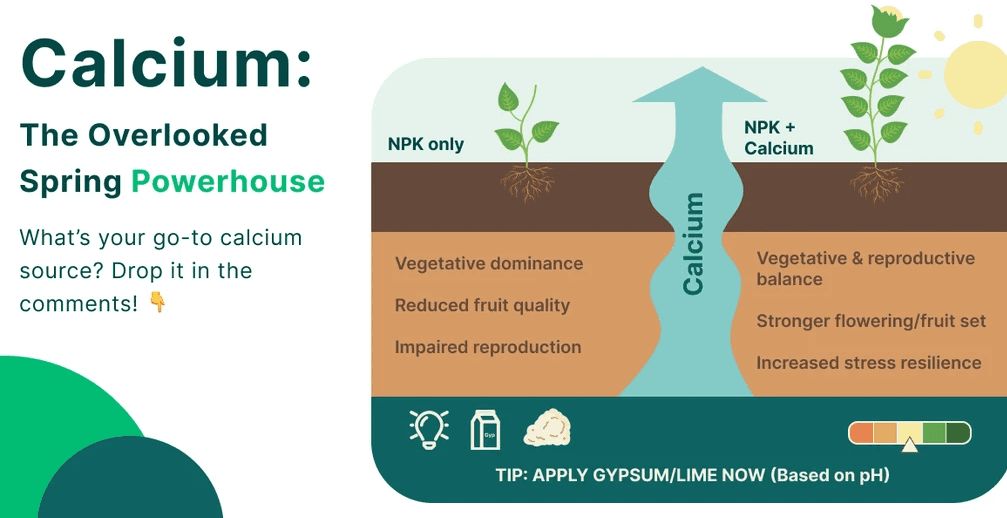
Calcium: The Overlooked Spring Powerhouse
by
Buse Soysal
Nutrient Interactions
Are fertilizer costs cutting into your bottom line?
by
Buse Soysal
Fertilizers
Advancing Precision Irrigation: Leveraging Technology for Sustainable Agriculture

by
Buse Soysal
Soil Health
Unlocking Agriculture’s Hidden Helpers: Microbial Genomics and the Data Challenge

by
Buse Soysal
The importance of microbial amendments: How to increase overall crop resilience

by
Buse Soysal
Soil Health
Unlocking Crop Potential: The Untapped Power of Plant Sap Analysis

by
Buse Soysal
Regenerative Agriculture
Unlocking Carbon Credits: What Data Farmers Need to Track and How We Can Help

by
Buse Soysal
Data Analytics
Enhancing Weed Management: Leveraging Data Analytics for Sustainable Agriculture
by
Buse Soysal
Data Analytics
Elevating Crop Health with Brix Measurements: The Sweet Science of Plant Immunity

by
Buse Soysal
Soil Health
Nutrient Management and Disease Resistance: Unveiling the Hidden Connections Through Data Analytics

by
Buse Soysal
Base Saturation Balancing: Achieving the Ideal Ratio for Optimal Crop Production

by
Buse Soysal
Soil Health
How to Achieve Zero Excess Free Nitrates and Ammonium in Plant Sap Analysis

by
Buse Soysal
Regenerative Agriculture
America's Buzzing Backbone: The Crucial Role of Migratory Beekeeping in U.S. Agriculture

by
Buse Soysal
Soil Health
Breaking Down Soil Biology Testing - Finding the ROI with PLFA Tests

by
Buse Soysal
Soil Testing
Precision Agriculture: Revolutionizing Farming, One Field at a Time

by
Buse Soysal
Precision Agriculture
Ag101: What is the difference between organic and regenerative agriculture?
by
Buse Soysal
Soil Health
Your Favourite Beans are in Danger: Threats to Coffee & Chocolate Production
by
Buse Soysal
Soil Health
IPM Programs: Best of the Pest Prevention Measures

by
Buse Soysal
Pest & Disease
Wet Spring Issues - Why So Irreparable?

by
Buse Soysal
Nutrient Interactions
The Influence of Nutrient Applications on Post Harvest
by
Buse Soysal
Nutrient Interactions
Orange Juice in Danger: The Threat of HLB Disease

by
Buse Soysal
Soil Health
California Dreaming: The Issue with Almond Production

by
Buse Soysal
Sight Unseen: Zinc Deficiency in Soil

by
Buse Soysal
Nutrient Interactions
Battle Beneath: Understanding Calcium - Potassium Antagonism in Soil

by
Buse Soysal
Nutrient Interactions
The Plant Kingdom's Power Couple: Nitrogen and Sulfur's Synergistic Symphony

by
Buse Soysal
Nutrients for Beginners
Increase Drought Tolerance With This Commonly Missed Micronutrient

by
Buse Soysal
Climate Change
Digging Deeper: The Great Soil Analysis Debate for Regenerative Agriculture

by
Buse Soysal
Soil Health
Ammonium vs Calcium: The Nutrient Balancing Act for Thriving Plants

by
Buse Soysal
Nutrient Interactions
Improving Soil Structure: Boost Your Farm’s Resilience
by
Buse Soysal
Soil Health
Sodium and Calcium Relationship: A Tale of Frenemies in the Soil

by
Buse Soysal
Nutrient Interactions
The Soil Office: Molybdenum and Nitrate's Tumultuous Relationship
by
Buse Soysal
Nutrient Interactions
The Delicate Dance: Achieving the Perfect Nitrogen Balance for Optimal Crop Productivity

by
Buse Soysal
Nutrient Interactions
Paving the Way for a Regenerative Future: Insights into the "Data Driven Regenerative Ag" Project

by
Buse Soysal
Regenerative Agriculture
Unlocking Soil's Full Potential: The Pioneering Principles of Dr. William A. Albrecht

by
Buse Soysal
Soil Health
The Benefits of Regenerative Agriculture for Human Health

by
Buse Soysal
Regenerative Agriculture
Responsible Data Exchange in Agriculture

by
Buse Soysal
Data Analytics
Responsible Fertilizer Use for Mitigating Drought

by
Buse Soysal
Climate Change
The Power of Healthy Soil: for a Happy World Earth Day

by
Buse Soysal
Soil Health
Crop Scouting for Regenerative Agriculture
by
Buse Soysal
Regenerative Agriculture
Plantsap and Soil Analyses for Nitrogen Emission Reduction
by
Buse Soysal
Regenerative Agriculture
How do you use Plant Nutrition for Regenerative Agriculture?

by
Buse Soysal
Regenerative Agriculture
Profitability of Regenerative Agriculture and Transition Management

by
Buse Soysal
Regenerative Agriculture
How can we use Data-Driven Farming for a Bright Future?

by
Buse Soysal
Data Analytics
Plantsap Analysis for More Yield and Less Fertilizer

by
Buse Soysal
Regenerative Agriculture