
Straw can improve soil carbon while raising greenhouse-gas emissions. A global review shows why both outcomes need to be measured.
This SoilBeat article draws on research by Xiaoyan Wang and Feng Luo, published in Frontiers in Sustainable Food Systems. The study findings are theirs; the practical interpretation below is SoilBeat’s. Read the original research.
Returning crop straw is often presented as a straightforward climate and soil-health practice. The agronomic logic is real: residue adds carbon, recycles potassium and other nutrients, protects the surface, and can improve aggregation and water retention. But a higher soil-carbon stock does not automatically mean lower net greenhouse-gas emissions.
A global meta-analysis makes that tension unusually visible. Across 137 peer-reviewed field studies, straw incorporation increased soil organic-carbon storage. At the same time, carbon dioxide, methane, nitrous oxide, and combined global-warming potential were all higher than under no straw return. Studies lasting more than five years showed a smaller emissions increase than shorter studies, but emissions remained above the control.
The finding does not make straw return “bad.” It shows why residue management must be judged as a soil–plant–nutrient–water system rather than from one indicator.
Research finding
The researchers screened 733 records and retained 137 field studies for quantitative synthesis. They used random-effects models and log response ratios, with observations nested within source studies. The comparison was straw incorporation versus no straw return.
Across the database, straw incorporation increased soil organic-carbon storage by 23.57% on average.
Source: Xiaoyan Wang and Feng Luo (Frontiers in Sustainable Food Systems, 2026)
The greenhouse-gas results were split by study duration. In studies lasting five years or less, straw incorporation increased CO2 emissions by 43.36%, CH4 by 52.80%, N2O by 31.31%, and combined global-warming potential by 36.31% relative to no return.
In studies lasting more than five years, the increases were smaller: 35.24% for CO2, 41.25% for CH4, 23.81% for N2O, and 22.44% for global-warming potential. The authors therefore describe an attenuation of the emissions increment over time.
That wording needs careful interpretation. The long-term subgroup did not show lower emissions than no straw. It showed a smaller increase than the short-term subgroup.
Why soil carbon and emissions can rise together
Straw is carbon-rich biological material. Incorporation places that carbon into direct contact with soil organisms. Some carbon is stabilized in aggregates or associated with minerals, contributing to soil organic matter. Some is decomposed and returned to the atmosphere as CO2.
The same decomposition can affect nitrogen cycling. Microbes may temporarily immobilize mineral N when residues have a wide carbon-to-nitrogen ratio. Later, mineralization can release ammonium, which can be nitrified to nitrate. If nitrate, available carbon, and wet or oxygen-limited microsites coincide, denitrification can produce N2O.
Moisture is central. Straw can conserve water, change evaporation, and alter pore-scale oxygen. In flooded or poorly aerated systems, added carbon can support methanogenesis and increase CH4. In well-aerated upland soils, methane behavior is different, but respiration and N2O remain sensitive to moisture, temperature, mineral N, and placement.
This is why nutrient form and timing matter. A residue layer, shallow incorporation, deep incorporation, dry-soil application, and incorporation before heavy rainfall can create very different conditions. Adding mineral N to accelerate decomposition may also change the balance between crop uptake, microbial immobilization, nitrate accumulation, and gaseous loss.
Agronomic interpretation
The strongest conclusion is not that straw should be removed. It is that carbon storage and greenhouse-gas accounting answer different questions.
Soil carbon influences nutrient buffering, aggregation, biological activity, water-holding capacity, trafficability, and resilience. Those benefits may improve yield stability and reduce some input requirements over time. Burning, exporting, or removing residues also has costs and alternative emissions.
But climate claims require a broader boundary. A practice can store more carbon in soil while increasing N2O or CH4 enough to weaken—or potentially outweigh—the climate benefit. N2O is especially important in fertilized systems because small changes in the fraction of N lost can have a large warming effect.
The meta-analysis does not calculate a complete farm carbon balance for every system. It compares measured soil-carbon and greenhouse-gas responses reported by the included studies. It therefore sharpens the question but does not provide a universal answer for every crop, soil, and climate.
Possible management implication
Residue management should begin with measurement and nutrient accounting.
First, quantify the residue load and its nutrient content. Straw is not just carbon. It returns potassium readily, contains phosphorus and sulfur, and influences the timing of N immobilization and mineralization. Nutrient credits should be crop-, residue-, and soil-specific.
Second, follow mineral N through the root zone. Soil nitrate and ammonium before incorporation, before planting, during rapid uptake, and after harvest can reveal whether the system is immobilizing N, synchronizing release, or leaving a loss-prone surplus.
Third, pair soil data with plant data. Tissue or sap analysis can indicate whether apparent soil supply is translating into uptake. A crop can face temporary N shortage during residue decomposition even when the season-long N balance looks adequate.
Fourth, record moisture, irrigation, rainfall, drainage, and temperature. These variables determine whether added carbon is processed mainly under aerobic or oxygen-limited conditions. In rice, water regime is inseparable from CH4. In upland crops, wet periods following N supply can dominate N2O risk.
Fifth, measure outcome, not only process. Yield, crop quality, nutrient removal, soil carbon, and input cost must be tracked together. Where greenhouse-gas measurement is impractical, validated regional emission factors and scenario analysis are more defensible than assuming zero trade-off.
Recommendation
Straw return remains an established option for recycling nutrients and maintaining soil organic matter, but it should not be sold as automatic climate mitigation.
Use local trials to compare residue amount, placement, timing, tillage, and N management. Avoid a single global rate or a fixed fertilizer deduction. The right adjustment depends on residue C:N, soil texture, pH, moisture, temperature, rooting pattern, preceding crop, and the next crop’s demand curve.
For nitrogen, the practical target is synchronization: avoid mineral-N excess during wet periods while preventing crop deficiency during microbial immobilization. That may require altered timing, split applications, cover crops, drainage changes, or different incorporation timing. The new meta-analysis does not identify one universally superior package.
Limitations and unknowns
The synthesis is global, but the underlying studies are not evenly distributed across crops, climates, soils, and management systems. Study duration was divided at five years, a useful but coarse threshold. The authors could not systematically resolve every interaction involving residue rate, incorporation method, fertilizer program, tillage, climate, or soil type.
Publication-bias assessment relied on fail-safe N rather than a fuller set of diagnostics. Outcomes were reported as relative responses, which are powerful for synthesis but do not replace absolute emissions, carbon stocks, yield, and economics at a specific site.
The analysis also cannot prove that time alone caused the smaller long-term emissions response. Long-duration studies may differ from short studies in location, management, measurement, or baseline conditions.
The SoilBeat perspective
This evidence fits a Measure → interpret → recommend → act → monitor approach.
Measure residue load, soil carbon, mineral N, moisture, pH, crop uptake, yield, and applications. Interpret whether carbon addition is supporting aggregation and nutrient cycling, causing temporary immobilization, or coinciding with a loss-prone surplus. Recommend changes that match the soil, crop, stage, and weather. Act through a controlled field comparison. Monitor the result across seasons rather than declaring success from one soil-carbon test.
Soil carbon is an important outcome, but it is not a complete climate balance. A strong residue program should build soil function, feed the crop efficiently, and control the conditions that convert recycled carbon and nitrogen into avoidable gaseous losses.
References
Xiaoyan Wang and Feng Luo (2026). Long-term straw incorporation in farmland promotes carbon sequestration and mitigates emissions: a global meta-analysis. Frontiers in Sustainable Food Systems.
AI-generated editorial illustration for SoilBeat. Conceptual imagery; not a photograph or figure from the study.

Written by
SoilBeat
Related
Other Articles.
Less mineral nitrogen, stronger reserves: reading a conservation field

by
Buse Soysal
Fertiliser
Foliar manganese and zinc: why humidity changes the result

by
Buse Soysal
Fertiliser
Organic fertilizer helped maize—but wheat needed a different plan

by
Buse Soysal
Fertiliser
Slurry Injection Saves Nitrogen But What Does It Cost Elsewhere?

by
Buse Soysal
Fertilizers
The New Global Fertilizer Map

by
Buse Soysal
Fertiliser
Fertilizers
Climate Change
Can Vetch Catch Crops Improve Greenhouse Vegetables and Reduce Fertilizer

by
Buse Soysal
Best Practices
Fertiliser
Nutrient Interactions
Soil Health
Turning lab report into a fertiliser recommendation

by
Buse Soysal
Fertiliser
Chloride: The Gatekeeper

by
Buse Soysal
Plantsap
Fertiliser
Nutrient Interactions
Sodium: The Opportunist
by
Buse Soysal
Plantsap
Fertiliser
Nutrient Interactions
Sulfur: The Finisher

by
Buse Soysal
Plantsap
Fertiliser
Nutrient Interactions
Unlocking Hidden Nutrients with Total Digestion Soil Tests
by
Buse Soysal
Zinc: The Coordinator

by
Buse Soysal
Plantsap
Fertiliser
Nutrient Interactions
How to Balance a High Bacterial to Fungal Ratio in your Soil

by
Buse Soysal
Soil Health
Magnesium: The Technician
by
Buse Soysal
Plantsap
Fertiliser
Nutrient Interactions
Iron: The Power Engineer

by
Buse Soysal
Plantsap
Fertiliser
Nutrient Interactions
Copper: The Defender

by
Buse Soysal
Plantsap
Fertiliser
Nutrient Interactions
Molybdenum: The Facilitator

by
Buse Soysal
Plantsap
Fertiliser
Nutrient Interactions
Magnesium: The Unsung Hero of Photosynthesis
by
Buse Soysal
Nutrient Interactions
Nitrogen: The Builder
by
Buse Soysal
Plantsap
Manganese: The Regulator

by
Buse Soysal
Plantsap
Fertiliser
Nutrient Interactions
Unlocking Smarter Farming with Weather + Nutrient Analytics

by
Buse Soysal
Nutrient Interactions
Water Meets Nutrient Strategy

by
Buse Soysal
Nutrient Interactions
Boron: The Connector

by
Buse Soysal
Plantsap
Nutrient Interactions
Fertilizers
Calcium: The Architect
by
Buse Soysal
Plantsap
Fertiliser
Nutrient Interactions
Potassium: The Logistics Manager

by
Buse Soysal
Plantsap
Phosphorus: The Strategist
by
Buse Soysal
Plantsap
Unit Conversion Meets Crop Intelligence

by
Buse Soysal
Soil Testing
Soil Biology Testing—What Are Your Options?
by
Buse Soysal
Soil Testing
Predict Problems Before They Hit — The Power of Plant Sap Analysis

by
Buse Soysal
Data Analytics
Maximizing Cover Crop Benefits for Your Cash Crop

by
Buse Soysal
Nutrient Interactions
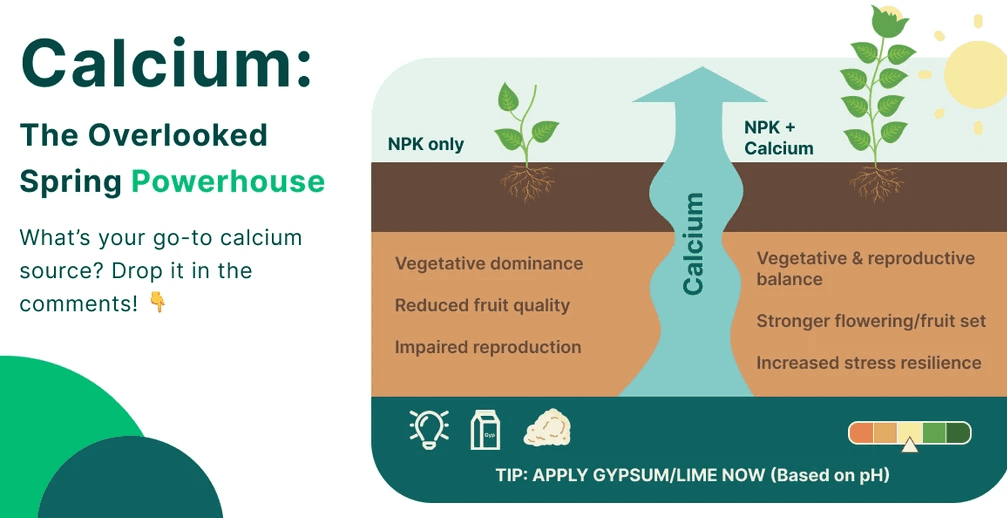
Calcium: The Overlooked Spring Powerhouse
by
Buse Soysal
Nutrient Interactions
Are fertilizer costs cutting into your bottom line?
by
Buse Soysal
Fertilizers
Advancing Precision Irrigation: Leveraging Technology for Sustainable Agriculture

by
Buse Soysal
Soil Health
Unlocking Agriculture’s Hidden Helpers: Microbial Genomics and the Data Challenge

by
Buse Soysal
The importance of microbial amendments: How to increase overall crop resilience

by
Buse Soysal
Soil Health
Unlocking Crop Potential: The Untapped Power of Plant Sap Analysis

by
Buse Soysal
RegenAg
Unlocking Carbon Credits: What Data Farmers Need to Track and How We Can Help

by
Buse Soysal
Data Analytics
Enhancing Weed Management: Leveraging Data Analytics for Sustainable Agriculture
by
Buse Soysal
Data Analytics
Elevating Crop Health with Brix Measurements: The Sweet Science of Plant Immunity

by
Buse Soysal
Soil Health
Nutrient Management and Disease Resistance: Unveiling the Hidden Connections Through Data Analytics

by
Buse Soysal
Base Saturation Balancing: Achieving the Ideal Ratio for Optimal Crop Production

by
Buse Soysal
Soil Health
How to Achieve Zero Excess Free Nitrates and Ammonium in Plant Sap Analysis

by
Buse Soysal
RegenAg
America's Buzzing Backbone: The Crucial Role of Migratory Beekeeping in U.S. Agriculture

by
Buse Soysal
Soil Health
Breaking Down Soil Biology Testing - Finding the ROI with PLFA Tests

by
Buse Soysal
Soil Testing
Precision Agriculture: Revolutionizing Farming, One Field at a Time

by
Buse Soysal
PrecisionAg
Ag101: What is the difference between organic and regenerative agriculture?
by
Buse Soysal
Soil Health
Your Favourite Beans are in Danger: Threats to Coffee & Chocolate Production

by
Buse Soysal
Soil Health
IPM Programs: Best of the Pest Prevention Measures

by
Buse Soysal
Pest & Disease
Wet Spring Issues - Why So Irreparable?

by
Buse Soysal
Nutrient Interactions
The Influence of Nutrient Applications on Post Harvest
by
Buse Soysal
Nutrient Interactions
Orange Juice in Danger: The Threat of HLB Disease

by
Buse Soysal
Soil Health
California Dreaming: The Issue with Almond Production

by
Buse Soysal
Sight Unseen: Zinc Deficiency in Soil

by
Buse Soysal
Nutrient Interactions
Battle Beneath: Understanding Calcium - Potassium Antagonism in Soil

by
Buse Soysal
Nutrient Interactions
The Plant Kingdom's Power Couple: Nitrogen and Sulfur's Synergistic Symphony

by
Buse Soysal
Nutrients for Beginners
Increase Drought Tolerance With This Commonly Missed Micronutrient

by
Buse Soysal
Climate Change
Digging Deeper: The Great Soil Analysis Debate for Regenerative Agriculture

by
Buse Soysal
Soil Health
Ammonium vs Calcium: The Nutrient Balancing Act for Thriving Plants

by
Buse Soysal
Nutrient Interactions
Improving Soil Structure: Boost Your Farm’s Resilience
by
Buse Soysal
Soil Health
Sodium and Calcium Relationship: A Tale of Frenemies in the Soil

by
Buse Soysal
Nutrient Interactions
The Soil Office: Molybdenum and Nitrate's Tumultuous Relationship
by
Buse Soysal
Nutrient Interactions
The Delicate Dance: Achieving the Perfect Nitrogen Balance for Optimal Crop Productivity

by
Buse Soysal
Nutrient Interactions
Paving the Way for a Regenerative Future: Insights into the "Data Driven Regenerative Ag" Project

by
Buse Soysal
RegenAg
Unlocking Soil's Full Potential: The Pioneering Principles of Dr. William A. Albrecht

by
Buse Soysal
Soil Health
The Benefits of Regenerative Agriculture for Human Health

by
Buse Soysal
RegenAg
Responsible Data Exchange in Agriculture

by
Buse Soysal
Data Analytics
Responsible Fertilizer Use for Mitigating Drought

by
Buse Soysal
Climate Change
The Power of Healthy Soil: for a Happy World Earth Day

by
Buse Soysal
Soil Health
Crop Scouting for Regenerative Agriculture

by
Buse Soysal
RegenAg
Plantsap and Soil Analyses for Nitrogen Emission Reduction

by
Buse Soysal
RegenAg
How do you use Plant Nutrition for Regenerative Agriculture?

by
Buse Soysal
RegenAg
Profitability of Regenerative Agriculture and Transition Management

by
Buse Soysal
RegenAg
How can we use Data-Driven Farming for a Bright Future?

by
Buse Soysal
Data Analytics
Plantsap Analysis for More Yield and Less Fertilizer

by
Buse Soysal
RegenAg