
Iron: The Power Engineer
Iron is required in relatively small quantities, but it supports some of the plant’s most energy-intensive processes. It is involved in photosynthetic electron transport, respiration, chloroplast development, nitrogen metabolism and sulfur metabolism, which means that a shortage of iron can affect the plant far beyond simple leaf colour. Iron is especially important because many of the proteins that move electrons through the plant’s metabolic machinery depend on it. For that reason, iron is best understood as The Power Engineer: it helps keep the plant’s internal energy system running.
The challenge with iron is that its presence in the soil does not guarantee that the plant can use it. Many soils contain large reserves of iron, yet crops can still become iron deficient because Fe availability is strongly influenced by pH, bicarbonate, oxygen conditions, root activity and interactions with other nutrients. In practice, iron management is therefore often less about how much Fe is present and more about whether the plant can access and metabolise it.
Iron’s personality: powerful, reactive and difficult to access
Iron’s greatest strength is its ability to participate in electron transfer, which makes it essential in photosynthesis, respiration and several enzyme systems. This same chemical reactivity, however, is also its main weakness. Iron changes oxidation state easily, and that means its solubility and availability can shift dramatically depending on the chemistry of the root zone.
A useful way to think about iron is as a highly skilled engineer who may be present on the farm but unable to reach the control room. The total amount of Fe in the soil may be high, yet the plant can still behave as though iron is absent if the root-zone conditions keep it in poorly available forms. This is why iron is one of the clearest examples of the difference between nutrient presence and nutrient availability.
Iron’s greatest strength: supporting the plant’s energy system
Iron plays a central role in photosynthesis because it forms part of proteins and cofactors involved in the electron transport chain. These iron-containing components help move electrons generated by light reactions through the chloroplast, where that energy is converted into the chemical energy needed for growth and carbon fixation.
Iron is also important for chloroplast development and chlorophyll formation. It is important to make one distinction here: magnesium, not iron, is the central atom in chlorophyll. Iron supports the systems required to produce and maintain functional chloroplasts, which is why Fe deficiency still causes strong chlorosis even though Fe is not physically part of the chlorophyll molecule.
This distinction is useful in the field because magnesium and iron deficiencies can both cause pale leaves, but they usually appear in different parts of the plant. Magnesium is relatively mobile and tends to show deficiency first in older leaves, while iron is poorly remobilised and typically shows deficiency first in young leaves.
Iron’s main weakness: availability depends heavily on root-zone chemistry
Iron availability is strongly influenced by pH. As root-zone pH rises, Fe becomes progressively less soluble and harder for roots to access, which is why iron chlorosis is so common in calcareous soils, alkaline substrates and irrigation systems with high bicarbonate.
Bicarbonate can make the problem worse by interfering with the plant’s ability to acidify the rhizosphere and mobilise Fe around the root surface. This means a grower can apply iron repeatedly and still see poor results if the root environment keeps shifting that iron back into unavailable forms.
At the other extreme, acidic or strongly reducing conditions can increase Fe solubility sharply. That may improve availability temporarily, but if Fe2+ accumulates too much, iron toxicity can develop. Iron therefore performs best within a balanced chemical environment rather than at either extreme.
Iron and sulfur: partners in electron transfer
Sulfur is one of iron’s most important biochemical allies because the two nutrients combine to form iron-sulfur clusters. These structures occur in proteins involved in photosynthesis, respiration, nitrogen metabolism and other redox processes, so Fe and S work together in some of the plant’s most important energy-transfer systems.
This is a complementary relationship. Iron provides the metal component, while sulfur helps form the functional cluster around it. If sulfur becomes strongly deficient, the plant may struggle to build these proteins efficiently even when iron itself is present.
For a grower, this means that low Fe should not always be interpreted in isolation. If sulfur is also marginal, part of the problem may be reduced capacity to build and use Fe-containing proteins effectively.
Iron and manganese: a balance between two redox-active micronutrients
Iron and manganese often need to be interpreted together because both are involved in redox-sensitive processes and both are strongly influenced by pH and root-zone chemistry. They can also compete with one another when one becomes excessive.
High manganese can reduce iron uptake or function, while very high iron can suppress manganese under some conditions. This means a sap result showing low Fe with high Mn can indicate more than simple Fe shortage; it may reflect a broader micronutrient imbalance or root-zone condition that favours Mn over Fe.
The important point is not that iron and manganese are permanent antagonists. Their relationship becomes problematic mainly when one nutrient is supplied or mobilised far beyond the plant’s demand.
Iron and phosphorus: interaction depends on context
Phosphorus and iron interact both in the soil and inside the plant. In soil, phosphate can bind strongly to iron oxides, while Fe and phosphate can also form poorly soluble compounds under certain conditions. At the same time, high phosphorus supply can contribute to Fe imbalance in the plant, particularly when iron availability is already marginal.
This is why the relationship should not be simplified to “iron blocks phosphorus” or “phosphorus blocks iron.” The direction and severity of the interaction depend on soil pH, mineralogy, nutrient concentration and crop physiology.
In practical terms, a pattern of high P and low Fe deserves closer attention because simply adding more iron may not solve the underlying imbalance.
Iron and copper: cooperation can become competition
Iron and copper both support electron-transfer systems, so under balanced conditions they function as useful partners in plant metabolism. Problems arise when one becomes excessive.
High copper can interfere with Fe uptake or utilisation, which may create an apparent iron deficiency even where soil Fe is adequate. This is particularly relevant on farms with a long history of copper-based fungicide use, where Cu can accumulate in the soil over time.
A sap pattern of high Cu together with low Fe should therefore trigger a review of copper pressure before the grower simply increases Fe inputs.
Iron and oxygen: more oxygen does not always mean more iron
Iron chemistry is strongly influenced by oxidation and reduction conditions. Under well-aerated, oxidising conditions, iron is more likely to occur as Fe3+, which is often poorly soluble. Under reducing conditions, such as waterlogged soils, Fe3+ can be converted into the more soluble Fe2+ form.
That increase in solubility can improve iron availability, but it can also become excessive. In strongly reducing soils, Fe2+ may accumulate to toxic levels and damage roots and leaves.
For this reason, oxygen should not be described as simply beneficial or harmful to iron. The crop needs healthy root aeration, but Fe availability still depends on the overall redox balance of the root zone.
What happens when iron is too low?
Because iron has limited mobility in the plant, deficiency symptoms usually appear first in young tissue. The plant cannot efficiently move enough Fe from older leaves into new growth, so the newest leaves begin to lose chlorophyll and become pale.
As Fe deficiency progresses, photosynthesis declines, growth slows and the crop loses vigour. Severe deficiency can reduce leaf area, delay development and lower yield potential, especially when it persists during rapid growth.
Visual clues of iron deficiency
Typical symptoms include:
• Interveinal chlorosis in young leaves
• Young leaves becoming pale green or yellow while veins remain greener
• Increasingly uniform yellowing as deficiency becomes more severe
• Very pale or nearly white young leaves in severe cases
• Reduced shoot growth
• Small or weak new leaves
• Lower overall crop vigour
These symptoms can resemble manganese or zinc deficiency, so visual diagnosis should be supported by plant sap analysis and root-zone information.
What happens when iron is too high?
Iron toxicity is less common in alkaline, well-aerated soils but can occur in acidic, waterlogged or strongly reducing conditions where Fe2+ becomes highly soluble. Excess Fe can create oxidative stress, damage roots and interfere with other nutrients, particularly manganese and phosphorus.
Symptoms vary by crop but may include leaf bronzing, brown spotting, reduced root growth, darkened roots and weaker overall performance. In severe cases, photosynthesis and nutrient balance can both deteriorate.
Iron imbalance: when low sap Fe does not mean low soil Fe
Iron is one of the clearest nutrients where a low sap result should not automatically lead to more fertiliser. A crop can have low Fe because the nutrient is present but inaccessible.
Possible causes include:
• High root-zone pH
• High bicarbonate
• Poor root activity
• Excess phosphorus
• High manganese
• High copper
• Unsuitable redox conditions
• Restricted root growth
This is why iron should be interpreted as a combination of supply, chemistry, root function and nutrient balance.
The agronomy behind iron
From an agronomic perspective, iron’s key functions can be grouped into three areas. It supports electron transfer through Fe-containing proteins and cofactors, contributes to chloroplast development and chlorophyll formation, and participates in nitrogen and sulfur metabolism through Fe-dependent enzymes and Fe-S proteins.
Its usefulness comes from its redox chemistry, but that same chemistry makes it sensitive to the root environment. pH, bicarbonate, oxygen conditions and competing micronutrients can all change the amount of iron that the plant can actually use.
Reading iron in plant sap analysis
Because iron has limited mobility, young-leaf Fe is usually the most informative indicator of an emerging deficiency. If Fe is falling in young tissue while older leaves remain acceptable, the crop is likely struggling to supply new growth rather than simply running out of total Fe.
When Fe is low, examine the result together with pH, bicarbonate, phosphorus, manganese, copper, sulfur and root health. The interaction pattern often tells more than the Fe number itself.
For example:
• Low Fe + high Mn may indicate Fe-Mn competition.
• Low Fe + high P may indicate a phosphorus-related imbalance.
• Low Fe + high Cu may indicate copper interference.
• Low Fe + high pH or bicarbonate strongly suggests an availability problem.
• High Fe + low Mn may indicate the opposite micronutrient imbalance.
What should the grower investigate?
When iron is low in sap, the first question should be whether the plant can access the Fe that is already present. Check root-zone pH, bicarbonate, root health, irrigation-water chemistry, Mn and Cu pressure, phosphorus supply and whether waterlogging or poor aeration is changing Fe chemistry.
If Fe is unusually high, investigate whether the soil has become strongly acidic or reducing, especially after prolonged waterlogging. The aim is to understand the cause of the iron result before deciding how to correct it.
The practical lesson
Iron deserves the name The Power Engineer because it supports the plant’s energy-transfer systems and helps keep photosynthesis, respiration and several metabolic pathways functioning efficiently.
Its greatest challenge is not usually total supply, but access. A soil can contain plenty of iron while the crop remains deficient if pH, bicarbonate, root function or nutrient competition keep Fe unavailable.
The goal is therefore not to maximise iron, but to maintain a root-zone environment in which iron stays accessible, balanced with other micronutrients and available to young growing tissue. When the Power Engineer can reach the control room, the plant’s energy system works efficiently; when Fe becomes inaccessible, the crop can have plenty of iron in the soil but very little usable power.
This blog is part of SoilBeat’s Plant Sap Nutrient Series, created through the SNN project with co-financing from the European Union and Samenwerkingsverband Noord-Nederland (SNN).

Written by
Buse Soysal
Related
Other Articles.
Slurry Injection Saves Nitrogen But What Does It Cost Elsewhere?

by
Buse Soysal
Best Practices
Nutrient Interactions
Soil Health
Fertilizers
Soil Testing
PrecisionAg
The New Global Fertilizer Map

by
Buse Soysal
Fertiliser
Fertilizers
Data Analytics
Climate Change
Can Vetch Catch Crops Improve Greenhouse Vegetables and Reduce Fertilizer

by
Buse Soysal
Best Practices
Fertiliser
Nutrient Interactions
Soil Health
Chloride: The Gatekeeper

by
Buse Soysal
Plantsap
Fertiliser
Nutrient Interactions
Sodium: The Opportunist
by
Buse Soysal
Plantsap
Fertiliser
Nutrient Interactions
Sulfur: The Finisher

by
Buse Soysal
Plantsap
Fertiliser
Nutrient Interactions
Unlocking Hidden Nutrients with Total Digestion Soil Tests
by
Buse Soysal
Zinc: The Coordinator
by
Buse Soysal
Plantsap
Fertiliser
Nutrient Interactions
How to Balance a High Bacterial to Fungal Ratio in your Soil

by
Buse Soysal
Soil Health
Magnesium: The Technician
by
Buse Soysal
Plantsap
Fertiliser
Nutrient Interactions
Copper: The Defender
by
Buse Soysal
Plantsap
Fertiliser
Nutrient Interactions
Molybdenum: The Facilitator

by
Buse Soysal
Plantsap
Fertiliser
Nutrient Interactions
Magnesium: The Unsung Hero of Photosynthesis
by
Buse Soysal
Nutrient Interactions
Nitrogen: The Builder
by
Buse Soysal
Plantsap
Manganese: The Regulator
by
Buse Soysal
Plantsap
Fertiliser
Nutrient Interactions
Unlocking Smarter Farming with Weather + Nutrient Analytics

by
Buse Soysal
Nutrient Interactions
Water Meets Nutrient Strategy

by
Buse Soysal
Nutrient Interactions
Boron: The Connector

by
Buse Soysal
Plantsap
Nutrient Interactions
Fertilizers
Calcium: The Architect
by
Buse Soysal
Plantsap
Fertiliser
Nutrient Interactions
Potassium: The Logistics Manager

by
Buse Soysal
Plantsap
Phosphorus: The Strategist
by
Buse Soysal
Plantsap
Unit Conversion Meets Crop Intelligence

by
Buse Soysal
Soil Testing
Soil Biology Testing—What Are Your Options?
by
Buse Soysal
Soil Testing
Predict Problems Before They Hit — The Power of Plant Sap Analysis
by
Buse Soysal
Data Analytics
Maximizing Cover Crop Benefits for Your Cash Crop

by
Buse Soysal
Nutrient Interactions
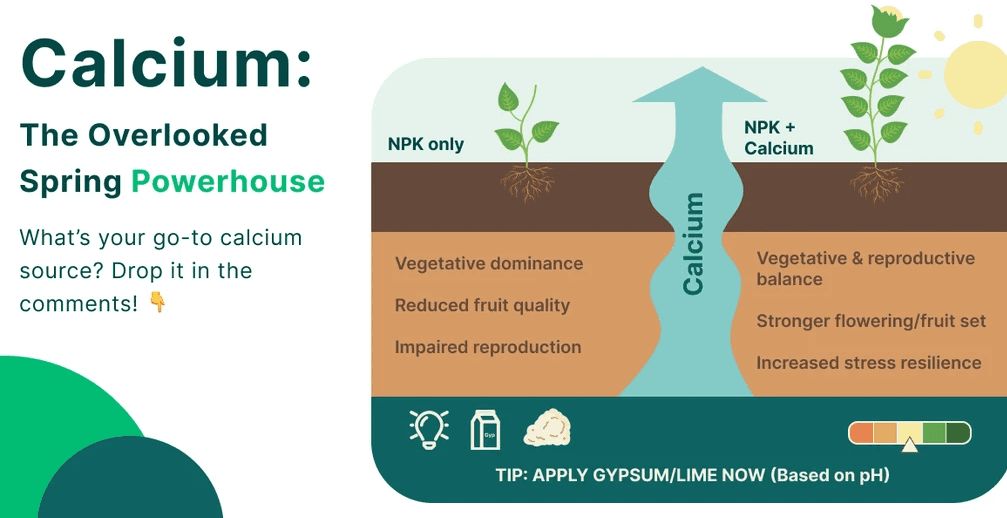
Calcium: The Overlooked Spring Powerhouse
by
Buse Soysal
Nutrient Interactions
Are fertilizer costs cutting into your bottom line?
by
Buse Soysal
Fertilizers
Advancing Precision Irrigation: Leveraging Technology for Sustainable Agriculture

by
Buse Soysal
Soil Health
Unlocking Agriculture’s Hidden Helpers: Microbial Genomics and the Data Challenge

by
Buse Soysal
The importance of microbial amendments: How to increase overall crop resilience

by
Buse Soysal
Soil Health
Unlocking Crop Potential: The Untapped Power of Plant Sap Analysis

by
Buse Soysal
RegenAg
Unlocking Carbon Credits: What Data Farmers Need to Track and How We Can Help

by
Buse Soysal
Data Analytics
Enhancing Weed Management: Leveraging Data Analytics for Sustainable Agriculture
by
Buse Soysal
Data Analytics
Elevating Crop Health with Brix Measurements: The Sweet Science of Plant Immunity

by
Buse Soysal
Soil Health
Nutrient Management and Disease Resistance: Unveiling the Hidden Connections Through Data Analytics

by
Buse Soysal
Base Saturation Balancing: Achieving the Ideal Ratio for Optimal Crop Production

by
Buse Soysal
Soil Health
How to Achieve Zero Excess Free Nitrates and Ammonium in Plant Sap Analysis

by
Buse Soysal
RegenAg
America's Buzzing Backbone: The Crucial Role of Migratory Beekeeping in U.S. Agriculture

by
Buse Soysal
Soil Health
Breaking Down Soil Biology Testing - Finding the ROI with PLFA Tests

by
Buse Soysal
Soil Testing
Precision Agriculture: Revolutionizing Farming, One Field at a Time

by
Buse Soysal
PrecisionAg
Ag101: What is the difference between organic and regenerative agriculture?
by
Buse Soysal
Soil Health
Your Favourite Beans are in Danger: Threats to Coffee & Chocolate Production
by
Buse Soysal
Soil Health
IPM Programs: Best of the Pest Prevention Measures

by
Buse Soysal
Pest & Disease
Wet Spring Issues - Why So Irreparable?

by
Buse Soysal
Nutrient Interactions
The Influence of Nutrient Applications on Post Harvest
by
Buse Soysal
Nutrient Interactions
Orange Juice in Danger: The Threat of HLB Disease

by
Buse Soysal
Soil Health
California Dreaming: The Issue with Almond Production

by
Buse Soysal
Sight Unseen: Zinc Deficiency in Soil

by
Buse Soysal
Nutrient Interactions
Battle Beneath: Understanding Calcium - Potassium Antagonism in Soil

by
Buse Soysal
Nutrient Interactions
The Plant Kingdom's Power Couple: Nitrogen and Sulfur's Synergistic Symphony

by
Buse Soysal
Nutrients for Beginners
Increase Drought Tolerance With This Commonly Missed Micronutrient

by
Buse Soysal
Climate Change
Digging Deeper: The Great Soil Analysis Debate for Regenerative Agriculture

by
Buse Soysal
Soil Health
Ammonium vs Calcium: The Nutrient Balancing Act for Thriving Plants

by
Buse Soysal
Nutrient Interactions
Improving Soil Structure: Boost Your Farm’s Resilience
by
Buse Soysal
Soil Health
Sodium and Calcium Relationship: A Tale of Frenemies in the Soil

by
Buse Soysal
Nutrient Interactions
The Soil Office: Molybdenum and Nitrate's Tumultuous Relationship
by
Buse Soysal
Nutrient Interactions
The Delicate Dance: Achieving the Perfect Nitrogen Balance for Optimal Crop Productivity

by
Buse Soysal
Nutrient Interactions
Paving the Way for a Regenerative Future: Insights into the "Data Driven Regenerative Ag" Project

by
Buse Soysal
RegenAg
Unlocking Soil's Full Potential: The Pioneering Principles of Dr. William A. Albrecht

by
Buse Soysal
Soil Health
The Benefits of Regenerative Agriculture for Human Health

by
Buse Soysal
RegenAg
Responsible Data Exchange in Agriculture

by
Buse Soysal
Data Analytics
Responsible Fertilizer Use for Mitigating Drought

by
Buse Soysal
Climate Change
The Power of Healthy Soil: for a Happy World Earth Day

by
Buse Soysal
Soil Health
Crop Scouting for Regenerative Agriculture
by
Buse Soysal
RegenAg
Plantsap and Soil Analyses for Nitrogen Emission Reduction
by
Buse Soysal
RegenAg
How do you use Plant Nutrition for Regenerative Agriculture?

by
Buse Soysal
RegenAg
Profitability of Regenerative Agriculture and Transition Management

by
Buse Soysal
RegenAg
How can we use Data-Driven Farming for a Bright Future?
by
Buse Soysal
Data Analytics
Plantsap Analysis for More Yield and Less Fertilizer

by
Buse Soysal
RegenAg