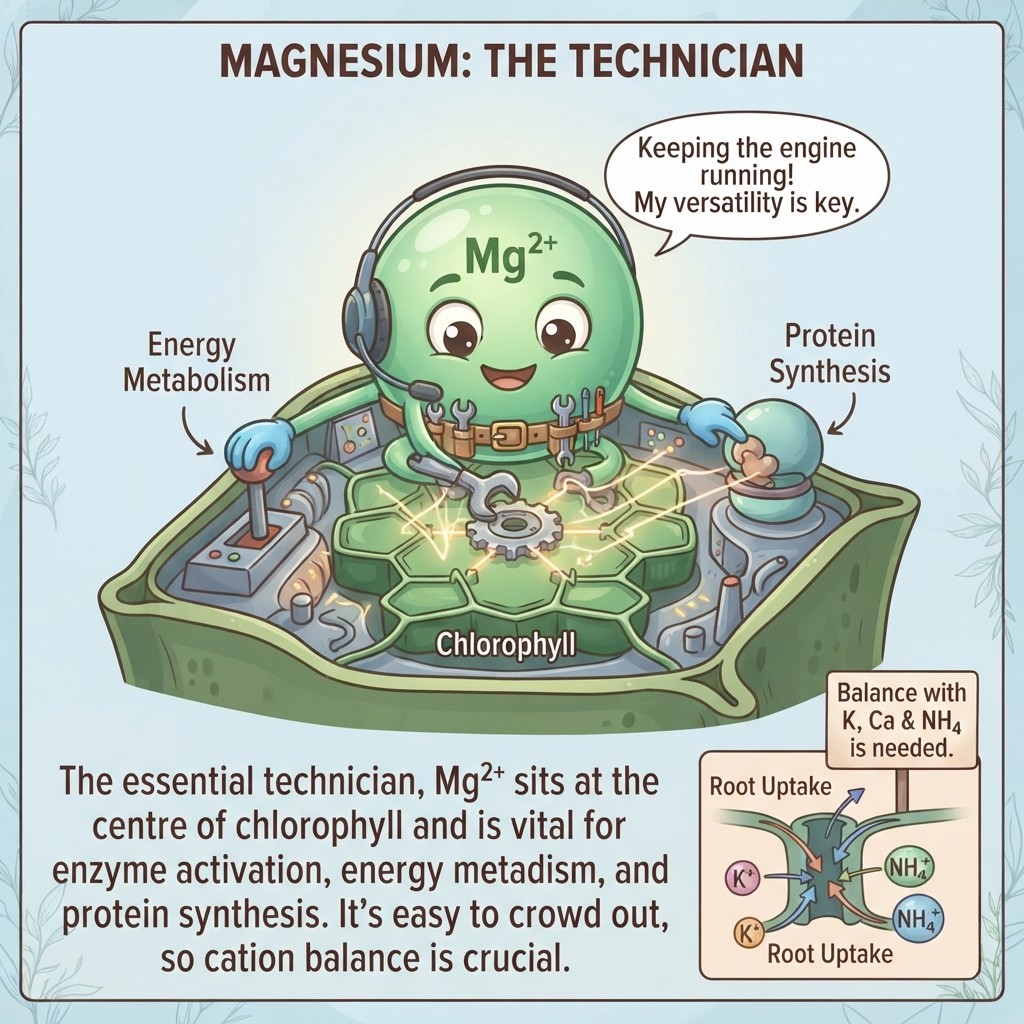
Magnesium: The Technician
Magnesium is often associated with chlorophyll, and for good reason: it sits at the centre of the chlorophyll molecule and is therefore essential for photosynthesis. But its role in the plant goes much further than leaf greenness. Magnesium is involved in enzyme activation, energy metabolism, protein synthesis, ribosome function and carbohydrate transport, which means that a crop with insufficient Mg can struggle to convert light, nutrients and carbon into productive growth.
For that reason, magnesium is best understood as The Technician. It does not usually drive growth in the same obvious way as nitrogen, nor does it dominate transport like potassium or provide structural strength like calcium. Instead, magnesium makes sure that many of the plant’s internal systems actually function as intended. When it is well supplied, the crop’s photosynthetic and metabolic machinery runs smoothly; when it is short, efficiency declines across several processes at once.
Magnesium’s personality: versatile, essential and easy to crowd out
Magnesium’s greatest strength is versatility. It supports photosynthesis through chlorophyll, helps activate enzymes, stabilises ribosomes, participates in ATP-dependent reactions and supports the movement of carbohydrates through the phloem. In practical terms, magnesium helps connect energy capture with energy use.
Its main weakness is that it is relatively easy to suppress. Magnesium shares the root-zone cation environment with potassium, calcium and ammonium, and when one of those becomes too dominant, Mg uptake can decline even when the soil contains enough magnesium. This makes Mg one of the classic examples of a nutrient that may be present but not sufficiently available to the plant.
The Technician therefore depends on balance. It does not need to dominate the nutrient system, but it does need enough room to work.
Magnesium’s greatest strength: keeping photosynthesis productive
Magnesium’s most visible role is in chlorophyll, where it sits at the centre of the molecule and allows the plant to capture light energy. If Mg becomes limiting, chlorophyll formation and photosynthetic efficiency decline, which reduces the amount of sugar available for growth, root exudation, fruit filling and stress recovery.
This is why magnesium deficiency can have consequences that extend far beyond leaf colour. A plant with low Mg may still receive plenty of nitrogen, phosphorus and potassium, but if photosynthesis is underperforming, the crop cannot use those nutrients as efficiently. The result can be slower growth, reduced sugar production and poorer overall nutrient-use efficiency.
For growers, this is an important distinction: magnesium is not simply a “green leaf” nutrient. It is a central part of the plant’s energy-production system.
Magnesium and phosphorus: energy partners
Magnesium and phosphorus have one of the clearest complementary relationships in plant nutrition. Phosphorus is central to ATP and energy transfer, but ATP is commonly used by enzymes in association with magnesium. In other words, phosphorus provides the energy currency, while magnesium helps make that currency usable.
This means that a plant can have adequate phosphorus yet still struggle to use energy efficiently if Mg is limiting. The relationship is especially important during periods of rapid growth, flowering and fruit development, when ATP demand rises sharply.
A crop with good P but low Mg may therefore show disappointing performance even though phosphorus itself appears adequate. The problem is not necessarily lack of energy supply, but reduced ability to use that energy effectively.
Magnesium and nitrogen: supporting protein synthesis
Magnesium also works closely with nitrogen metabolism. Nitrogen drives amino acid and protein production, while magnesium supports the enzyme systems, ribosomes and energy reactions needed to turn absorbed nitrogen into functional proteins.
This means that low Mg can contribute to poor nitrogen-use efficiency. A crop may take up nitrate and still struggle to convert that nitrogen efficiently if photosynthesis and protein synthesis are constrained.
A useful plant sap pattern to watch is adequate or high nitrate combined with low magnesium and weak crop colour or growth. In that situation, simply applying more nitrogen may make the imbalance worse. The more useful question is whether the plant has enough Mg and photosynthetic capacity to use the nitrogen already present.
Magnesium and potassium: one of the most important competitions
Potassium is one of magnesium’s strongest competitors. Both are essential, but when potassium supply becomes excessive relative to Mg, magnesium uptake can decline.
This relationship is particularly important in fruiting crops, where K is often increased to support fruit filling and sugar movement. If potassium is pushed too aggressively, the crop may begin to lose Mg just as photosynthetic demand is increasing.
That can create a practical contradiction: the grower increases potassium to improve transport and fruit filling, but the resulting Mg suppression reduces photosynthesis and sugar production.
For that reason, a sap pattern of high K combined with falling Mg should be taken seriously. The issue may not be insufficient magnesium supply alone; potassium dominance may be part of the cause.
Magnesium and calcium: another cation balance
Calcium can also compete with magnesium when Ca becomes very dominant in the root zone. Both nutrients are positively charged and can influence each other’s uptake, especially in soils or substrates where the cation balance is strongly skewed.
This does not mean that high calcium is always harmful to magnesium or that the two nutrients are natural enemies. The interaction becomes important mainly when the balance shifts too far in one direction.
In practical terms, Mg should be interpreted together with both K and Ca. A magnesium shortage may reflect low Mg supply, but it may also reflect excessive competition from other cations.
Magnesium and ammonium: nitrogen form matters
Ammonium is another cation that can interfere with magnesium uptake when present at high levels. This means the form of nitrogen matters, not just the total N supply.
A crop receiving a high proportion of nitrogen as ammonium may show falling Mg even when magnesium fertilisation has not changed. If this happens, the grower should investigate whether ammonium pressure is contributing to the problem before simply increasing Mg inputs.
A sap pattern of high NH4 combined with low Mg can therefore point toward competition at the root rather than a simple deficiency in the fertiliser programme.
Magnesium’s role in sugar transport
Magnesium is also involved in phloem loading and carbohydrate movement. This is important because sugars produced in the leaf need to be exported toward sinks such as roots, fruit, seeds and growing tissues.
When magnesium becomes deficient, sugars can accumulate in source leaves while transport to sinks becomes less efficient. This can reduce root growth and weaken the flow of carbon below ground, which in turn can affect microbial activity and nutrient uptake.
For regenerative systems, this is especially relevant because photosynthetic carbon flow to the root zone is one of the main ways plants feed the rhizosphere. Low Mg can therefore reduce not only plant performance above ground but also the carbon supply that supports biological activity below ground.
What happens when magnesium is too low?
Because magnesium is relatively mobile in the plant, the crop can remobilise it from older leaves toward younger tissues when supply becomes inadequate. For that reason, deficiency symptoms usually appear first in older leaves.
As Mg is withdrawn, chlorophyll declines and photosynthesis weakens. The classic symptom is interveinal chlorosis, where the tissue between the veins becomes yellow while the veins remain greener.
If deficiency continues, the yellow areas can become necrotic and the plant may lose older leaves prematurely. Over time, reduced photosynthesis can affect crop vigour, fruit filling and yield.
Visual clues of magnesium deficiency
Typical symptoms can include:
• Interveinal chlorosis on older leaves
• Green veins with yellow tissue between them
• Progressive yellowing from older toward younger leaves if deficiency becomes severe
• Reddish or purplish colouring in some crops
• Leaf-edge necrosis in advanced deficiency
• Premature loss of older leaves
• Reduced photosynthetic vigour
• Poor fruit filling or reduced sugar production in severe cases
The exact appearance varies between crops, but the combination of older-leaf symptoms and interveinal chlorosis is one of the strongest field clues.
What happens when magnesium is too high?
Direct magnesium toxicity is relatively uncommon, but excessive Mg can still create problems through nutrient imbalance. When Mg dominates the cation balance, it can interfere with calcium and potassium uptake and contribute to a less balanced root-zone environment.
In soils with very high Mg relative to Ca, growers may also see poorer physical structure, especially where dispersion and drainage are already concerns. This is a soil issue rather than a direct plant toxicity effect, but it can indirectly reduce root function and nutrient uptake.
The practical risk of excessive Mg is therefore usually not a classic toxicity symptom, but secondary imbalance.
Visual clues of magnesium excess
There are few unique visual symptoms that can be attributed directly to high Mg. More often, the crop shows signs associated with the nutrients being suppressed, such as:
• Calcium-related weakness in young tissue
• Potassium deficiency symptoms
• Reduced crop vigour despite high Mg values
• Poor nutrient balance in plant sap
This is another reason why Mg should always be interpreted in relation to K and Ca rather than judged in isolation.
The agronomy behind magnesium
Magnesium has several major agronomic functions. It sits at the centre of chlorophyll, supports enzyme activity, stabilises ribosomes, participates in ATP-dependent reactions and contributes to phloem loading and carbohydrate transport. These functions explain why low Mg can reduce both energy production and the movement of the sugars that energy production creates.
Its availability is strongly influenced by the wider cation balance. Potassium, calcium and ammonium can all compete with Mg when their concentrations become high, which means that a magnesium problem may reflect antagonism rather than absolute lack of supply.
From a practical perspective, the key principle is that magnesium supports photosynthetic capacity, energy use and carbohydrate movement, but only when the root-zone balance allows adequate uptake.
Reading magnesium in plant sap analysis
Because magnesium is mobile, older leaves are often the first place to show a shortage. A declining old-leaf Mg result can therefore provide an early indication that the plant is remobilising magnesium toward younger tissues.
When Mg is low, the most important related nutrients to examine are potassium, calcium, ammonium-N and phosphorus. These help distinguish between a true shortage and a competitive imbalance.
Useful patterns include:
• Low Mg + high K may indicate potassium dominance.
• Low Mg + high Ca may indicate cation competition.
• Low Mg + high NH4 may indicate ammonium pressure.
• Low Mg + adequate or high nitrate may indicate that nitrogen is present but the crop’s photosynthetic machinery is becoming constrained.
• Low Mg + adequate P may still indicate poor energy use because Mg is needed to activate ATP-dependent reactions.
The trend over time is often more useful than a single measurement.
What should the grower investigate?
When magnesium is low, the first question should not automatically be whether more Mg needs to be applied. Instead, check whether potassium is too high, whether calcium is dominating the cation balance, whether ammonium is elevated, whether root activity is good and whether the crop is entering a period of high photosynthetic or fruit-filling demand.
It is also useful to examine whether the crop is showing older-leaf chlorosis and whether nitrate remains high. If nitrate is adequate but Mg is falling, the crop may be accumulating nitrogen faster than its photosynthetic system can process it efficiently.
The practical lesson
Magnesium deserves the name The Technician because it keeps many of the plant’s most important systems functioning behind the scenes. It supports chlorophyll, energy metabolism, protein synthesis, ribosome function and carbohydrate transport, which means that a shortage can reduce the efficiency of the entire crop even before severe visual symptoms appear.
Its greatest challenge is not usually toxicity, but competition. Potassium, calcium and ammonium can all suppress Mg when they become too dominant, so successful magnesium management depends on balance rather than on simply increasing application rates.
The goal is therefore to maintain enough magnesium to sustain strong photosynthesis, efficient energy use and reliable sugar transport while keeping K, Ca and NH4 in balance. When the Technician has the resources it needs, the plant’s machinery runs smoothly; when Mg is crowded out, the whole system becomes less efficient.
This blog is part of SoilBeat’s Plant Sap Nutrient Series, created through the SNN project with co-financing from the European Union and Samenwerkingsverband Noord-Nederland (SNN).

Written by
Buse Soysal
Related
Other Articles.
Slurry Injection Saves Nitrogen But What Does It Cost Elsewhere?

by
Buse Soysal
Best Practices
Nutrient Interactions
Soil Health
Fertilizers
Soil Testing
PrecisionAg
The New Global Fertilizer Map

by
Buse Soysal
Fertiliser
Fertilizers
Data Analytics
Climate Change
Can Vetch Catch Crops Improve Greenhouse Vegetables and Reduce Fertilizer

by
Buse Soysal
Best Practices
Fertiliser
Nutrient Interactions
Soil Health
Chloride: The Gatekeeper

by
Buse Soysal
Plantsap
Fertiliser
Nutrient Interactions
Sodium: The Opportunist
by
Buse Soysal
Plantsap
Fertiliser
Nutrient Interactions
Sulfur: The Finisher

by
Buse Soysal
Plantsap
Fertiliser
Nutrient Interactions
Unlocking Hidden Nutrients with Total Digestion Soil Tests
by
Buse Soysal
Zinc: The Coordinator
by
Buse Soysal
Plantsap
Fertiliser
Nutrient Interactions
How to Balance a High Bacterial to Fungal Ratio in your Soil

by
Buse Soysal
Soil Health
Iron: The Power Engineer

by
Buse Soysal
Plantsap
Fertiliser
Nutrient Interactions
Copper: The Defender
by
Buse Soysal
Plantsap
Fertiliser
Nutrient Interactions
Molybdenum: The Facilitator

by
Buse Soysal
Plantsap
Fertiliser
Nutrient Interactions
Magnesium: The Unsung Hero of Photosynthesis
by
Buse Soysal
Nutrient Interactions
Nitrogen: The Builder
by
Buse Soysal
Plantsap
Manganese: The Regulator
by
Buse Soysal
Plantsap
Fertiliser
Nutrient Interactions
Unlocking Smarter Farming with Weather + Nutrient Analytics

by
Buse Soysal
Nutrient Interactions
Water Meets Nutrient Strategy

by
Buse Soysal
Nutrient Interactions
Boron: The Connector

by
Buse Soysal
Plantsap
Nutrient Interactions
Fertilizers
Calcium: The Architect
by
Buse Soysal
Plantsap
Fertiliser
Nutrient Interactions
Potassium: The Logistics Manager

by
Buse Soysal
Plantsap
Phosphorus: The Strategist
by
Buse Soysal
Plantsap
Unit Conversion Meets Crop Intelligence

by
Buse Soysal
Soil Testing
Soil Biology Testing—What Are Your Options?
by
Buse Soysal
Soil Testing
Predict Problems Before They Hit — The Power of Plant Sap Analysis
by
Buse Soysal
Data Analytics
Maximizing Cover Crop Benefits for Your Cash Crop

by
Buse Soysal
Nutrient Interactions
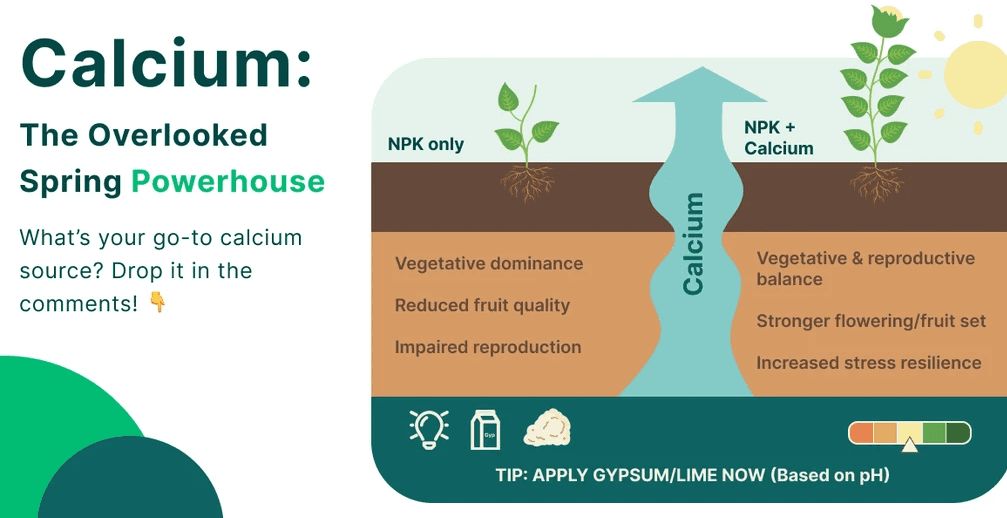
Calcium: The Overlooked Spring Powerhouse
by
Buse Soysal
Nutrient Interactions
Are fertilizer costs cutting into your bottom line?
by
Buse Soysal
Fertilizers
Advancing Precision Irrigation: Leveraging Technology for Sustainable Agriculture

by
Buse Soysal
Soil Health
Unlocking Agriculture’s Hidden Helpers: Microbial Genomics and the Data Challenge

by
Buse Soysal
The importance of microbial amendments: How to increase overall crop resilience

by
Buse Soysal
Soil Health
Unlocking Crop Potential: The Untapped Power of Plant Sap Analysis

by
Buse Soysal
RegenAg
Unlocking Carbon Credits: What Data Farmers Need to Track and How We Can Help

by
Buse Soysal
Data Analytics
Enhancing Weed Management: Leveraging Data Analytics for Sustainable Agriculture
by
Buse Soysal
Data Analytics
Elevating Crop Health with Brix Measurements: The Sweet Science of Plant Immunity

by
Buse Soysal
Soil Health
Nutrient Management and Disease Resistance: Unveiling the Hidden Connections Through Data Analytics

by
Buse Soysal
Base Saturation Balancing: Achieving the Ideal Ratio for Optimal Crop Production

by
Buse Soysal
Soil Health
How to Achieve Zero Excess Free Nitrates and Ammonium in Plant Sap Analysis

by
Buse Soysal
RegenAg
America's Buzzing Backbone: The Crucial Role of Migratory Beekeeping in U.S. Agriculture

by
Buse Soysal
Soil Health
Breaking Down Soil Biology Testing - Finding the ROI with PLFA Tests

by
Buse Soysal
Soil Testing
Precision Agriculture: Revolutionizing Farming, One Field at a Time

by
Buse Soysal
PrecisionAg
Ag101: What is the difference between organic and regenerative agriculture?
by
Buse Soysal
Soil Health
Your Favourite Beans are in Danger: Threats to Coffee & Chocolate Production
by
Buse Soysal
Soil Health
IPM Programs: Best of the Pest Prevention Measures

by
Buse Soysal
Pest & Disease
Wet Spring Issues - Why So Irreparable?

by
Buse Soysal
Nutrient Interactions
The Influence of Nutrient Applications on Post Harvest
by
Buse Soysal
Nutrient Interactions
Orange Juice in Danger: The Threat of HLB Disease

by
Buse Soysal
Soil Health
California Dreaming: The Issue with Almond Production

by
Buse Soysal
Sight Unseen: Zinc Deficiency in Soil

by
Buse Soysal
Nutrient Interactions
Battle Beneath: Understanding Calcium - Potassium Antagonism in Soil

by
Buse Soysal
Nutrient Interactions
The Plant Kingdom's Power Couple: Nitrogen and Sulfur's Synergistic Symphony

by
Buse Soysal
Nutrients for Beginners
Increase Drought Tolerance With This Commonly Missed Micronutrient

by
Buse Soysal
Climate Change
Digging Deeper: The Great Soil Analysis Debate for Regenerative Agriculture

by
Buse Soysal
Soil Health
Ammonium vs Calcium: The Nutrient Balancing Act for Thriving Plants

by
Buse Soysal
Nutrient Interactions
Improving Soil Structure: Boost Your Farm’s Resilience
by
Buse Soysal
Soil Health
Sodium and Calcium Relationship: A Tale of Frenemies in the Soil

by
Buse Soysal
Nutrient Interactions
The Soil Office: Molybdenum and Nitrate's Tumultuous Relationship
by
Buse Soysal
Nutrient Interactions
The Delicate Dance: Achieving the Perfect Nitrogen Balance for Optimal Crop Productivity

by
Buse Soysal
Nutrient Interactions
Paving the Way for a Regenerative Future: Insights into the "Data Driven Regenerative Ag" Project

by
Buse Soysal
RegenAg
Unlocking Soil's Full Potential: The Pioneering Principles of Dr. William A. Albrecht

by
Buse Soysal
Soil Health
The Benefits of Regenerative Agriculture for Human Health

by
Buse Soysal
RegenAg
Responsible Data Exchange in Agriculture

by
Buse Soysal
Data Analytics
Responsible Fertilizer Use for Mitigating Drought

by
Buse Soysal
Climate Change
The Power of Healthy Soil: for a Happy World Earth Day

by
Buse Soysal
Soil Health
Crop Scouting for Regenerative Agriculture

by
Buse Soysal
RegenAg
Plantsap and Soil Analyses for Nitrogen Emission Reduction

by
Buse Soysal
RegenAg
How do you use Plant Nutrition for Regenerative Agriculture?

by
Buse Soysal
RegenAg
Profitability of Regenerative Agriculture and Transition Management

by
Buse Soysal
RegenAg
How can we use Data-Driven Farming for a Bright Future?

by
Buse Soysal
Data Analytics
Plantsap Analysis for More Yield and Less Fertilizer

by
Buse Soysal
RegenAg