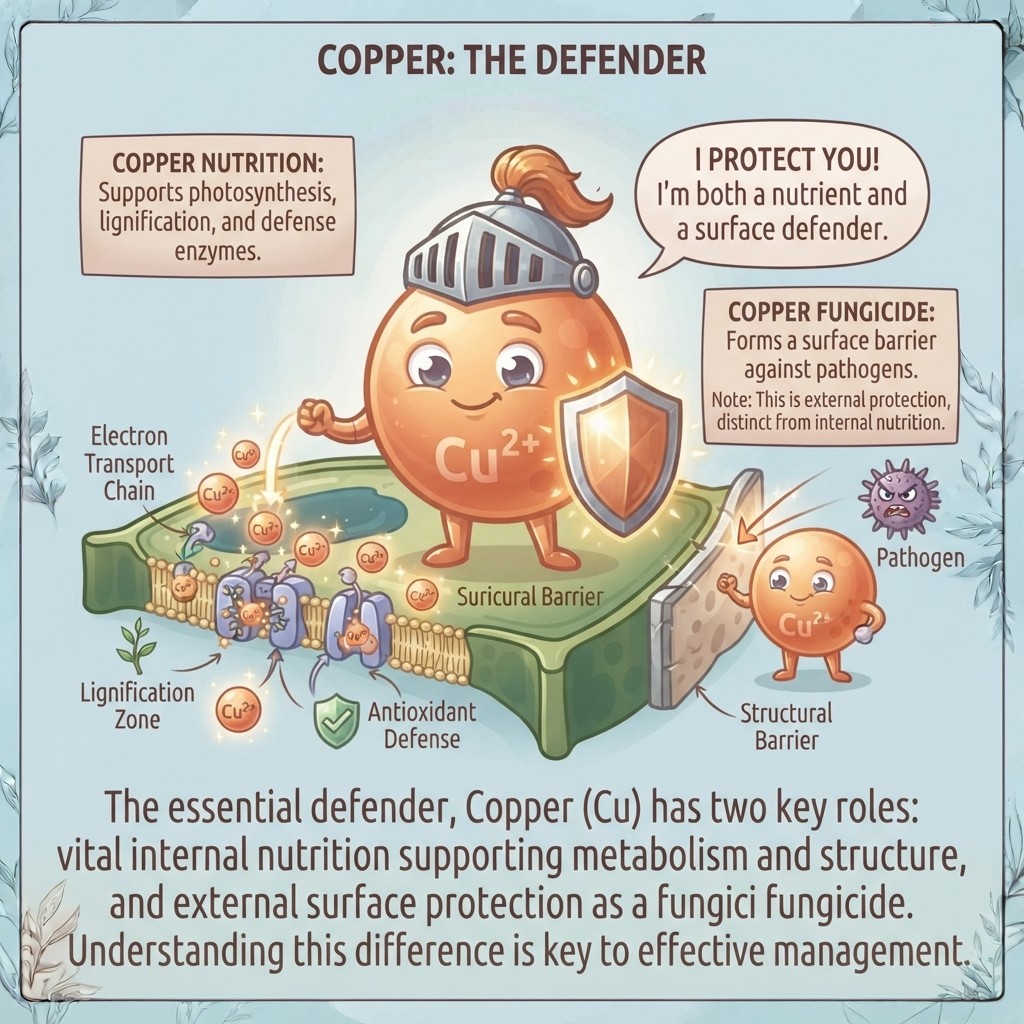
Copper: The Defender
Copper is required in only very small amounts, but it plays an important role in some of the plant’s most demanding processes. It is involved in photosynthetic electron transport, lignification, antioxidant metabolism, hormone signalling and several enzyme systems that depend on controlled oxidation and reduction reactions. Because of this, copper contributes to both the plant’s internal metabolism and the strength of the tissues that help protect it from stress.
That combination makes copper a good fit for the role of The Defender. Its value is not that it acts like an internal pesticide, but that adequate copper helps the plant build stronger structural barriers and maintain the biochemical systems that support normal defence responses. At the same time, copper has to be handled carefully, because the same chemical reactivity that makes it useful can also make it damaging when concentrations become too high.
Copper’s personality: reactive, protective and tightly controlled
Copper’s greatest strength is its ability to participate in electron transfer. That makes it highly useful in processes where the plant needs to move electrons in a controlled way, including photosynthesis and several oxidation reactions. It also helps support enzymes involved in lignin formation, which contributes to stronger cell walls and better structural integrity.
Its main weakness is that copper is highly reactive and required in only small quantities. The plant therefore has to control copper very carefully. Too little copper can leave important enzymes under-supplied, but too much copper can create oxidative stress, damage roots and interfere with the uptake or metabolism of other micronutrients.
This is what makes copper different from nutrients that are mainly difficult because of poor mobility or weak availability. With copper, the challenge is often precision. The Defender must be present, but it must remain disciplined.
Copper’s greatest strength: supporting photosynthesis and structural defence
One of copper’s most important roles is in photosynthesis. Copper is part of plastocyanin, a protein that helps transfer electrons within the photosynthetic electron transport chain. If copper becomes limiting, this part of the photosynthetic system can function less efficiently, which can reduce the plant’s ability to convert light energy into usable energy for growth.
Copper is also closely associated with lignification. Several copper-containing enzymes, including laccases, are involved in the formation and polymerisation of lignin. Lignin helps strengthen cell walls, supports vascular tissues and contributes to the physical barriers that make plant tissues more resistant to mechanical damage and pathogen entry.
This is why copper is often associated with plant defence, but the distinction is important: adequate copper supports the plant’s defence capacity; nutritional copper does not act as an internal fungicide.
Nutritional copper is not the same as copper fungicide
Copper has two very different roles in agriculture, and these should not be confused.
When copper is used as a fungicide or bactericide, copper compounds remain largely on the plant surface and can directly damage microorganisms that come into contact with them. This is a crop-protection effect.
Nutritional copper works differently. Once copper is taken up by the plant, it becomes part of enzymes and proteins involved in photosynthesis, lignification, antioxidant metabolism and signalling. Its role is to support plant function, not to circulate through the plant killing pathogens.
That difference matters because a crop that is low in nutritional copper may benefit from improved Cu nutrition, but increasing internal copper does not replace an appropriate disease-management strategy. Likewise, repeated use of copper-based fungicides can contribute to copper accumulation in the soil over time, even if the intention was disease control rather than plant nutrition.
Copper and iron: two redox specialists
Copper and iron are closely connected because both are used in electron-transfer systems. They are therefore both essential to metabolism, but they can also compete or interfere with one another when one becomes excessive.
When copper concentrations become too high, iron uptake or utilisation can decline. This can create a situation where the crop appears to have an iron problem even though soil iron is adequate. The issue may not be a lack of Fe in the soil, but an imbalance created by excessive Cu pressure.
This is particularly important when interpreting plant sap. A pattern of high copper combined with declining iron should not automatically lead to more iron application. It should first raise the question of whether copper is part of the cause.
Copper and zinc: balance among micronutrients
Copper also interacts with zinc. Both are needed in small quantities and both are involved in important enzyme systems, but excessive copper can reduce zinc uptake or accumulation.
The practical consequence is that aggressive copper use can create a secondary zinc shortage. A grower may then respond by adding zinc, while the underlying problem remains the same: copper has become too dominant.
This is why micronutrients should not be managed as isolated elements. The balance between Cu, Zn, Fe and Mn is often more important than the concentration of any one of them on its own.
Copper and manganese: another competitive relationship
Manganese can also be affected when copper becomes excessive. Both micronutrients participate in redox-sensitive processes and are influenced by root-zone pH and soil chemistry.
When Cu rises strongly, Mn uptake or utilisation may be reduced under some conditions. The crop may then show slower photosynthetic performance or develop symptoms that look like a manganese deficiency, even though Mn is present in the soil.
Again, the important principle is not that copper is inherently antagonistic to manganese, but that competition becomes more important when one micronutrient is supplied far beyond the crop’s demand.
Copper’s weakness: low mobility and limited room for error
Copper has relatively limited mobility within many plants, which means that developing tissues can become deficient even when older tissues contain adequate copper. This makes young leaves and growing points important when assessing Cu status.
At the same time, the crop requires only a small amount. That creates a narrow management window between sufficient supply and unnecessary excess.
The combination of low requirement, limited mobility and strong chemical reactivity is what makes copper difficult to manage well.
What happens when copper is too low?
Copper deficiency affects processes that depend on electron transfer, lignification and reproductive development. Because copper is not highly mobile, deficiency often becomes more apparent in younger tissues and growing points.
The crop may lose structural strength, become less efficient in photosynthesis and show weaker reproductive performance. In some species, flowering and seed development can be particularly sensitive.
Visual clues of copper deficiency
Symptoms vary considerably between crops, but possible field signs include:
• Pale or chlorotic young leaves
• Twisting, wilting or deformation of young growth
• Dieback of shoot tips in more severe cases
• Weak stems or reduced structural strength
• Poor lignification
• Reduced flowering or fertility
• Poor seed or grain development in susceptible crops
• Reduced vigour despite apparently adequate major nutrients
Because these symptoms are not unique to copper, they should always be interpreted together with plant sap, crop history and the wider micronutrient profile.
What happens when copper is too high?
Excess copper can be more damaging than a mild deficiency because Cu is chemically reactive. High concentrations can contribute to oxidative stress, damage root tissues and interfere with several other nutrients.
Roots are often among the first tissues affected because they are exposed directly to copper in the root zone. If root growth is restricted, the effects can spread beyond Cu itself because the plant’s ability to take up water and other nutrients declines.
Excess copper can contribute to:
• Reduced root growth
• Root darkening or damage
• Chlorosis
• Reduced photosynthesis
• Suppression of iron, zinc or manganese
• Poor overall vigour
• Secondary nutrient deficiencies
• Reduced yield when toxicity becomes severe
In fields with a long history of copper-based fungicide use, soil accumulation should be considered as part of the diagnosis.
Copper imbalance: when the problem is not simply high or low Cu
Copper problems are often more complex than a single deficiency or toxicity.
A plant may show low Cu in young tissue because root uptake is restricted by pH, strong organic binding or poor root function. In another field, copper may be high because of repeated foliar or fungicide applications, while Fe or Zn begin to fall as a secondary consequence.
This means the grower should always ask what is causing the copper result, rather than reacting only to the number.
A low Cu result can be associated with:
• high pH,
• strong binding to organic matter,
• poor root activity,
• restricted uptake,
• or insufficient supply.
A high Cu result may be associated with:
• repeated copper fungicide use,
• excessive foliar nutrition,
• accumulation in soil,
• or over-correction of an earlier deficiency.
The agronomy behind copper
Copper is part of several important proteins and enzymes. In photosynthesis, it is a component of plastocyanin, which transfers electrons between parts of the photosynthetic electron transport chain. Copper is also involved in enzymes that participate in lignification, antioxidant protection and hormone metabolism.
Its usefulness comes from its ability to shift between oxidation states, which makes it effective in redox reactions. However, this same property also explains why excess copper can damage cells. The plant therefore regulates copper tightly and binds it to specific proteins and transport systems to keep it under control.
From a practical agronomic perspective, the important lesson is that copper is powerful at low concentrations and disruptive at high concentrations.
Reading copper in plant sap analysis
Plant sap analysis is useful for copper because it can help identify both a developing deficiency and a developing imbalance with other micronutrients.
Because copper has limited mobility, young-leaf Cu deserves particular attention. If Cu is low in young tissue while older leaves remain adequate, this may indicate that supply to new growth is not keeping pace with demand.
Copper should also be interpreted together with iron, zinc and manganese. A single Cu value rarely tells the whole story. The relationships are often more informative.
For example:
• Low Cu + normal Fe/Zn/Mn may point toward a more specific Cu availability issue.
• High Cu + low Fe may indicate Cu-related competition or disruption of Fe metabolism.
• High Cu + low Zn may indicate micronutrient antagonism.
• High Cu + low Mn may indicate broader micronutrient imbalance.
The fertiliser and crop-protection history should also be reviewed. Repeated copper fungicide use can change the interpretation of a high Cu result considerably.
What should the grower investigate?
When copper is outside the desired range, the first step should be to understand the context. If Cu is low, ask whether root-zone pH is high, organic matter is strongly binding copper, roots are healthy and active, and the crop is receiving enough Cu to meet demand.
If Cu is high, investigate whether copper-based fungicides or foliar products have been used repeatedly, whether soil Cu has accumulated, and whether Fe, Zn or Mn are beginning to decline at the same time.
The most useful questions are therefore:
• Is copper truly deficient, or is uptake being restricted?
• Is copper high because of nutrition, crop protection or soil accumulation?
• Are iron, zinc or manganese being suppressed?
• Are roots showing signs of stress?
• Is the crop’s reproductive or structural performance consistent with the sap result?
The practical lesson
Copper earns the name The Defender because it supports several of the systems that help plants remain structurally strong and metabolically resilient. It contributes to photosynthetic electron transport, lignification, antioxidant metabolism and defence-related processes, all of which help the crop function under stress.
But copper is a nutrient that must be managed with precision. Too little can weaken growth, structure and reproduction, while too much can damage roots, create oxidative stress and suppress other micronutrients.
The objective is therefore not to maximise copper, but to maintain enough Cu to support the plant’s metabolic and structural defence systems without allowing the Defender to become destructive.
This blog is part of SoilBeat’s Plant Sap Nutrient Series, created through the SNN project with co-financing from the European Union and Samenwerkingsverband Noord-Nederland (SNN).

Written by
Buse Soysal
Related
Other Articles.
Slurry Injection Saves Nitrogen But What Does It Cost Elsewhere?

by
Buse Soysal
Best Practices
Nutrient Interactions
Soil Health
Fertilizers
Soil Testing
PrecisionAg
The New Global Fertilizer Map

by
Buse Soysal
Fertiliser
Fertilizers
Data Analytics
Climate Change
Can Vetch Catch Crops Improve Greenhouse Vegetables and Reduce Fertilizer

by
Buse Soysal
Best Practices
Fertiliser
Nutrient Interactions
Soil Health
Chloride: The Gatekeeper

by
Buse Soysal
Plantsap
Fertiliser
Nutrient Interactions
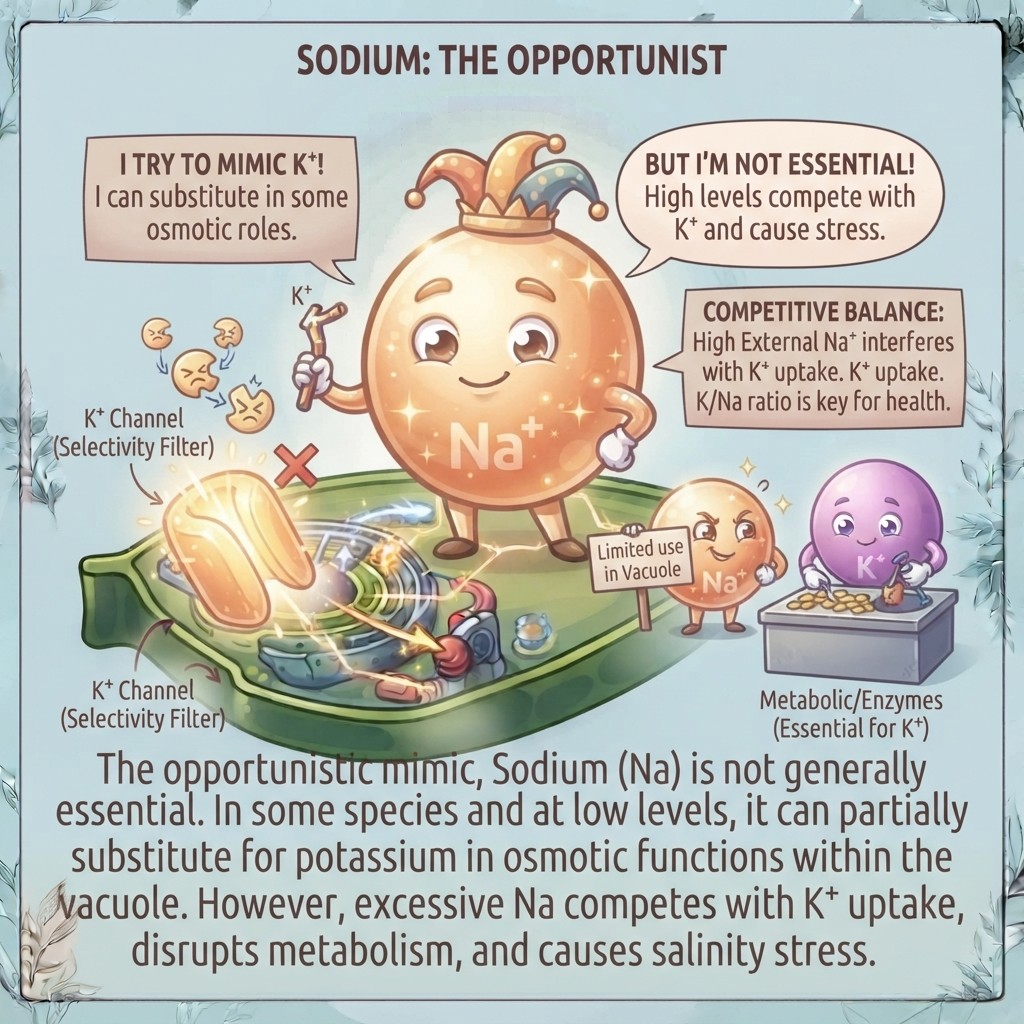
Sodium: The Opportunist
by
Buse Soysal
Plantsap
Fertiliser
Nutrient Interactions
Sulfur: The Finisher

by
Buse Soysal
Plantsap
Fertiliser
Nutrient Interactions
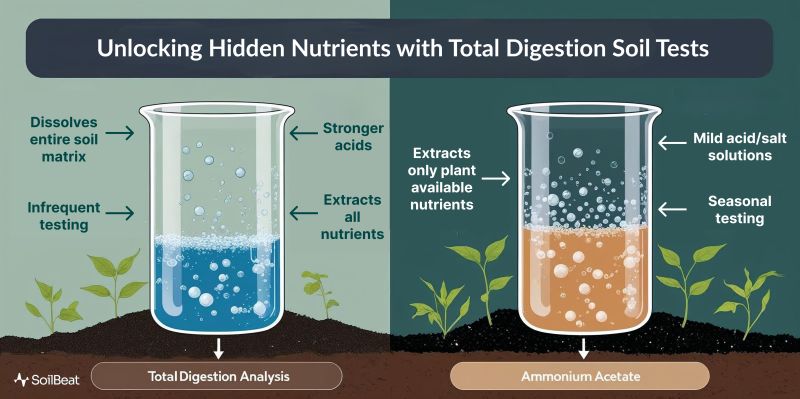
Unlocking Hidden Nutrients with Total Digestion Soil Tests
by
Buse Soysal
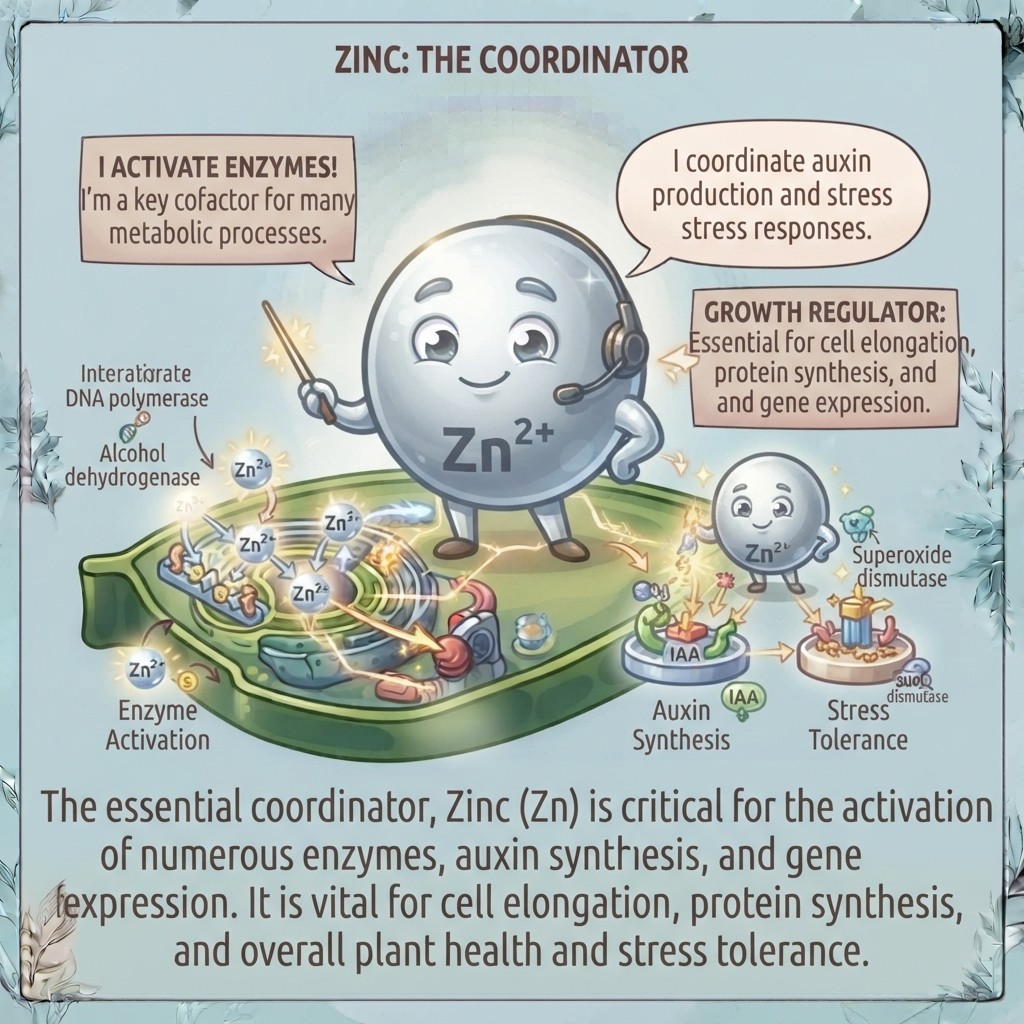
Zinc: The Coordinator
by
Buse Soysal
Plantsap
Fertiliser
Nutrient Interactions
How to Balance a High Bacterial to Fungal Ratio in your Soil
by
Buse Soysal
Soil Health
Magnesium: The Technician
by
Buse Soysal
Plantsap
Fertiliser
Nutrient Interactions
Iron: The Power Engineer

by
Buse Soysal
Plantsap
Fertiliser
Nutrient Interactions
Molybdenum: The Facilitator

by
Buse Soysal
Plantsap
Fertiliser
Nutrient Interactions
Magnesium: The Unsung Hero of Photosynthesis
by
Buse Soysal
Nutrient Interactions
Nitrogen: The Builder
by
Buse Soysal
Plantsap
Manganese: The Regulator
by
Buse Soysal
Plantsap
Fertiliser
Nutrient Interactions
Unlocking Smarter Farming with Weather + Nutrient Analytics

by
Buse Soysal
Nutrient Interactions
Water Meets Nutrient Strategy

by
Buse Soysal
Nutrient Interactions
Boron: The Connector

by
Buse Soysal
Plantsap
Nutrient Interactions
Fertilizers
Calcium: The Architect
by
Buse Soysal
Plantsap
Fertiliser
Nutrient Interactions
Potassium: The Logistics Manager

by
Buse Soysal
Plantsap
Phosphorus: The Strategist
by
Buse Soysal
Plantsap
Unit Conversion Meets Crop Intelligence

by
Buse Soysal
Soil Testing
Soil Biology Testing—What Are Your Options?
by
Buse Soysal
Soil Testing
Predict Problems Before They Hit — The Power of Plant Sap Analysis
by
Buse Soysal
Data Analytics
Maximizing Cover Crop Benefits for Your Cash Crop

by
Buse Soysal
Nutrient Interactions
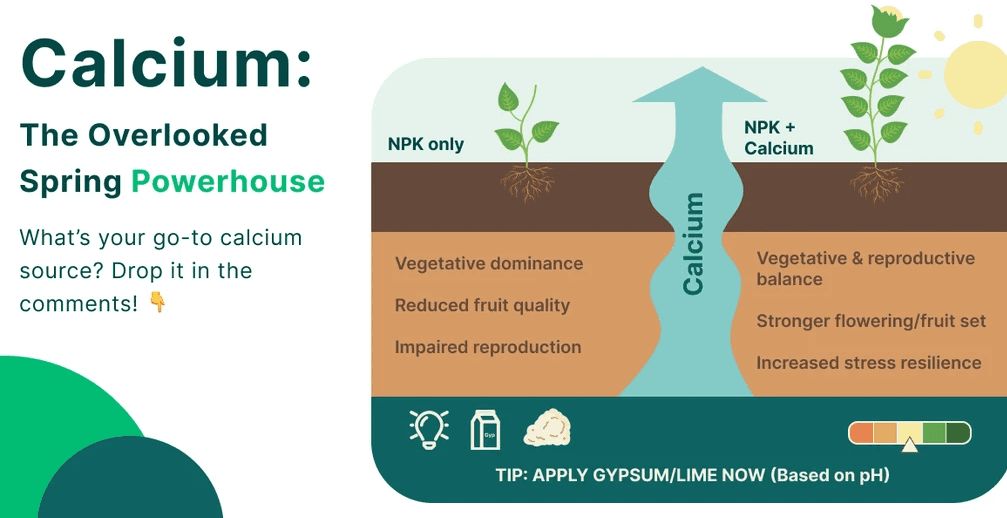
Calcium: The Overlooked Spring Powerhouse
by
Buse Soysal
Nutrient Interactions
Are fertilizer costs cutting into your bottom line?
by
Buse Soysal
Fertilizers
Advancing Precision Irrigation: Leveraging Technology for Sustainable Agriculture

by
Buse Soysal
Soil Health
Unlocking Agriculture’s Hidden Helpers: Microbial Genomics and the Data Challenge

by
Buse Soysal
The importance of microbial amendments: How to increase overall crop resilience

by
Buse Soysal
Soil Health
Unlocking Crop Potential: The Untapped Power of Plant Sap Analysis

by
Buse Soysal
RegenAg
Unlocking Carbon Credits: What Data Farmers Need to Track and How We Can Help

by
Buse Soysal
Data Analytics
Enhancing Weed Management: Leveraging Data Analytics for Sustainable Agriculture
by
Buse Soysal
Data Analytics
Elevating Crop Health with Brix Measurements: The Sweet Science of Plant Immunity

by
Buse Soysal
Soil Health
Nutrient Management and Disease Resistance: Unveiling the Hidden Connections Through Data Analytics

by
Buse Soysal
Base Saturation Balancing: Achieving the Ideal Ratio for Optimal Crop Production

by
Buse Soysal
Soil Health
How to Achieve Zero Excess Free Nitrates and Ammonium in Plant Sap Analysis

by
Buse Soysal
RegenAg
America's Buzzing Backbone: The Crucial Role of Migratory Beekeeping in U.S. Agriculture

by
Buse Soysal
Soil Health
Breaking Down Soil Biology Testing - Finding the ROI with PLFA Tests

by
Buse Soysal
Soil Testing
Precision Agriculture: Revolutionizing Farming, One Field at a Time

by
Buse Soysal
PrecisionAg
Ag101: What is the difference between organic and regenerative agriculture?
by
Buse Soysal
Soil Health
Your Favourite Beans are in Danger: Threats to Coffee & Chocolate Production
by
Buse Soysal
Soil Health
IPM Programs: Best of the Pest Prevention Measures

by
Buse Soysal
Pest & Disease
Wet Spring Issues - Why So Irreparable?

by
Buse Soysal
Nutrient Interactions
The Influence of Nutrient Applications on Post Harvest
by
Buse Soysal
Nutrient Interactions
Orange Juice in Danger: The Threat of HLB Disease

by
Buse Soysal
Soil Health
California Dreaming: The Issue with Almond Production

by
Buse Soysal
Sight Unseen: Zinc Deficiency in Soil

by
Buse Soysal
Nutrient Interactions
Battle Beneath: Understanding Calcium - Potassium Antagonism in Soil

by
Buse Soysal
Nutrient Interactions
The Plant Kingdom's Power Couple: Nitrogen and Sulfur's Synergistic Symphony

by
Buse Soysal
Nutrients for Beginners
Increase Drought Tolerance With This Commonly Missed Micronutrient

by
Buse Soysal
Climate Change
Digging Deeper: The Great Soil Analysis Debate for Regenerative Agriculture

by
Buse Soysal
Soil Health
Ammonium vs Calcium: The Nutrient Balancing Act for Thriving Plants

by
Buse Soysal
Nutrient Interactions
Improving Soil Structure: Boost Your Farm’s Resilience
by
Buse Soysal
Soil Health
Sodium and Calcium Relationship: A Tale of Frenemies in the Soil

by
Buse Soysal
Nutrient Interactions
The Soil Office: Molybdenum and Nitrate's Tumultuous Relationship
by
Buse Soysal
Nutrient Interactions
The Delicate Dance: Achieving the Perfect Nitrogen Balance for Optimal Crop Productivity

by
Buse Soysal
Nutrient Interactions
Paving the Way for a Regenerative Future: Insights into the "Data Driven Regenerative Ag" Project

by
Buse Soysal
RegenAg
Unlocking Soil's Full Potential: The Pioneering Principles of Dr. William A. Albrecht

by
Buse Soysal
Soil Health
The Benefits of Regenerative Agriculture for Human Health

by
Buse Soysal
RegenAg
Responsible Data Exchange in Agriculture

by
Buse Soysal
Data Analytics
Responsible Fertilizer Use for Mitigating Drought

by
Buse Soysal
Climate Change
The Power of Healthy Soil: for a Happy World Earth Day

by
Buse Soysal
Soil Health
Crop Scouting for Regenerative Agriculture
by
Buse Soysal
RegenAg
Plantsap and Soil Analyses for Nitrogen Emission Reduction
by
Buse Soysal
RegenAg
How do you use Plant Nutrition for Regenerative Agriculture?

by
Buse Soysal
RegenAg
Profitability of Regenerative Agriculture and Transition Management

by
Buse Soysal
RegenAg
How can we use Data-Driven Farming for a Bright Future?
by
Buse Soysal
Data Analytics
Plantsap Analysis for More Yield and Less Fertilizer

by
Buse Soysal
RegenAg