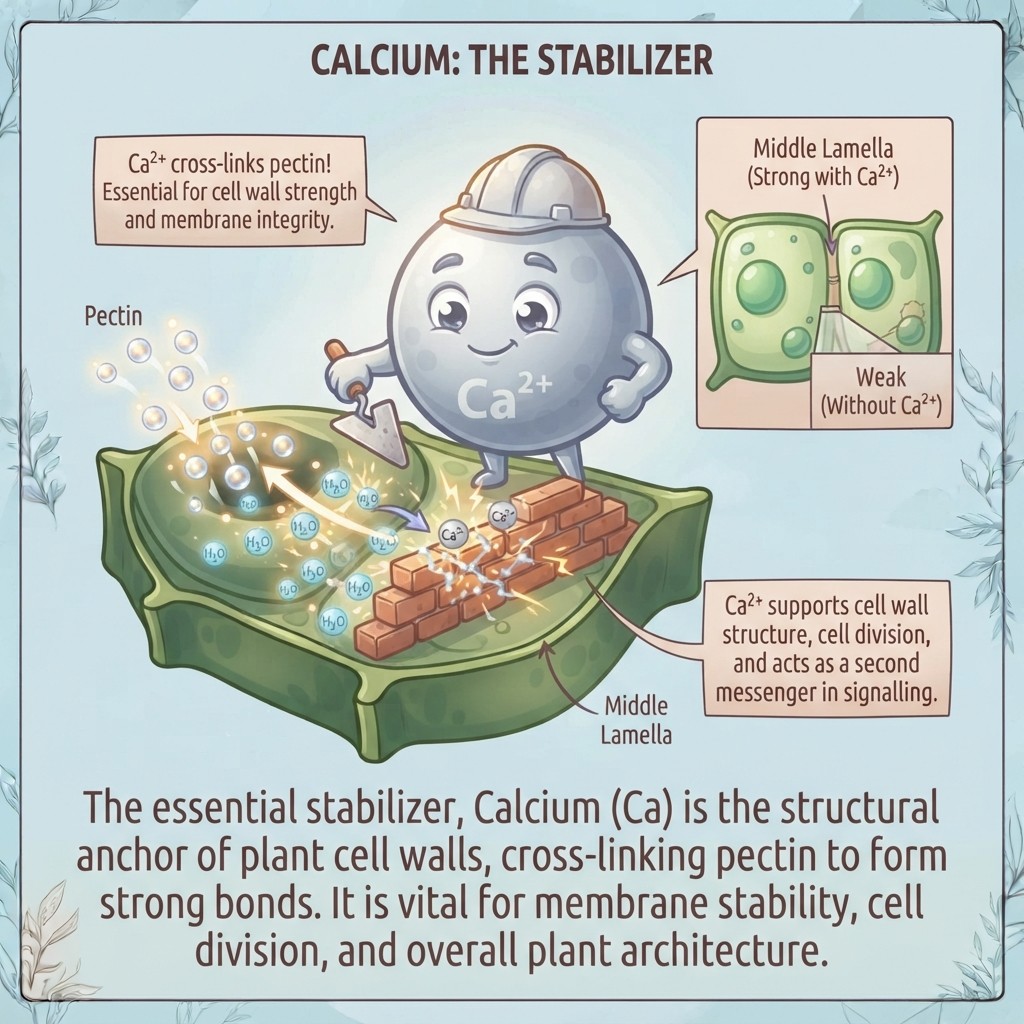
Calcium: The Architect
Calcium is often described as a structural nutrient, but that only tells part of the story.
Yes, calcium is fundamental for building strong plant tissue. It helps bind pectins in the cell wall, stabilises cell membranes and supports the physical integrity of growing tissues. But calcium also plays an important role in plant signalling, helping cells respond to changes in their environment, stress and growth conditions.
Its importance becomes especially obvious in tissues that are developing rapidly, such as root tips, shoot meristems, young leaves, flowers and fruit.
The challenge with calcium is therefore not simply whether the soil contains enough of it. In many situations, the real question is:
Can the plant deliver enough calcium to the tissues that need it, at the moment they need it?
That is what makes calcium such a distinctive nutrient.
Calcium’s personality: the architect
If calcium had a personality, it would be The Architect.
Its job is to make sure new structures are built properly and remain stable. It reinforces cell walls, helps membranes function correctly and contributes to the organisation of developing tissue.
Its greatest strength is stability.
Its greatest weakness is mobility.
Once calcium has been incorporated into older plant tissue, the plant cannot easily move it elsewhere. Unlike mobile nutrients such as nitrogen, phosphorus, potassium or magnesium, calcium is not readily remobilised from an old leaf to a new growing point.
That means young tissues depend on a continuous fresh supply.
The Architect must arrive while the building is being constructed. Once the wall is finished, it cannot simply be dismantled and moved to another part of the plant.
Calcium’s greatest strength: building strong tissue
Calcium is particularly important in tissues where cells are expanding rapidly.
In the cell wall, calcium helps link pectic compounds together, strengthening the structure between neighbouring cells. This contributes to tissue firmness, cell adhesion and resistance to physical breakdown.
At the same time, calcium helps stabilise cell membranes. Healthy membranes are essential because they control what enters and leaves the cell and help maintain the separation between different metabolic processes.
This combination makes calcium especially important for:
• Strong growing points
• Healthy root tips
• Firm leaves and stems
• Flower development
• Fruit firmness and storage quality
• Reduced risk of physiological disorders linked to poor Ca delivery
Calcium also functions as a signalling ion inside the plant. When cells detect stress, changes in water availability or developmental signals, calcium is frequently involved in transmitting that information.
So calcium is not only part of the structure.
It also helps the plant coordinate how that structure responds.
Calcium’s main weakness: it does not move easily
The biggest challenge with calcium is getting it to the right place.
Calcium moves mainly with water through the xylem. It has very limited mobility in the phloem, which means the plant cannot efficiently redistribute calcium from older tissues toward developing leaves, flowers or fruit.
This creates an important practical consequence:
A plant can contain plenty of calcium overall and still have a calcium shortage in a specific tissue.
An old leaf may contain high calcium levels while a young leaf, flower or fruit remains poorly supplied.
This is especially important in fruiting crops.
Leaves often transpire strongly and therefore attract a large share of the calcium moving upward in the xylem. Fruit typically transpire much less, so they may receive less calcium even when leaf calcium looks completely adequate.
This is why good calcium levels in leaves do not automatically guarantee good calcium levels in fruit.
Calcium and water: a delivery relationship
Water movement is one of calcium’s most important allies.
Because calcium travels largely with the xylem stream, its delivery depends strongly on root water uptake, plant hydraulics and transpiration.
That does not mean that “more transpiration is always better.”
What matters is a steady and well-functioning flow of water through the plant.
Irregular irrigation can interrupt calcium delivery. A plant may experience strong growth after a period of moisture stress, but the calcium supply may not increase quickly enough to match that growth.
High humidity can also reduce transpiration, especially in protected crops, which may restrict calcium movement toward young leaves.
At the other extreme, severe water stress can reduce root uptake and close stomata, also limiting calcium transport.
For calcium, consistency matters.
Calcium and boron: two structural partners
Boron is one of calcium’s most important structural allies, but their relationship is often oversimplified.
Boron does not simply “transport calcium” through the plant.
Instead, calcium and boron perform different but complementary roles in developing tissue.
Calcium helps stabilise cell walls and membranes.
Boron helps organise and cross-link specific pectic structures within the cell wall.
Think of them as two specialists working on the same building.
Calcium provides reinforcement and stability. Boron helps connect and organise parts of the framework.
When either one is deficient, the plant can struggle to maintain healthy growing points, roots, flowers and fruit.
This is why calcium and boron problems can sometimes produce similar visual symptoms.
Calcium’s competitors
Calcium does not work in isolation. It shares the root-zone cation environment with potassium, magnesium, ammonium and sodium.
When one of these becomes too dominant, calcium uptake can suffer.
Potassium
Potassium is one of calcium’s most important competitors.
Both nutrients are essential, but if potassium is pushed too hard, particularly in fruiting crops, calcium uptake can decline.
This creates a common management conflict.
Growers often increase potassium to support fruit sizing, colour and sugar transport. If K becomes excessive, however, the crop may improve one aspect of fruit filling while weakening calcium nutrition.
The result can be softer fruit or a greater risk of calcium-related disorders.
Magnesium
Magnesium can also compete with calcium when Mg levels become excessive relative to Ca.
This does not mean magnesium is undesirable. It means the cation balance matters.
A crop needs enough calcium, magnesium and potassium to perform their different roles without one dominating uptake.
Ammonium
High ammonium supply can reduce calcium uptake.
This is particularly important in crops prone to calcium-related disorders.
A nitrogen programme with too much NH4 can therefore create a secondary calcium problem even when calcium supply itself has not changed.
Sodium
Sodium can become especially problematic under saline conditions.
High sodium interferes with root function, competes within the cation system and can make it harder for the plant to maintain balanced calcium nutrition.
For calcium, salinity is therefore not just a water-stress issue. It can also become a nutrient-balance issue.
What happens when calcium is too low?
Calcium deficiency usually shows up first in young and rapidly developing tissues.
Because calcium cannot be easily remobilised from old leaves, the plant cannot simply take calcium from older tissue and move it to the new growth.
This means deficiency symptoms are often concentrated in:
• Growing points
• Young leaves
• Root tips
• Flowers
• Developing fruit
Rather than producing a simple uniform colour change, calcium deficiency often affects the shape, strength and integrity of the tissue.
Visual clues of calcium deficiency
Depending on the crop, common visual symptoms can include:
• Distorted or poorly expanding young leaves
• Necrosis around young leaf tips or margins
• Death or damage of the growing point
• Weak or damaged root tips
• Poor root elongation
• Brittle or weak young tissue
• Poor flower development
• Reduced fruit firmness
• Blossom-end rot in tomato, pepper and related crops
• Tipburn in lettuce and leafy vegetables
• Bitter pit in apples
• Internal tissue breakdown or poor storage quality in susceptible crops
One of the most important lessons is that these disorders do not always mean the soil is low in calcium.
Often they reflect poor calcium delivery.
Functional calcium deficiency
This is an important concept for growers.
A plant can experience what is effectively a calcium deficiency even when soil calcium is high.
Possible causes include:
• Poor root activity
• Irregular irrigation
• Rapid vegetative growth
• High humidity and low transpiration
• Excess potassium
• High ammonium
• High magnesium
• Salinity
• Root disease or compaction
• Low oxygen around the roots
• Rapid fruit expansion
In these situations, adding more calcium may not solve the underlying problem.
If the delivery system is not functioning, adding more calcium is like delivering more building material to the warehouse while the road to the construction site remains blocked.
What happens when calcium is too high?
Calcium toxicity inside the plant is less common than deficiency, but excessive calcium in the root zone can still create problems.
The main risk is often not direct toxicity but nutrient imbalance.
Very high calcium can interfere with the uptake or availability of other nutrients, particularly:
• Magnesium
• Potassium
• Boron
• Iron, manganese and zinc indirectly through pH effects
This is especially relevant where large lime applications raise soil pH too far.
In such cases, the crop may appear to have a micronutrient deficiency even though those micronutrients are present in the soil.
So excessive calcium management can create secondary problems by altering cation balance and nutrient availability.
Visual clues of calcium excess
There are few universally reliable visual symptoms that can be attributed directly to calcium excess alone.
More commonly, growers see the consequences of secondary nutrient imbalance, such as:
• Magnesium deficiency symptoms
• Potassium imbalance
• Micronutrient chlorosis after excessive liming
• Reduced growth despite apparently high soil fertility
• Poor nutrient uptake in high-pH soils
This is why high calcium should be interpreted in relation to the rest of the nutrient profile rather than judged on the calcium value alone.
The agronomy behind calcium
Calcium has three major roles that growers should keep in mind:
Structural support
Calcium helps stabilise pectins in the cell wall, which contributes to cell adhesion and tissue strength.
Membrane stability
Calcium helps maintain healthy cell membranes and regulates membrane permeability.
Signalling
Small changes in calcium concentration inside the cell help the plant respond to environmental and developmental signals.
These roles explain why calcium deficiency can affect many different processes at the same time.
The key agronomic point is that calcium transport is mainly linked to xylem flow.
Because phloem mobility is limited, young leaves and fruit cannot rely heavily on calcium stored in older tissue.
This is why the phrase:
“Calcium depends entirely on transpiration”
is too simplistic.
A better description is:
“Calcium delivery is strongly influenced by xylem water flow, transpiration, root activity and the plant’s hydraulic conditions.”
That distinction matters because different organs compete very differently for calcium.
Leaves often have strong transpiration demand.
Fruit generally do not.
Reading calcium in plant sap analysis
Plant sap analysis is particularly useful for calcium because it allows growers to compare young and old plant tissue.
For calcium, young leaves are especially important.
If old-leaf calcium is high but young-leaf calcium is low, the problem is probably not simply a shortage of calcium in the plant.
Instead, it suggests that calcium is not reaching the new growth effectively.
That should immediately trigger questions about delivery and competition.
Look at:
• Young-leaf Ca versus old-leaf Ca
• Potassium levels
• Magnesium levels
• Ammonium-N
• Sodium
• Boron
• Root-zone moisture
• Irrigation consistency
• Humidity and transpiration conditions
• Root health
• Growth rate
• Fruit load and fruit expansion
In fruit crops, do not assume that good leaf calcium means good fruit calcium.
The fruit may still be poorly supplied because calcium movement into the fruit is much more restricted than movement into transpiring leaves.
What should the grower investigate?
When calcium is low in young tissue, ask:
• Is potassium being pushed too hard?
• Is ammonium too high?
• Is magnesium dominating the cation balance?
• Is sodium or salinity interfering with root function?
• Is irrigation irregular?
• Are roots healthy and active?
• Is the crop growing exceptionally quickly?
• Is humidity reducing transpiration?
• Is boron also low?
• Is the issue appearing mainly in fruit, young leaves or root tips?
These questions are often more useful than simply asking whether another calcium application is needed.
The practical lesson
Calcium is not mainly a nutrient-management problem.
It is often a delivery-management problem.
The soil may contain enough calcium. The old leaves may contain enough calcium. The crop may even receive regular calcium applications.
But if water flow is inconsistent, roots are weak, potassium or ammonium is excessive, or developing tissues are growing faster than calcium can reach them, the plant can still experience a functional calcium shortage.
That is why calcium deserves the name The Architect.
It builds strength, stability and organisation into developing tissue, but it has to arrive while that tissue is being constructed.
The goal is therefore not simply to maximise calcium.
The goal is to maintain a continuous, balanced supply and an effective delivery system so that the Architect reaches every construction site on time.
This blog is part of SoilBeat’s Plant Sap Nutrient Series, created through the SNN project with co-financing from the European Union and Samenwerkingsverband Noord-Nederland (SNN).

Written by
Buse Soysal
Related
Other Articles.
Slurry Injection Saves Nitrogen But What Does It Cost Elsewhere?

by
Buse Soysal
Best Practices
Nutrient Interactions
Soil Health
Fertilizers
Soil Testing
PrecisionAg
The New Global Fertilizer Map

by
Buse Soysal
Fertiliser
Fertilizers
Data Analytics
Climate Change
Can Vetch Catch Crops Improve Greenhouse Vegetables and Reduce Fertilizer

by
Buse Soysal
Best Practices
Fertiliser
Nutrient Interactions
Soil Health
Chloride: The Gatekeeper

by
Buse Soysal
Plantsap
Fertiliser
Nutrient Interactions
Sodium: The Opportunist
by
Buse Soysal
Plantsap
Fertiliser
Nutrient Interactions
Sulfur: The Finisher

by
Buse Soysal
Plantsap
Fertiliser
Nutrient Interactions
Unlocking Hidden Nutrients with Total Digestion Soil Tests
by
Buse Soysal
Zinc: The Coordinator
by
Buse Soysal
Plantsap
Fertiliser
Nutrient Interactions
How to Balance a High Bacterial to Fungal Ratio in your Soil

by
Buse Soysal
Soil Health
Magnesium: The Technician
by
Buse Soysal
Plantsap
Fertiliser
Nutrient Interactions
Iron: The Power Engineer

by
Buse Soysal
Plantsap
Fertiliser
Nutrient Interactions
Copper: The Defender
by
Buse Soysal
Plantsap
Fertiliser
Nutrient Interactions
Molybdenum: The Facilitator

by
Buse Soysal
Plantsap
Fertiliser
Nutrient Interactions
Magnesium: The Unsung Hero of Photosynthesis
by
Buse Soysal
Nutrient Interactions
Nitrogen: The Builder
by
Buse Soysal
Plantsap
Manganese: The Regulator
by
Buse Soysal
Plantsap
Fertiliser
Nutrient Interactions
Unlocking Smarter Farming with Weather + Nutrient Analytics

by
Buse Soysal
Nutrient Interactions
Water Meets Nutrient Strategy

by
Buse Soysal
Nutrient Interactions
Boron: The Connector

by
Buse Soysal
Plantsap
Nutrient Interactions
Fertilizers
Potassium: The Logistics Manager

by
Buse Soysal
Plantsap
Phosphorus: The Strategist
by
Buse Soysal
Plantsap
Unit Conversion Meets Crop Intelligence

by
Buse Soysal
Soil Testing
Soil Biology Testing—What Are Your Options?
by
Buse Soysal
Soil Testing
Predict Problems Before They Hit — The Power of Plant Sap Analysis
by
Buse Soysal
Data Analytics
Maximizing Cover Crop Benefits for Your Cash Crop

by
Buse Soysal
Nutrient Interactions
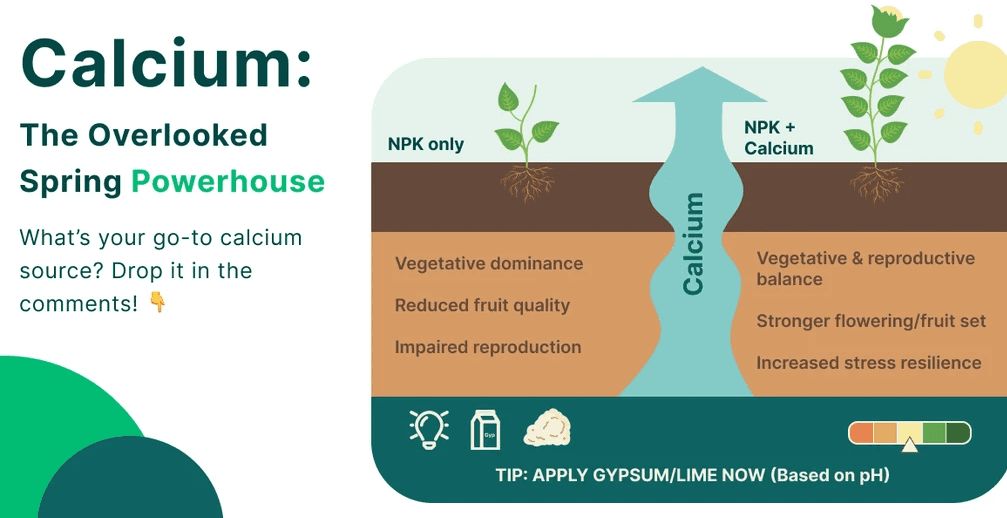
Calcium: The Overlooked Spring Powerhouse
by
Buse Soysal
Nutrient Interactions
Are fertilizer costs cutting into your bottom line?
by
Buse Soysal
Fertilizers
Advancing Precision Irrigation: Leveraging Technology for Sustainable Agriculture

by
Buse Soysal
Soil Health
Unlocking Agriculture’s Hidden Helpers: Microbial Genomics and the Data Challenge

by
Buse Soysal
The importance of microbial amendments: How to increase overall crop resilience

by
Buse Soysal
Soil Health
Unlocking Crop Potential: The Untapped Power of Plant Sap Analysis

by
Buse Soysal
RegenAg
Unlocking Carbon Credits: What Data Farmers Need to Track and How We Can Help

by
Buse Soysal
Data Analytics
Enhancing Weed Management: Leveraging Data Analytics for Sustainable Agriculture
by
Buse Soysal
Data Analytics
Elevating Crop Health with Brix Measurements: The Sweet Science of Plant Immunity

by
Buse Soysal
Soil Health
Nutrient Management and Disease Resistance: Unveiling the Hidden Connections Through Data Analytics

by
Buse Soysal
Base Saturation Balancing: Achieving the Ideal Ratio for Optimal Crop Production

by
Buse Soysal
Soil Health
How to Achieve Zero Excess Free Nitrates and Ammonium in Plant Sap Analysis

by
Buse Soysal
RegenAg
America's Buzzing Backbone: The Crucial Role of Migratory Beekeeping in U.S. Agriculture

by
Buse Soysal
Soil Health
Breaking Down Soil Biology Testing - Finding the ROI with PLFA Tests

by
Buse Soysal
Soil Testing
Precision Agriculture: Revolutionizing Farming, One Field at a Time

by
Buse Soysal
PrecisionAg
Ag101: What is the difference between organic and regenerative agriculture?
by
Buse Soysal
Soil Health
Your Favourite Beans are in Danger: Threats to Coffee & Chocolate Production
by
Buse Soysal
Soil Health
IPM Programs: Best of the Pest Prevention Measures

by
Buse Soysal
Pest & Disease
Wet Spring Issues - Why So Irreparable?

by
Buse Soysal
Nutrient Interactions
The Influence of Nutrient Applications on Post Harvest
by
Buse Soysal
Nutrient Interactions
Orange Juice in Danger: The Threat of HLB Disease

by
Buse Soysal
Soil Health
California Dreaming: The Issue with Almond Production

by
Buse Soysal
Sight Unseen: Zinc Deficiency in Soil

by
Buse Soysal
Nutrient Interactions
Battle Beneath: Understanding Calcium - Potassium Antagonism in Soil

by
Buse Soysal
Nutrient Interactions
The Plant Kingdom's Power Couple: Nitrogen and Sulfur's Synergistic Symphony

by
Buse Soysal
Nutrients for Beginners
Increase Drought Tolerance With This Commonly Missed Micronutrient

by
Buse Soysal
Climate Change
Digging Deeper: The Great Soil Analysis Debate for Regenerative Agriculture

by
Buse Soysal
Soil Health
Ammonium vs Calcium: The Nutrient Balancing Act for Thriving Plants

by
Buse Soysal
Nutrient Interactions
Improving Soil Structure: Boost Your Farm’s Resilience
by
Buse Soysal
Soil Health
Sodium and Calcium Relationship: A Tale of Frenemies in the Soil

by
Buse Soysal
Nutrient Interactions
The Soil Office: Molybdenum and Nitrate's Tumultuous Relationship
by
Buse Soysal
Nutrient Interactions
The Delicate Dance: Achieving the Perfect Nitrogen Balance for Optimal Crop Productivity

by
Buse Soysal
Nutrient Interactions
Paving the Way for a Regenerative Future: Insights into the "Data Driven Regenerative Ag" Project

by
Buse Soysal
RegenAg
Unlocking Soil's Full Potential: The Pioneering Principles of Dr. William A. Albrecht

by
Buse Soysal
Soil Health
The Benefits of Regenerative Agriculture for Human Health

by
Buse Soysal
RegenAg
Responsible Data Exchange in Agriculture

by
Buse Soysal
Data Analytics
Responsible Fertilizer Use for Mitigating Drought

by
Buse Soysal
Climate Change
The Power of Healthy Soil: for a Happy World Earth Day

by
Buse Soysal
Soil Health
Crop Scouting for Regenerative Agriculture

by
Buse Soysal
RegenAg
Plantsap and Soil Analyses for Nitrogen Emission Reduction

by
Buse Soysal
RegenAg
How do you use Plant Nutrition for Regenerative Agriculture?

by
Buse Soysal
RegenAg
Profitability of Regenerative Agriculture and Transition Management

by
Buse Soysal
RegenAg
How can we use Data-Driven Farming for a Bright Future?

by
Buse Soysal
Data Analytics
Plantsap Analysis for More Yield and Less Fertilizer

by
Buse Soysal
RegenAg