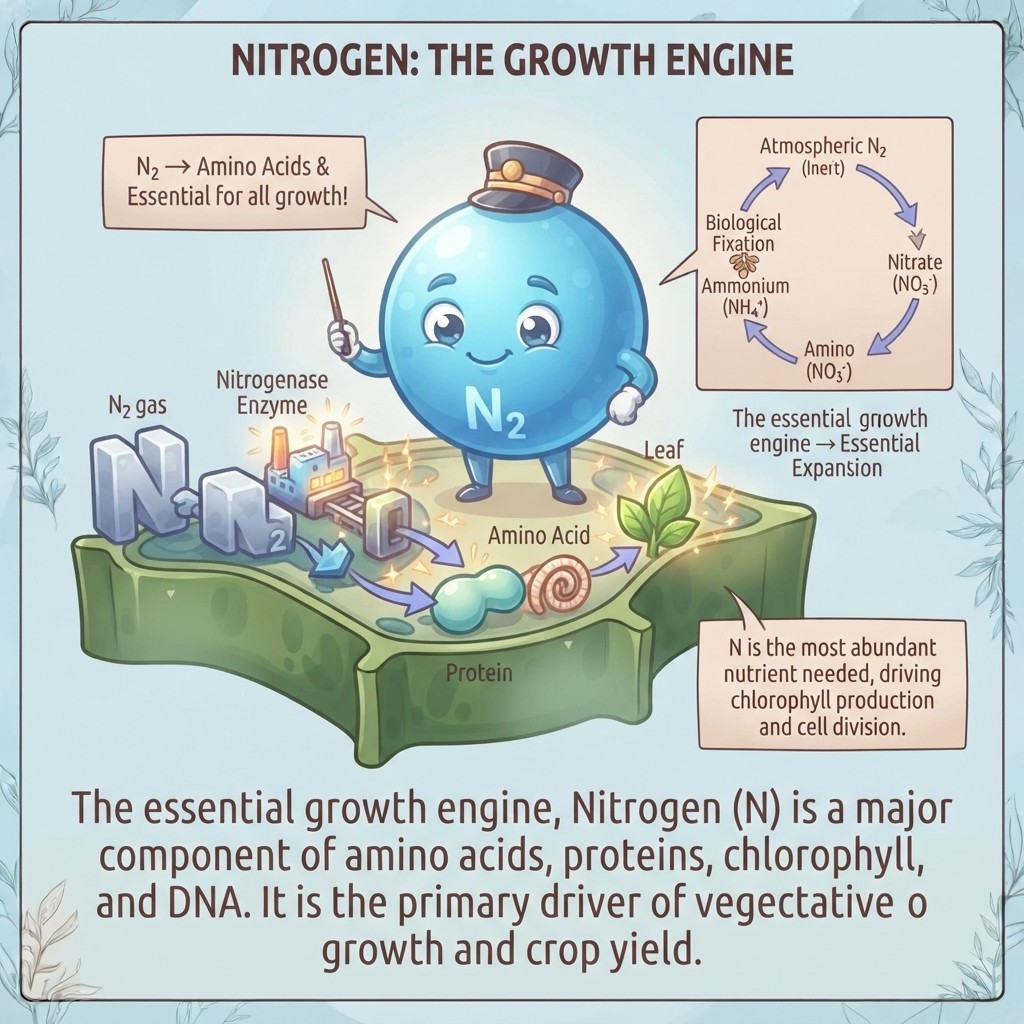
Nitrogen is one of the main nutrients controlling the productive
capacity of a crop. It is incorporated into amino acids, proteins,
enzymes, nucleic acids and
chlorophyll, which means that almost every
process associated with growth depends on an adequate nitrogen supply.
That makes nitrogen extraordinarily powerful. It also makes nitrogen
easy to misuse.
A crop supplied with too little nitrogen lacks the raw material to build
productive leaf area and photosynthetic machinery. A crop supplied with
more nitrogen than it can efficiently assimilate may continue producing
lush vegetative growth without converting that nitrogen efficiently into
functional proteins and high-quality tissue.
The objective is therefore not to maximise nitrogen concentration. It is
to maximise nitrogen conversion: the plant's ability to take
nitrogen up, reduce and assimilate it, incorporate it into functional
compounds, and use those compounds to build productive crop tissue.
Plant sap analysis can add an important layer to this question. Instead
of asking only how much nitrogen has been applied or how much nitrogen
is present in the soil, it allows the grower and agronomist to look at
nitrogen-related signals inside the plant itself. Those signals become
most useful when they are interpreted together with leaf age, crop
stage, trends, other nutrients, root-zone conditions and recent
management.
The agronomic question is not simply "Does the crop contain
nitrogen?" It is "Is the crop able to use the nitrogen that is
available?"
Nitrogen's personality and its relationships
Think of nitrogen as an ambitious builder. It is highly productive,
growth-oriented and always ready to expand the project.
Its strength is speed. Give nitrogen favourable conditions and the plant
can rapidly produce leaves, shoots and new biomass.
Its weakness is that it cannot complete the project alone.
Sulfur: the finishing specialist
Sulfur is one of nitrogen's closest partners. Nitrogen provides much of
the raw material needed to build amino acids and proteins, but sulfur is
required for sulfur-containing amino acids such as cysteine and
methionine.
When sulfur supply falls behind nitrogen supply, nitrogen metabolism can
become less efficient. Research has shown that sulfur deficiency can
reduce nitrate uptake and nitrate-reductase activity and can contribute
to the accumulation of nitrate and other non-protein forms of nitrogen.
This is why a high nitrate signal should not automatically be
interpreted as proof that the crop simply has "plenty of nitrogen". It
can also raise the question of whether the plant is converting nitrate
efficiently.
Molybdenum: the gatekeeper
When nitrogen enters the plant as nitrate, it cannot be incorporated
directly into amino acids. Nitrate first has to be reduced to nitrite by
the enzyme nitrate reductase.
That enzyme depends on a molybdenum cofactor.
Molybdenum is therefore needed in tiny quantities, but its role is
strategically important. A crop can have nitrate available while still
facing a bottleneck in nitrate metabolism if the biochemical machinery
required to process it is constrained.
This does not mean that every high nitrate reading is evidence of
molybdenum deficiency. It means molybdenum is one of the pieces of
context worth considering when the wider pattern points towards
restricted nitrate assimilation.
Iron: part of the reduction pathway
After nitrate has been converted to nitrite, nitrite must be reduced
further before nitrogen can enter amino-acid metabolism. Iron-containing
systems are involved in this pathway.
Iron also has wider roles in photosynthesis and electron transport. Its
relevance to nitrogen therefore extends beyond one enzyme step: a crop
needs functioning photosynthetic and metabolic machinery to use nitrogen
productively.
Magnesium: the energy team
Magnesium sits at the centre of the chlorophyll molecule and contributes
to many enzyme and ATP-related processes.
Nitrogen can stimulate the construction of photosynthetic tissue, but
that tissue still needs the machinery to capture energy and produce
carbon compounds. If photosynthetic performance is constrained, the crop
may not use additional nitrogen as efficiently as expected.
The nitrogen question is therefore connected to the plant's ability to
generate the energy and carbon skeletons needed for assimilation and
growth.
Phosphorus: the energy infrastructure
Nitrogen assimilation is metabolically demanding. Phosphorus is
fundamental to energy transfer through compounds such as ATP and is
involved in nucleic acids, membranes and many other metabolic processes.
Nitrogen and phosphorus therefore often support growth together. A crop
pushed strongly with nitrogen while phosphorus-related processes are
constrained may not respond in the way expected from nitrogen supply
alone.
Again, the relationship is contextual rather than a simple one-to-one
rule. Plant sap interpretation should use the actual measurements, crop
stage and supporting evidence rather than infer a phosphorus problem
from nitrogen alone.
Potassium: the logistics network
Potassium is not incorporated into proteins in the way nitrogen is, but
it plays a major role in ion balance, membrane function, osmotic
regulation, stomatal behaviour and transport processes.
Nitrate and potassium transport are closely coordinated in plants.
Potassium also supports photosynthesis and the movement of assimilates.
For practical interpretation, this means nitrogen efficiency should not
be viewed separately from the plant's transport and water-regulation
systems. A crop may contain nitrogen while other limitations restrict
where resources move and how effectively they are used.
The agronomy behind nitrogen conversion
Plants acquire inorganic nitrogen mainly as nitrate (NO₃⁻) and ammonium
(NH₄⁺), although the relative importance of these forms depends on the
crop and growing environment.
Nitrate follows a biochemical conversion pathway before its nitrogen can
be incorporated into amino acids:
Nitrate → Nitrite → Ammonium → Amino acids → Proteins and other
N-containing compounds
The first reduction step is catalysed by nitrate reductase and depends
on a molybdenum cofactor. Nitrite reduction then takes place in plastids
and involves iron-containing components. From there, reduced nitrogen is
incorporated into amino acids and connected with carbon metabolism.
This is one reason why nitrogen status cannot be understood as a single
isolated concentration.
Nitrogen assimilation depends on a functioning network involving
nutrient supply, enzymes, energy, carbon metabolism, water relations and
root activity. If one part of that network becomes limiting, nitrogen
can cease to be the factor controlling crop performance even when a
nitrogen-related measurement appears abnormal.
Nitrate, ammonium and total nitrogen are different signals
A plant sap report may contain several nitrogen-related measurements.
These should not automatically be collapsed into one "nitrogen status".
Nitrate-N
Nitrate is both a nutrient and a signalling molecule. It is transported
through the plant and must be reduced before its nitrogen can be
incorporated into amino acids.
A high nitrate value can have several possible interpretations depending
on crop, tissue, stage and context. It may reflect strong nitrate supply
or uptake, but it can also justify investigating whether assimilation is
keeping pace.
A low nitrate value is equally contextual. It may coincide with limited
nitrogen availability, but it should not be interpreted without total
nitrogen, ammonium, crop demand, growth stage and the wider evidence.
Ammonium-N
Ammonium can enter nitrogen assimilation more directly than nitrate
because it does not first require nitrate reduction. But ammonium
nutrition also changes ion balance and root-zone chemistry.
High ammonium availability can affect the uptake of other cations. Where
high NH₄-N occurs together with low potassium, calcium or magnesium, the
combination can therefore be a useful verification point.
It is not proof that ammonium caused the other values. Root conditions,
nutrient availability, EC, pH and fertilisation history still need to be
checked.
Total nitrogen
Total nitrogen provides a broader picture of nitrogen contained in the
sample, but it does not by itself show how that nitrogen is partitioned
among nitrate, ammonium, amino acids, proteins and other
nitrogen-containing compounds.
For interpretation, total N becomes more useful when read together with
nitrogen forms, leaf position, crop stage and comparable historical
measurements.
Nitrogen is mobile --- so young and old leaves both matter
Nitrogen is a mobile nutrient. Plants can remobilise nitrogen from older
tissue and redistribute it towards actively growing organs.
This makes the relationship between young leaves and old leaves
agronomically interesting.
But the correct sequence matters.
First assess the young and old leaf values independently against the
relevant laboratory or crop reference. Only then interpret their
distribution.
A balanced relationship between young and old leaves is not proof of
adequate nitrogen status. Both can be low. Likewise, a difference
between old and young leaves is not automatically evidence of a
deficiency.
The distribution is a supporting signal.
For a mobile nutrient such as nitrogen, relatively lower values in older
tissue can sometimes be consistent with remobilisation towards younger
growth. Relatively higher values in old tissue may raise different
questions about distribution, demand and crop stage.
The meaning depends on the absolute measurements and the crop's
physiological situation.
Crop stage changes the nitrogen question
Nitrogen demand is not constant throughout the season.
During rapid vegetative growth, nitrogen is heavily associated with
expanding leaf area and photosynthetic capacity. Later in the crop
cycle, the agronomic objective may increasingly shift towards
reproductive growth, fruit, grain, seed, tuber or bulb development,
quality, maturity and efficient remobilisation.
A nitrogen concentration that is appropriate at one stage can therefore
carry a different meaning at another.
This is particularly important when interpreting trends. A value
measured three weeks later is not automatically directly comparable
simply because it comes from the same field.
Before calling a change a physiological trend, ask whether the samples
are genuinely comparable:
Was the same crop and variety sampled?
Was the same leaf position and leaf age used?
Was the analytical method comparable?
Was the crop at a comparable physiological stage?
Did the laboratory reference basis remain the same?
Were there recent foliar applications or unusual environmental
conditions?Was sample quality comparable?
If those conditions are not sufficiently aligned, the apparent trend
should be interpreted cautiously.
What does low nitrogen in plant sap mean?
A low nitrogen-related value is a signal to investigate, not an
automatic fertiliser prescription.
Possible questions include:
Is plant-available nitrogen in the root zone actually low?
Is root activity restricted?
Is the root zone too dry, too wet or poorly aerated?
Is root-zone temperature limiting uptake?
Has rapid biomass expansion diluted tissue concentrations?
Is the crop at a stage where nitrogen is being remobilised?
Are pH or EC conditions affecting nutrient acquisition?
Do young and old leaves tell the same story?
Do previous comparable measurements support the pattern?
Is crop growth visibly constrained?
The value becomes agronomically stronger when several independent
signals point in the same direction.
What does high nitrogen in plant sap mean?
High nitrogen should not automatically be celebrated, and it should not
automatically be treated as a problem.
The interpretation depends on the form of nitrogen, crop, stage and the
wider nutrient pattern.
Useful questions include:
Is nitrate high, total nitrogen high, or both?
Is ammonium also elevated?
Is the crop converting nitrogen into productive growth?
Is sulfur keeping pace?
Do molybdenum and iron provide any reason for further investigation?
Is magnesium supporting photosynthetic function?
Is potassium supporting transport and ionic balance?
Is growth excessively vegetative relative to the desired crop stage?
Are young and old leaves showing a coherent pattern?
Has nitrogen remained elevated across genuinely comparable samples?
A high nitrate signal combined with disappointing crop performance
deserves a different interpretation from a high nitrogen status in a
rapidly growing, balanced crop.
The nitrogen-to-sulfur relationship deserves special attention
Among nutrient relationships, nitrogen and sulfur are particularly
closely connected because both feed directly into protein metabolism.
Sulfur deficiency can impair nitrogen utilisation and contribute to
nitrate or soluble non-protein nitrogen accumulation. Conversely, strong
nitrogen-driven growth can increase the crop's requirement for sulfur.
This creates an important practical lesson:
When nitrogen supply increases, the crop's ability to process
nitrogen must increase with it.
That does not mean nitrogen and sulfur should be managed according to
one universal ratio. Crop, stage, production system, laboratory method
and target ranges remain important.
The relationship is valuable because it helps shift attention from
nutrient quantity towards metabolic balance.
Nitrogen, potassium and water
Nitrogen management is also inseparable from water relations.
Nitrate and potassium transport are physiologically coordinated, while
potassium contributes strongly to osmotic regulation and stomatal
function. Root-zone moisture also affects mass flow, root activity and
nutrient acquisition.
This means an apparent nutrient limitation can sometimes be secondary to
a water limitation.
If crop uptake falls during drought or root-zone stress, simply adding
more fertiliser may not solve the underlying problem. The first question
should be whether the roots and transport system can access and move the
nutrients already present.
Plant sap interpretation is most useful when it helps distinguish
nutrient supply from nutrient access and utilisation.
What should a grower look for in plant sap?
Do not interpret total nitrogen in isolation.
Look at nitrate-N, ammonium-N and total N together, and compare
young and old leaves using the crop- and laboratory-specific reference
ranges available for the analysis.
Then broaden the picture.
If nitrate is high
Ask whether nitrogen conversion appears to be keeping pace. Look at
sulfur and consider the wider metabolic context, including Mo, Fe, Mg
and crop performance. Check crop stage and recent nitrogen inputs.
If ammonium is high
Look at K, Ca and Mg and investigate root-zone pH, EC, oxygen, water
status and the form of recent nitrogen applications.
If nitrogen is low in young leaves
Check the old leaves as well. Because nitrogen is mobile, the
distribution can add context about remobilisation. Then verify root-zone
supply, water status, rooting and crop demand.
If nitrogen is declining over time
First establish whether the measurements are genuinely comparable. A
decline can be meaningful, but crop development, leaf selection and
growth dilution can also change concentrations.
If nitrogen is high but crop performance disappoints
Do not automatically add more nitrogen. Ask whether the plant has the
nutritional, photosynthetic and root-zone conditions required to use the
nitrogen already present.
A practical interpretation sequence
A useful nitrogen interpretation can be built in a consistent order:
Check the individual measurements. Assess total N, NO₃-N and
NH₄-N separately against the relevant laboratory references.Compare young and old leaves. Evaluate each independently before
interpreting the distribution.Place the values in crop context. Consider crop, variety,
phenological stage and current growth.Check comparable trends. Use earlier analyses only when sampling
and analytical conditions are sufficiently comparable.Look at related nutrients. Sulfur, Mo, Fe, Mg, P and K can
provide useful supporting context.Check the root zone and environment. Water, oxygen, pH, EC, root
health and recent applications can change the meaning of the plant
signal.Form a hypothesis. Describe what the pattern may indicate
without turning correlation into proven causality.Verify before correcting. Use field observations, soil or
substrate information, irrigation data and management history.Monitor what happens next. New measurements and observations
should add context to the next decision.
What SoilBeat adds
A laboratory report is a valuable snapshot. Agronomic decisions usually
require a timeline.
SoilBeat is designed to keep plant sap measurements connected to the
context that gives them meaning: field, crop, date, young and old leaf,
previous analyses, observations, activities and other available farm
evidence.
That makes it possible to move beyond repeatedly interpreting individual
PDFs.
Instead, each new measurement can become part of a growing agronomic
record.
For nitrogen, that means the discussion can evolve from:
"Nitrogen is high."
to:
"Nitrate is high in this tissue at this crop stage; the previous
comparable analysis showed a similar direction; sulfur and magnesium
provide additional context; recent nitrogen application and root-zone
conditions should be checked before deciding whether an intervention is
justified."
That is a much more useful starting point for agronomy.
The key takeaway
Nitrogen is the builder, but productive crops are not built by nitrogen
alone.
Nitrogen needs sulfur to support protein formation, molybdenum and iron
in nitrate metabolism, magnesium and phosphorus in the energy and
photosynthetic system, potassium in transport and ionic balance, and a
functioning root zone to keep the entire process supplied.
Plant sap analysis can make those relationships visible.
Its greatest value is not in producing another number. It is in helping
the grower and agronomist ask a better question:
How efficiently is this crop turning the nitrogen it has into
healthy, productive growth?
That is the difference between managing nitrogen concentration and
managing nitrogen performance.
Agronomic note
Plant sap analysis is one source of evidence and should be interpreted
alongside crop observations, laboratory reference ranges, soil or
substrate information, water and root-zone conditions, recent
applications and agronomic judgement. A single low or high nutrient
value is not, by itself, sufficient justification for a fertiliser or
crop-input application.
This blog is part of SoilBeat’s Plant Sap Nutrient Series, created through the SNN project with co-financing from the European Union and Samenwerkingsverband Noord-Nederland (SNN).

Written by
Buse Soysal
Related
Other Articles.
Turning lab report into a fertiliser recommendation

by
Buse Soysal
Fertiliser Recommendation
Unlocking Hidden Nutrients with Total Digestion Soil Tests
by
Buse Soysal
How to Balance a High Bacterial to Fungal Ratio in your Soil

by
Buse Soysal
Soil Health
Magnesium: The Unsung Hero of Photosynthesis
by
Buse Soysal
Nutrient Interactions
Unlocking Smarter Farming with Weather + Nutrient Analytics

by
Buse Soysal
Nutrient Interactions
Water Meets Nutrient Strategy

by
Buse Soysal
Nutrient Interactions
Calcium: The Architect
by
Buse Soysal
Plantsap
Potassium: The Logistics Manager

by
Buse Soysal
Plantsap
Phosphorus: The Strategist
by
Buse Soysal
Plantsap
Unit Conversion Meets Crop Intelligence

by
Buse Soysal
Soil Testing
Soil Biology Testing—What Are Your Options?
by
Buse Soysal
Soil Testing
Predict Problems Before They Hit — The Power of Plant Sap Analysis
by
Buse Soysal
Data Analytics
Maximizing Cover Crop Benefits for Your Cash Crop

by
Buse Soysal
Nutrient Interactions
Calcium: The Overlooked Spring Powerhouse
by
Buse Soysal
Nutrient Interactions
Are fertilizer costs cutting into your bottom line?
by
Buse Soysal
Fertilizers
Advancing Precision Irrigation: Leveraging Technology for Sustainable Agriculture

by
Buse Soysal
Soil Health
Unlocking Agriculture’s Hidden Helpers: Microbial Genomics and the Data Challenge

by
Buse Soysal
The importance of microbial amendments: How to increase overall crop resilience

by
Buse Soysal
Soil Health
Unlocking Crop Potential: The Untapped Power of Plant Sap Analysis

by
Buse Soysal
Regenerative Agriculture
Unlocking Carbon Credits: What Data Farmers Need to Track and How We Can Help

by
Buse Soysal
Data Analytics
Enhancing Weed Management: Leveraging Data Analytics for Sustainable Agriculture
by
Buse Soysal
Data Analytics
Elevating Crop Health with Brix Measurements: The Sweet Science of Plant Immunity

by
Buse Soysal
Soil Health
Nutrient Management and Disease Resistance: Unveiling the Hidden Connections Through Data Analytics

by
Buse Soysal
Base Saturation Balancing: Achieving the Ideal Ratio for Optimal Crop Production

by
Buse Soysal
Soil Health
How to Achieve Zero Excess Free Nitrates and Ammonium in Plant Sap Analysis

by
Buse Soysal
Regenerative Agriculture
America's Buzzing Backbone: The Crucial Role of Migratory Beekeeping in U.S. Agriculture

by
Buse Soysal
Soil Health
Breaking Down Soil Biology Testing - Finding the ROI with PLFA Tests

by
Buse Soysal
Soil Testing
Precision Agriculture: Revolutionizing Farming, One Field at a Time

by
Buse Soysal
Precision Agriculture
Ag101: What is the difference between organic and regenerative agriculture?
by
Buse Soysal
Soil Health
Your Favourite Beans are in Danger: Threats to Coffee & Chocolate Production

by
Buse Soysal
Soil Health
IPM Programs: Best of the Pest Prevention Measures

by
Buse Soysal
Pest & Disease
Wet Spring Issues - Why So Irreparable?

by
Buse Soysal
Nutrient Interactions
The Influence of Nutrient Applications on Post Harvest
by
Buse Soysal
Nutrient Interactions
Orange Juice in Danger: The Threat of HLB Disease

by
Buse Soysal
Soil Health
California Dreaming: The Issue with Almond Production

by
Buse Soysal
Sight Unseen: Zinc Deficiency in Soil

by
Buse Soysal
Nutrient Interactions
Battle Beneath: Understanding Calcium - Potassium Antagonism in Soil

by
Buse Soysal
Nutrient Interactions
The Plant Kingdom's Power Couple: Nitrogen and Sulfur's Synergistic Symphony

by
Buse Soysal
Nutrients for Beginners
Increase Drought Tolerance With This Commonly Missed Micronutrient

by
Buse Soysal
Climate Change
Digging Deeper: The Great Soil Analysis Debate for Regenerative Agriculture

by
Buse Soysal
Soil Health
Ammonium vs Calcium: The Nutrient Balancing Act for Thriving Plants

by
Buse Soysal
Nutrient Interactions
Improving Soil Structure: Boost Your Farm’s Resilience
by
Buse Soysal
Soil Health
Sodium and Calcium Relationship: A Tale of Frenemies in the Soil

by
Buse Soysal
Nutrient Interactions
The Soil Office: Molybdenum and Nitrate's Tumultuous Relationship
by
Buse Soysal
Nutrient Interactions
The Delicate Dance: Achieving the Perfect Nitrogen Balance for Optimal Crop Productivity

by
Buse Soysal
Nutrient Interactions
Paving the Way for a Regenerative Future: Insights into the "Data Driven Regenerative Ag" Project

by
Buse Soysal
Regenerative Agriculture
Unlocking Soil's Full Potential: The Pioneering Principles of Dr. William A. Albrecht

by
Buse Soysal
Soil Health
The Benefits of Regenerative Agriculture for Human Health

by
Buse Soysal
Regenerative Agriculture
Responsible Data Exchange in Agriculture

by
Buse Soysal
Data Analytics
Responsible Fertilizer Use for Mitigating Drought

by
Buse Soysal
Climate Change
The Power of Healthy Soil: for a Happy World Earth Day

by
Buse Soysal
Soil Health
Crop Scouting for Regenerative Agriculture

by
Buse Soysal
Regenerative Agriculture
Plantsap and Soil Analyses for Nitrogen Emission Reduction

by
Buse Soysal
Regenerative Agriculture
How do you use Plant Nutrition for Regenerative Agriculture?

by
Buse Soysal
Regenerative Agriculture
Profitability of Regenerative Agriculture and Transition Management

by
Buse Soysal
Regenerative Agriculture
How can we use Data-Driven Farming for a Bright Future?

by
Buse Soysal
Data Analytics
Plantsap Analysis for More Yield and Less Fertilizer

by
Buse Soysal
Regenerative Agriculture