1 okt 2026
Can Vetch Catch Crops Improve Greenhouse Vegetables and Reduce Fertilizer

Can Vetch Catch Crops Improve Greenhouse Vegetables and Reduce Fertilizer?
Greenhouse vegetable production can leave valuable land bare between cash crops. During that fallow, residual nitrate may remain vulnerable to loss, soil organisms receive little fresh carbon, and the next crop begins with no biological nutrient capture from the preceding interval.
Leguminous catch crops offer another option. They can take up residual soil nutrients, fix atmospheric nitrogen through rhizobia, produce residue, and return carbon and nutrients when terminated.
A newly published Plant and Soil study found that common vetch and hairy vetch grown during a greenhouse fallow improved the yield and selected quality measurements of the following chili, tomato, and cucumber crops. Soil nutrient indicators, enzyme activities, photosynthesis, and culturable microbial abundance also changed.
The findings are encouraging, particularly for intensive protected production. But the trial did not show that vetch replaced fertilizer. Every vegetable crop received the same conventional fertility program, and the researchers did not quantify the nutrient contribution from the catch crops.
That distinction determines what growers can safely take from the result.
Research finding
The experiment was conducted during 2023–2024 in protected vegetable production at Lijiazhuang, Yuzhong County, Gansu Province, China. The soil was described as a loam with pH ranging from 6.8 to 7.8 and initial organic matter of approximately 16.3–28.6 g/kg.
Researchers compared three fallow treatments:
Bare soil
Common vetch, Vicia sativa
Hairy vetch, Vicia villosa
The vetch crops were sown on July 5, 2023, then mechanically crushed and returned to the soil in early October. The following cash crops were chili, tomato, and cucumber.
Each crop–cover combination was replicated three times in 30-square-meter plots, producing 27 plots in total. The design was randomized within the experiment, but covered only one location and production cycle. The authors' public Research Square manuscript provides the detailed experimental methods.
All treatments received the same conventional fertility program. Depending on the vegetable, this included 400–500 kg/ha of an organic fertilizer plus mineral nutrients supplied through diammonium phosphate, calcium nitrate, and potassium sulfate. Reported mineral inputs were 23.7 kg N/ha, 38.4 kg P₂O₅/ha, and 72.9 kg K₂O/ha.
The cover crops therefore supplemented the fertilizer program. They did not replace part of it.
Both vetch species increased marketable yield:
Chili increased 19.4% after common vetch and 16.2% after hairy vetch.
Tomato increased 6.1% and 5.9%, respectively.
Cucumber increased 8.4% and 5.0%.
Quality responses differed by crop. Chili vitamin C increased most strongly after common vetch. Tomato soluble sugar increased while organic acids declined modestly. Cucumber soluble sugar increased by more than 60% under both vetch treatments, with smaller increases in vitamin C.
Net photosynthesis was also higher in several crop–vetch combinations. The peer-reviewed record was published September 13, 2026, in Plant and Soil; detailed experimental information is available in the authors’ public manuscript.
What changed in the soil?
The researchers compared soil before and after vegetable production. Several large changes were reported, although their magnitude varied by cash crop and vetch species.
For example, common vetch before chili was associated with increases in organic matter, alkali-hydrolyzable nitrogen, available phosphorus, and available potassium relative to bare fallow. Nitrogen and organic-matter indicators also increased in the tomato and cucumber comparisons.
Activities of enzymes associated with carbon, nitrogen, phosphorus, and sulfur cycling changed, while plate-culture measurements indicated greater abundance of culturable bacteria or fungi in some treatments.
These measurements show that the soil environment responded. They do not yet reveal how much plant-available nutrition the vetch supplied.
That distinction matters when interpreting soil data. A measurement showing that more of a nutrient is present does not automatically tell us how much will become available to the next crop. SoilBeat takes the same broader approach to nutrient and input decisions: soil measurements need to be interpreted alongside plant uptake, water, crop stage, previous applications, field observations, and growing history.
Short-term percentage changes in soil organic matter deserve particular caution. Incorporating fresh residue can increase measured carbon near the sampling zone, but large apparent changes over one production cycle may also reflect residue distribution, sampling variability, and differences in starting values. They should not be interpreted as stable soil-carbon sequestration without repeated, depth-standardized measurements over several years.
Likewise, culturable microbial counts represent only the organisms that grew under the laboratory conditions used. They do not describe the complete microbiome, its functional genes, or whether a particular organism improved nutrient delivery or disease suppression.
Agronomic interpretation
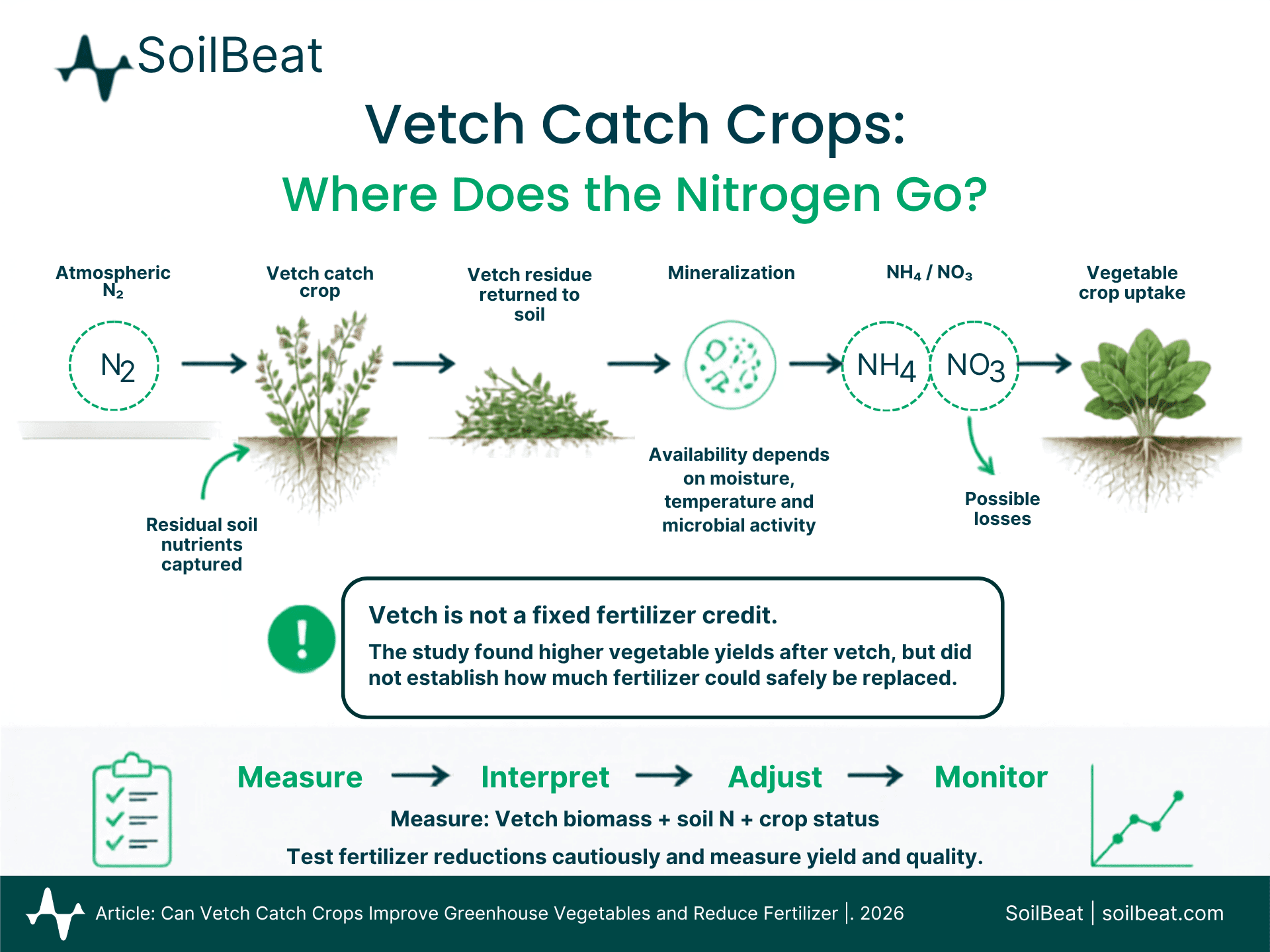
The crop does not take up “green manure nitrogen” directly as a single pool.
Most nitrogen in vetch residue is contained in proteins, amino compounds, and other organic molecules. Decomposer organisms must break down that material and release ammonium. Nitrifying organisms can then convert ammonium into nitrate when temperature, moisture, aeration, and pH are favorable.
The timing matters. Rapid mineralization before strong root demand can create nitrate vulnerable to leaching or denitrification. Slow mineralization can leave the vegetable short during early canopy development or fruit set, even when the residue contains substantial total nitrogen.
This is why nutrient management is ultimately about more than the amount of nutrient added to a system. SoilBeat describes the same principle in its approach to turning soil and crop measurements into nutrient decisions: measurements need crop, field, application, and management context before they can become useful recommendations.
Residue quality matters too. Vetch commonly has a lower carbon-to-nitrogen ratio than mature cereal residue and may therefore mineralize relatively quickly, but the rate changes with plant maturity, lignification, particle size, incorporation depth, soil temperature, moisture, and microbial activity.
None of those flows was quantified in this experiment. The study did not report harvested vetch biomass, tissue nutrient concentration, biological nitrogen fixation, residue C:N ratio, net mineralization, soil nitrate through the season, or nitrogen remaining after harvest.
Phosphorus and potassium responses also require context. Vetch does not create these nutrients. It can acquire them from the soil, concentrate them in biomass, and return them closer to the surface. Root exudates, rhizosphere pH, phosphatase activity, microbial turnover, and residue decomposition may change their measured availability.
This broader idea—cycling nutrients more effectively rather than simply adding more fertilizer—is also central to research into closing agricultural nutrient cycles and to wider evidence comparing organic amendments with mineral fertilizers, including a recent global compost and mineral-fertilizer meta-analysis.
Improved cycling can benefit the next crop, but repeated removal in harvested vegetables still requires a complete nutrient balance.
Moisture is another possible mechanism. Surface residue can reduce evaporation and moderate soil temperature, while a living catch crop consumes water before termination. Whether that is beneficial depends on water availability, irrigation cost, termination timing, and the interval before vegetable planting.
Possible management implication
The most defensible implication is that a fallow period can be managed as part of the nutrient cycle.
A vetch catch crop may capture residual nutrients, contribute biologically fixed nitrogen, add residue, and alter conditions experienced by the next crop. The reported yield responses suggest that these effects can remain agronomically meaningful even when conventional fertilizer is still applied.
But a fertilizer credit must be measured rather than assumed.
This distinction is important economically as well as agronomically. Fertilizer decisions should account for the amount of N already available from soil, residues, organic inputs, and previous management before deciding how much additional fertilizer is justified. Research programs such as GRDC's work on improving nitrogen-fertilizer decision-making illustrate the broader importance of making N decisions from measured supply and crop requirements rather than fixed assumptions.
A practical on-farm evaluation should record:
Catch-crop species, seeding date, establishment, and termination date
Aboveground biomass and, where practical, root biomass
Biomass dry matter, total N, P, K, sulfur, and C:N ratio
Baseline and preplant soil nitrate and ammonium by relevant depth
Soil moisture and temperature during residue decomposition
Fertilizer and irrigation inputs for the cash crop
Standardized tissue or sap measurements at key crop stages
Yield, grade, fruit quality, and rejected product
Postharvest mineral N and longer-term soil trends
Seed, irrigation, labor, machinery, and fertilizer costs
Standardized nutrient-management references such as the AHDB RB209 Nutrient Management Guide provide another useful example of why soil nutrient supply, crop requirement, organic inputs, and fertilizer applications need to be considered together rather than independently.
From potential nutrient supply to actual crop uptake
Measuring vetch biomass and nutrient concentration tells us the potential nutrient contribution.
It still does not tell us exactly when those nutrients become available—or whether the vegetable crop actually captures them.
That is where in-season crop measurements become useful.
SoilBeat's approach to greenhouse and glasshouse nutrient management combines soil or substrate information with plant measurements because each tells a different part of the story. Soil measurements help characterize nutrient supply, while tissue or plant sap measurements can provide evidence about what is happening in the crop during the season.
This matters particularly when testing a fertilizer reduction after vetch.
Rather than assuming that biologically fixed or recycled N has replaced a fixed amount of fertilizer, growers can establish a baseline, reduce fertilizer cautiously in a replicated treatment, and then follow crop nutrient status, yield, quality, and residual soil fertility.
SoilBeat's grower workflow is built around this same principle: connect soil tests, plant sap results, fertilization history and field observations before reducing synthetic inputs. The objective is not simply to use less fertilizer. It is to identify where inputs can be reduced without losing crop performance.
A useful trial would therefore compare the normal fertilizer program with one or more modest, predefined reductions after vetch, while retaining replicated bare-fallow controls. The fertilizer reduction should be small enough to manage risk and based on measured biomass-N, local mineralization experience, and in-season plant status.
Measure → interpret → recommend → act → monitor
This experiment provides a good example of why nutrient-management interventions need a complete feedback loop.
Measure: quantify vetch biomass, residue nutrients, soil mineral N, plant status, fertilizer inputs, yield, and quality.
Interpret: determine whether additional nutrient supply is actually becoming available when the crop needs it.
Recommend: calculate a cautious fertilizer adjustment rather than assuming a generic vetch N credit.
Act: test that adjustment in a defined field, greenhouse zone, or replicated strip.
Monitor: compare plant uptake, yield, quality, postharvest mineral N, and economics against the normal program.
This is also the logic behind SoilBeat's recommendation workflow: measurements and agronomic context are connected to a recommendation, the recommendation becomes an action, and subsequent observations and measurements provide evidence for the next decision.
For a grower testing vetch, that creates a much more useful question than simply asking whether cover crops “save fertilizer.”
The question becomes:
How much fertilizer can this particular system safely replace, under these conditions, while maintaining yield, quality, and profitability?
Limitations and unknowns
This was one season at one location with three replicates per crop–treatment combination. Results may change with soil type, greenhouse temperature, irrigation, cover-crop establishment, vegetable cultivar, termination method, and disease history.
Input packages were not nutrient-balanced between bare fallow and vetch because the nutrients returned in vetch biomass were not measured. The study therefore cannot determine how much of the crop response came from nitrogen fixation, recycled soil nutrients, residue carbon, moisture effects, microbial activity, or other mechanisms.
No fertilizer-rate gradient was included. Consequently, the study did not establish that fertilizer could be reduced, nor did it calculate agronomic nitrogen-use efficiency.
Root disease, pest pressure, nitrate leaching, gaseous nitrogen loss, salinity, residue-management cost, and return on investment were not measured. Quality improvements were promising but require confirmation across seasons and commercial grading systems.
These limitations are especially important because fertilizer economics can change rapidly. A biological intervention becomes commercially valuable as a fertilizer-saving strategy only when the value of the displaced input exceeds the additional seed, water, labor, machinery, and management costs. Fertilizer markets therefore belong in the economic calculation, but current price indicators should not be treated as agronomic evidence.
Recommendation
Consider leguminous catch crops a testable nutrient-management intervention where greenhouse fallows, water supply, and operating schedules permit them.
Do not subtract a generic vetch nitrogen credit from the next fertilizer program based on this study.
First quantify biomass and nutrients, follow soil mineral N and crop status, and compare yield, quality, residual fertility, and total cost against a matched control.
Where a fertilizer reduction is tested, connect the before-and-after evidence. SoilBeat can help growers and agronomists keep laboratory results, field observations, fertilizer records, crop history, and subsequent actions connected to the same crop and field, making it easier to determine whether an input change actually improved the system.
The practical insight is simple:
Replacing bare fallow with a living crop may improve the next vegetable crop—but the fertilizer-saving value exists only when the captured and fixed nutrients are measured through to crop uptake and economic return.
Sources
Guo, R.; Zhang, S.; He, H.; Yang, H.; Liu, R.; Wang, Z.; Liu, H.; and Zhang, W. “Catch-cropping leguminous green manure during fallow improves yield and quality of chili, tomato, and cucumber.” Plant and Soil, 2026.
Guo et al. “Public manuscript and detailed methods.” Research Square, 2026.
Jiang et al. — TaNPF7.6-A1mod, wheat yield, and nitrogen-use efficiency, Sept. 9, 2026.
Henan Agricultural University — Institutional summary of TaNPF7.6-A1mod research, Sept. 12, 2026.
Guo et al. — Long-term orchard-floor management in peach, Sept. 11, 2026.
González-Guzmán et al. — Soil-tailored residue-based amendments for wheat, accepted Sept. 11, 2026.
GRDC — Improving nitrogen-fertilizer decisions in northern NSW, Aug. 11, 2026.
Hayat et al. — Global compost and mineral-fertilizer meta-analysis, Apr. 4, 2026.
Wageningen University & Research — Options for closing European agricultural nutrient cycles, July 6, 2026.
Ren et al. — Soybean intercropping in walnut orchards, Sept. 11, 2026.
Jiang et al. — Fertilizer with humic acid or poultry manure in maize, accepted Sept. 11, 2026.
Agricultural and Resource Policy Center — September fertilizer-market white paper, September 2026.
AHDB — RB209 Nutrient Management Guide, 2026 edition.
FertilizerPrice.com — Current US fertilizer price indicators, updated Sept. 13, 2026; commercial aggregation, not independent agronomic evidence.

Geschreven door
Buse Soysal
Gerelateerd
Andere Artikelen.
Slurry Injection Saves Nitrogen But What Does It Cost Elsewhere?

door
Buse Soysal
Beste praktijken
Voedingsinteracties
Bodemgezondheid
Meststoffen
Bodemonderzoek
Precisielandbouw
De Nieuwe Wereldkaart voor Kunstmest

door
Buse Soysal
Bemestingsadvies
Meststoffen
Data Analyse
Klimaatverandering
Laboratoriumrapport vertalen naar bemestingsadvies

door
Buse Soysal
Bemestingsadvies
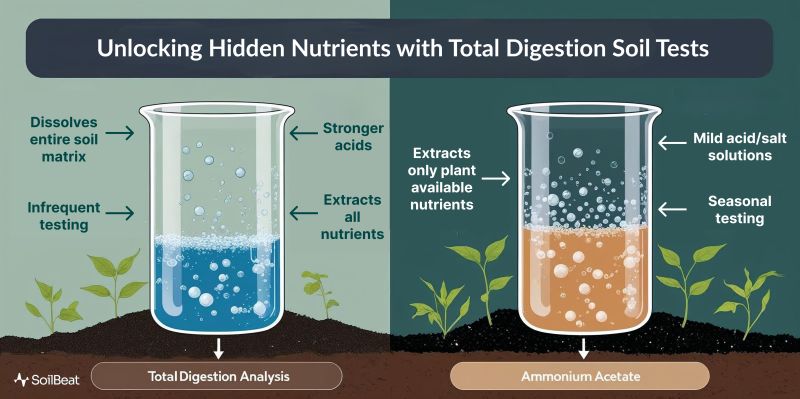
Vergrendel verborgen voedingsstoffen met Total Digestion Bodemtests
door
Buse Soysal
Hoe een hoge bacteriële naar schimmelverhouding in uw grond in balans te brengen

door
Buse Soysal
Bodemgezondheid
Magnesium: De Ongezongen Held van Fotosynthese

door
Buse Soysal
Voedingsinteracties
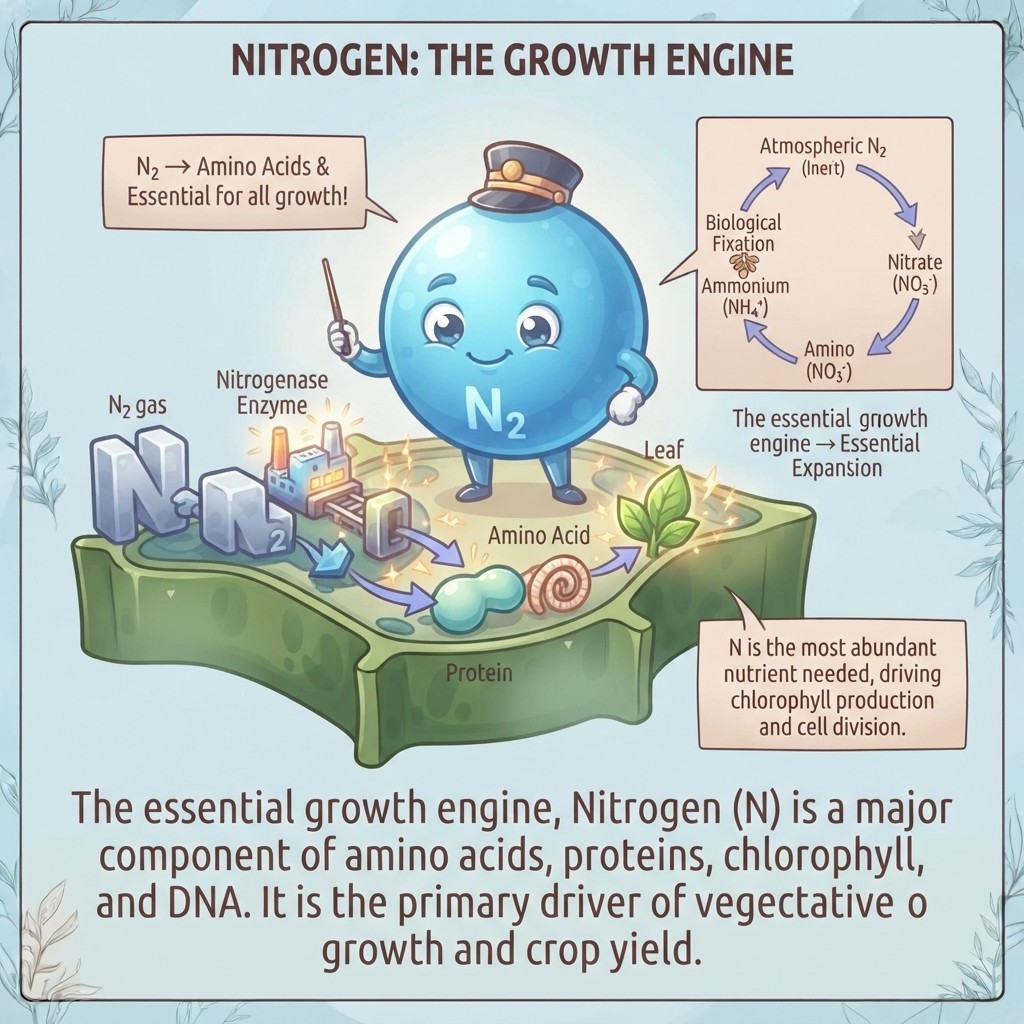
Stikstoffractie: De Bouwsteen
door
Buse Soysal
Plantsap
Slimmer boeren ontgrendelen met weer- en nutriëntenanalyse

door
Buse Soysal
Voedingsinteracties
Water Ontmoet Voedingsstrategie

door
Buse Soysal
Voedingsinteracties
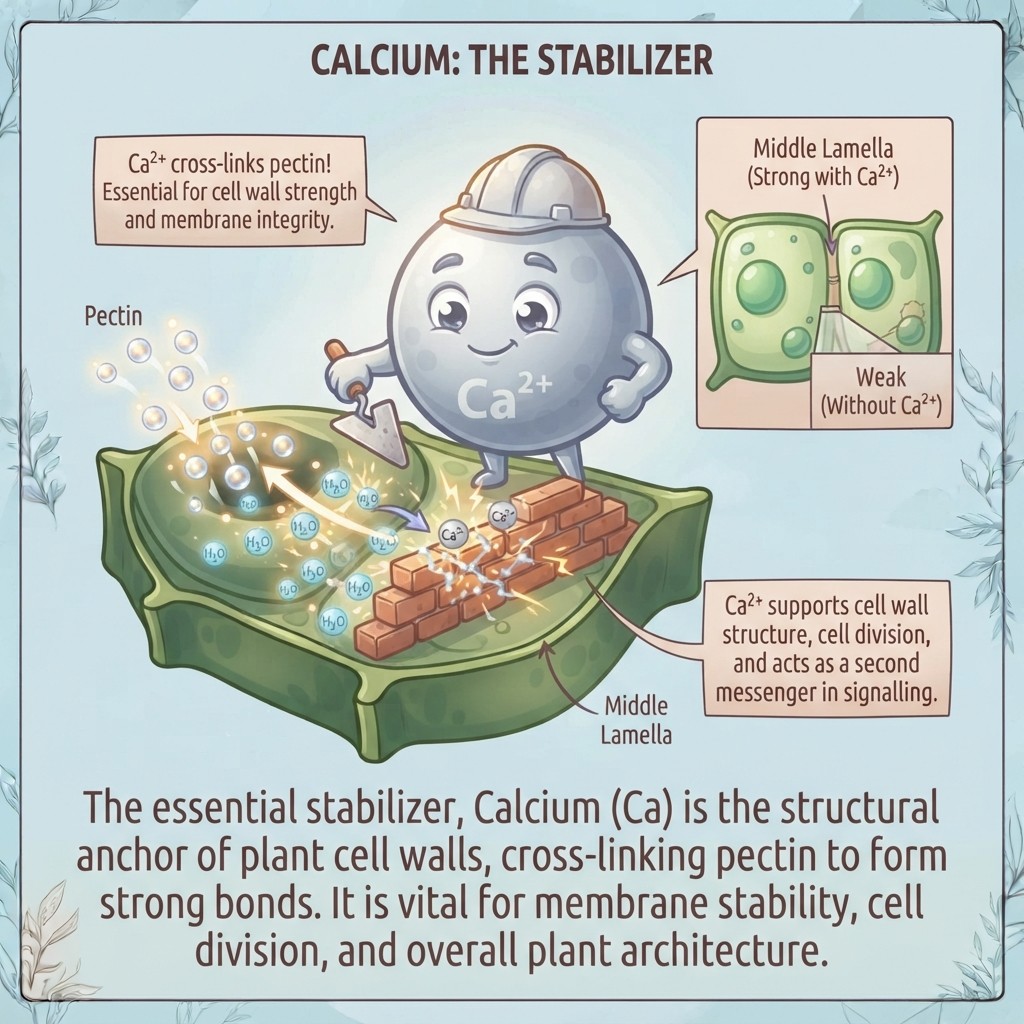
Calcium: De architect
door
Buse Soysal
Plantsap
Kalium: De logistiek manager

door
Buse Soysal
Plantsap
Fosfor: De Strateeg
door
Buse Soysal
Plantsap
Eenhedenconversie Ontmoet Cropprocessen

door
Buse Soysal
Bodemonderzoek
Bodembiologietests - Wat zijn uw opties?
door
Buse Soysal
Bodemonderzoek
Voorspel Problemen Voordat Ze Toeslaan — De Kracht van Plantsapanalyse
door
Buse Soysal
Data Analyse
Maximaliseren van de voordelen van dekgewassen voor uw teeltgewassen

door
Buse Soysal
Voedingsinteracties
Calcium: De Overlookte Lente Krachtpatser
door
Buse Soysal
Voedingsinteracties
Snijden de kosten van kunstmest in uw winst?
door
Buse Soysal
Meststoffen
Vooruitgang in Precisie-irrigatie: Technologie gebruiken voor Duurzame Landbouw

door
Buse Soysal
Bodemgezondheid
Het Ontgrendelen van de Verborgen Helpers in de Landbouw: Microbieel Genomics en de Dataprobleem

door
Buse Soysal
Het belang van microbiele amendementen: Hoe de algehele gewasresistentie te vergroten

door
Buse Soysal
Bodemgezondheid
Het Ontgrendelen van Oogstpotentieel: De Ongenoemde Kracht van Plantenappelsanalyse

door
Buse Soysal
Regeneratieve Landbouw
Het ontgrendelen van koolstofcredits: welke gegevens boeren moeten bijhouden en hoe wij kunnen helpen

door
Buse Soysal
Data Analyse
Verbeteren van Onkruidbeheer: Het Benutten van Gegevensanalyse voor Duurzame Landbouw
door
Buse Soysal
Data Analyse
Het Verhogen van Gewasgezondheid met Brixmetingen: De Zoete Wetenschap van Plantenimmuniteit

door
Buse Soysal
Bodemgezondheid
Voedselbeheer en Ziekteresistentie: De Verborgen Verbindingen Onthuld Door Gegevensanalyse

door
Buse Soysal
Voedingsinteracties
Basisverzadiging Balanceren: Het Bereiken van de Ideale Verhouding voor Optimale Gewasproductie

door
Buse Soysal
Bodemgezondheid
Hoe nul overtollige vrije nitraten en ammonium in planten sapanalyse te bereiken

door
Buse Soysal
Regeneratieve Landbouw
Amerika's Bruisende Ruggengraat: De Cruciale Rol van Migrerende Bijenteelt in de Amerikaanse Landbouw

door
Buse Soysal
Bodemgezondheid
De grondbiologietests ontleden - De ROI vinden met PLFA-tests

door
Buse Soysal
Bodemonderzoek
Precisielandbouw: De landbouw revolutioneren, één veld tegelijk

door
Buse Soysal
Precisielandbouw
Ag101: Wat is het verschil tussen biologische en regeneratieve landbouw?
door
Buse Soysal
Bodemgezondheid
Je favoriete bonen zijn in gevaar: Bedreigingen voor de productie van koffie en chocolade
door
Buse Soysal
Bodemgezondheid
IPM-programma's: De beste maatregelen voor plaagpreventie

door
Buse Soysal
Ziekten & Plagen
Natte Lenteproblemen - Waarom Zo Onherstelbaar?

door
Buse Soysal
Voedingsinteracties
De Invloed van Voedseltoepassingen op de Post-Oogst
door
Buse Soysal
Voedingsinteracties
Sinaasappelsap in gevaar: De bedreiging van HLB-ziekte

door
Buse Soysal
Bodemgezondheid
California Dreaming: Het Probleem met Amandelproductie

door
Buse Soysal
Onzichtbare Zicht: Zinktekort in de Bodem

door
Buse Soysal
Voedingsinteracties
Strijd onder de grond: Begrijpen van Calcium - Kalium Antagonisme in Bodem

door
Buse Soysal
Voedingsinteracties
Het Krachtkoppel van het Plantenrijk: de Synergetische Symfonie van Stikstof en Zwavel

door
Buse Soysal
Voedingsstoffen voor Beginners
Verhoog de droogtetolerantie met deze vaak gemiste micronutriënt

door
Buse Soysal
Klimaatverandering
Dieper Graven: Het Grote Bodemanalyse Debat voor Regeneratieve Landbouw

door
Buse Soysal
Bodemgezondheid
Ammonium vs Calcium: De Nutriëntenbalans voor Beter Groeiende Planten

door
Buse Soysal
Voedingsinteracties
Verbeteren van de Bodemstructuur: Verhoog de Weerbaarheid van Uw Boerderij
door
Buse Soysal
Bodemgezondheid
Relatie tussen Natrium en Calcium: Een Verhaal van Vijanden in de Bodem

door
Buse Soysal
Voedingsinteracties
Het Bodemkantoor: De Bewogen Relatie Tussen Molybdeen en Nitraat
door
Buse Soysal
Voedingsinteracties
De Delicate Dans: Het Bereiken van de Perfecte Stikstofbalans voor Optimale Oogstproductiviteit

door
Buse Soysal
Voedingsinteracties
De Weg Effenen voor een Regeneratieve Toekomst: Inzichten in het "Data Gedreven Regeneratieve Landbouw" Project

door
Buse Soysal
Regeneratieve Landbouw
Het Volledige Potentieel van de Grond Ontgrendelen: De Pionierende Principes van Dr. William A. Albrecht

door
Buse Soysal
Bodemgezondheid
De voordelen van regeneratieve landbouw voor de menselijke gezondheid

door
Buse Soysal
Regeneratieve Landbouw
Verantwoordelijke Gegevensuitwisseling in de Landbouw

door
Buse Soysal
Data Analyse
Verantwoord gebruik van meststoffen om droogte te beperken

door
Buse Soysal
Klimaatverandering
De kracht van gezonde bodem: voor een blije Wereld Aarde Dag

door
Buse Soysal
Bodemgezondheid
Gewasinspectie voor regeneratieve landbouw
door
Buse Soysal
Regeneratieve Landbouw
Plantenvoeding en Bodemanalyse voor Stikstofemissiereductie
door
Buse Soysal
Regeneratieve Landbouw
Hoe gebruik je Plantvoeding voor Regeneratieve Landbouw?

door
Buse Soysal
Regeneratieve Landbouw
Winstgevendheid van regeneratieve landbouw en transitiemanagement

door
Buse Soysal
Regeneratieve Landbouw
Hoe kunnen we data-gedreven landbouw gebruiken voor een heldere toekomst?
door
Buse Soysal
Data Analyse
Plantenanalyse voor Meer Opbrengst en Minder Meststoffen

door
Buse Soysal
Regeneratieve Landbouw