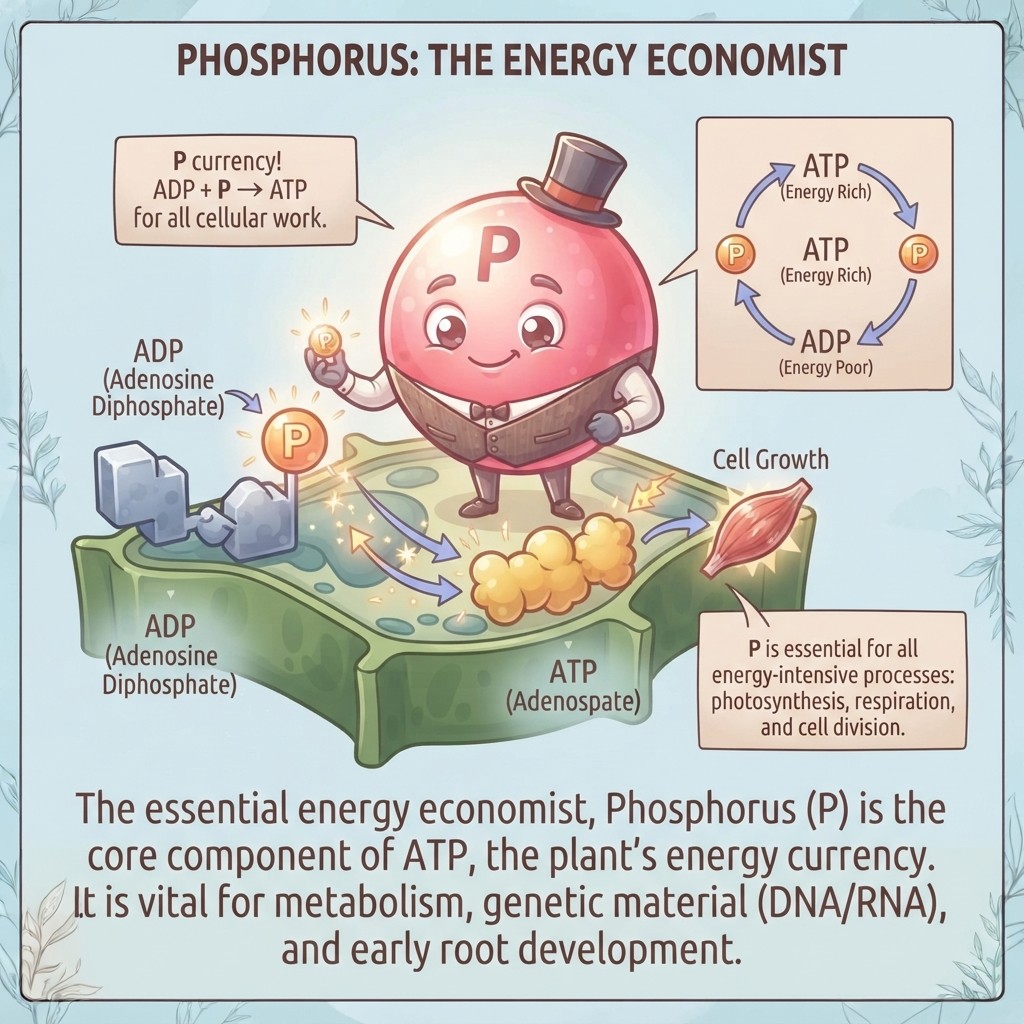
Phosphorus is the nutrient of energy, investment and allocation.
It forms part of ATP and other phosphorylated compounds involved in energy transfer. It is present in DNA and RNA, phospholipids and numerous metabolic intermediates. Photosynthesis, respiration, cell division, root development and reproduction all depend on adequate phosphorus nutrition.
For growers, however, phosphorus has an important characteristic: more is not necessarily better.
A plant needs adequate phosphorus to run its energy economy, but excessive phosphorus can disrupt the availability and utilisation of other nutrients, particularly zinc.
Phosphorus's personality and its relationships
Phosphorus behaves like a strategic capital allocator.
Nitrogen may want to expand immediately, but phosphorus asks whether the plant has enough energy to finance that expansion.
Its greatest strength is enabling energy transfer. ATP allows the plant to connect energy production with growth, nutrient assimilation, transport and biosynthesis.
Its weakness is a tendency to become disruptive when supplied beyond demand.
Magnesium is one of phosphorus's most important metabolic partners. Much of the ATP used by enzymes functions as a magnesium-ATP complex. In practical terms, phosphorus can provide the energy currency, but magnesium helps make that currency spendable.
Nitrogen is another major partner. Crops generally need N and P together to convert potential growth into actual biomass. Increasing one while the other remains limiting usually gives a poor return.
Zinc has a more complicated relationship with phosphorus. These two are not simple partners. Think of them as two senior managers who both need space to operate. When phosphorus becomes dominant, zinc status can decline. The result may be good P numbers accompanied by poor regulation of enzymes, hormones and growth.
Iron can become involved in a similar conflict. High phosphorus supply can alter Fe availability and internal Fe utilisation.
Calcium is not automatically phosphorus's ally. In high-pH or calcium-rich environments, Ca and phosphate chemistry can actually reduce phosphorus availability.
Boron remains very important to reproductive growth and sugar movement, but it should not be presented as a direct biochemical dependency of phosphorus.
The agronomy behind these relationships
Phosphorus is a constituent of ATP, nucleic acids, phospholipids and several important cofactors and intermediates. It participates directly in photosynthesis, respiration and cellular signalling. citeturn783874search7turn783874search19
It is more accurate to say that phosphorus status influences root-system architecture than to say phosphorus simply "builds roots." Plants actively change lateral roots, root hairs and rooting patterns in response to P availability. citeturn783874search0
One of the most important agronomic interactions is P–Zn. High phosphorus supply can reduce zinc concentration or aggravate an existing Zn shortage. The mechanisms differ between soils, crops and nutritional conditions and include soil sorption chemistry, root uptake, transport and internal homeostatic regulation. citeturn956577search0
Phosphorus also interacts positively with magnesium because Mg activates many reactions involving phosphate transfer. fileciteturn3file3 This is a stronger biochemical justification for calling Mg a phosphorus partner than the Ca–P relationship suggested in the original slide.
What should a grower look for in plant sap?
A high phosphorus result should never be viewed as automatically positive.
Evaluate P alongside zinc, iron and manganese. A high P value combined with declining Zn deserves attention, particularly if the trend persists over multiple samples.
Because phosphorus is mobile in the plant, differences between old and young leaves can also help indicate redistribution during periods when supply no longer matches demand.
The practical question is not "How high can we push phosphorus?"
It is "Do we have enough phosphorus to support energy metabolism without disturbing the micronutrient balance?"
This blog is part of SoilBeat’s Plant Sap Nutrient Series, created through the SNN project with co-financing from the European Union and Samenwerkingsverband Noord-Nederland (SNN).

Written by
Buse Soysal
Related
Other Articles.
Turning lab report into a fertiliser recommendation

by
Buse Soysal
Fertiliser Recommendation
Unlocking Hidden Nutrients with Total Digestion Soil Tests
by
Buse Soysal
How to Balance a High Bacterial to Fungal Ratio in your Soil

by
Buse Soysal
Soil Health
Magnesium: The Unsung Hero of Photosynthesis
by
Buse Soysal
Nutrient Interactions
PlantSap - Nitrogen: The Builder
by
Buse Soysal
Plantsap
Unlocking Smarter Farming with Weather + Nutrient Analytics

by
Buse Soysal
Nutrient Interactions
Water Meets Nutrient Strategy

by
Buse Soysal
Nutrient Interactions
Calcium: The Architect
by
Buse Soysal
Plantsap
Potassium: The Logistics Manager

by
Buse Soysal
Plantsap
Unit Conversion Meets Crop Intelligence

by
Buse Soysal
Soil Testing
Soil Biology Testing—What Are Your Options?
by
Buse Soysal
Soil Testing
Predict Problems Before They Hit — The Power of Plant Sap Analysis
by
Buse Soysal
Data Analytics
Maximizing Cover Crop Benefits for Your Cash Crop

by
Buse Soysal
Nutrient Interactions
Calcium: The Overlooked Spring Powerhouse
by
Buse Soysal
Nutrient Interactions
Are fertilizer costs cutting into your bottom line?
by
Buse Soysal
Fertilizers
Advancing Precision Irrigation: Leveraging Technology for Sustainable Agriculture

by
Buse Soysal
Soil Health
Unlocking Agriculture’s Hidden Helpers: Microbial Genomics and the Data Challenge

by
Buse Soysal
The importance of microbial amendments: How to increase overall crop resilience

by
Buse Soysal
Soil Health
Unlocking Crop Potential: The Untapped Power of Plant Sap Analysis

by
Buse Soysal
Regenerative Agriculture
Unlocking Carbon Credits: What Data Farmers Need to Track and How We Can Help

by
Buse Soysal
Data Analytics
Enhancing Weed Management: Leveraging Data Analytics for Sustainable Agriculture
by
Buse Soysal
Data Analytics
Elevating Crop Health with Brix Measurements: The Sweet Science of Plant Immunity

by
Buse Soysal
Soil Health
Nutrient Management and Disease Resistance: Unveiling the Hidden Connections Through Data Analytics

by
Buse Soysal
Base Saturation Balancing: Achieving the Ideal Ratio for Optimal Crop Production

by
Buse Soysal
Soil Health
How to Achieve Zero Excess Free Nitrates and Ammonium in Plant Sap Analysis

by
Buse Soysal
Regenerative Agriculture
America's Buzzing Backbone: The Crucial Role of Migratory Beekeeping in U.S. Agriculture

by
Buse Soysal
Soil Health
Breaking Down Soil Biology Testing - Finding the ROI with PLFA Tests

by
Buse Soysal
Soil Testing
Precision Agriculture: Revolutionizing Farming, One Field at a Time

by
Buse Soysal
Precision Agriculture
Ag101: What is the difference between organic and regenerative agriculture?
by
Buse Soysal
Soil Health
Your Favourite Beans are in Danger: Threats to Coffee & Chocolate Production
by
Buse Soysal
Soil Health
IPM Programs: Best of the Pest Prevention Measures

by
Buse Soysal
Pest & Disease
Wet Spring Issues - Why So Irreparable?

by
Buse Soysal
Nutrient Interactions
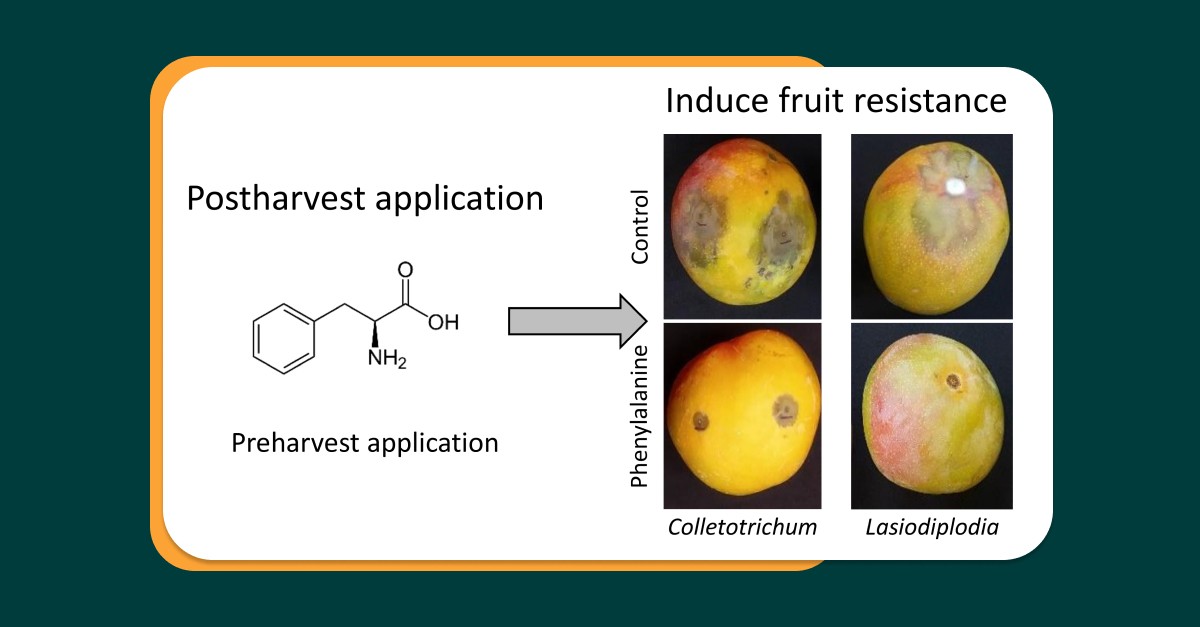
The Influence of Nutrient Applications on Post Harvest
by
Buse Soysal
Nutrient Interactions
Orange Juice in Danger: The Threat of HLB Disease

by
Buse Soysal
Soil Health
California Dreaming: The Issue with Almond Production

by
Buse Soysal
Sight Unseen: Zinc Deficiency in Soil

by
Buse Soysal
Nutrient Interactions
Battle Beneath: Understanding Calcium - Potassium Antagonism in Soil

by
Buse Soysal
Nutrient Interactions
The Plant Kingdom's Power Couple: Nitrogen and Sulfur's Synergistic Symphony

by
Buse Soysal
Nutrients for Beginners
Increase Drought Tolerance With This Commonly Missed Micronutrient

by
Buse Soysal
Climate Change
Digging Deeper: The Great Soil Analysis Debate for Regenerative Agriculture

by
Buse Soysal
Soil Health
Ammonium vs Calcium: The Nutrient Balancing Act for Thriving Plants

by
Buse Soysal
Nutrient Interactions
Improving Soil Structure: Boost Your Farm’s Resilience
by
Buse Soysal
Soil Health
Sodium and Calcium Relationship: A Tale of Frenemies in the Soil

by
Buse Soysal
Nutrient Interactions
The Soil Office: Molybdenum and Nitrate's Tumultuous Relationship
by
Buse Soysal
Nutrient Interactions
The Delicate Dance: Achieving the Perfect Nitrogen Balance for Optimal Crop Productivity

by
Buse Soysal
Nutrient Interactions
Paving the Way for a Regenerative Future: Insights into the "Data Driven Regenerative Ag" Project

by
Buse Soysal
Regenerative Agriculture
Unlocking Soil's Full Potential: The Pioneering Principles of Dr. William A. Albrecht

by
Buse Soysal
Soil Health
The Benefits of Regenerative Agriculture for Human Health

by
Buse Soysal
Regenerative Agriculture
Responsible Data Exchange in Agriculture

by
Buse Soysal
Data Analytics
Responsible Fertilizer Use for Mitigating Drought

by
Buse Soysal
Climate Change
The Power of Healthy Soil: for a Happy World Earth Day

by
Buse Soysal
Soil Health
Crop Scouting for Regenerative Agriculture

by
Buse Soysal
Regenerative Agriculture
Plantsap and Soil Analyses for Nitrogen Emission Reduction

by
Buse Soysal
Regenerative Agriculture
How do you use Plant Nutrition for Regenerative Agriculture?

by
Buse Soysal
Regenerative Agriculture
Profitability of Regenerative Agriculture and Transition Management

by
Buse Soysal
Regenerative Agriculture
How can we use Data-Driven Farming for a Bright Future?

by
Buse Soysal
Data Analytics
Plantsap Analysis for More Yield and Less Fertilizer

by
Buse Soysal
Regenerative Agriculture