Chemical balance
Review nutrient sufficiency, pH, salinity, exchangeable cations and potentially toxic concentrations. No universal calcium–magnesium–potassium ratio guarantees optimum fertility.
Understand soil testing methods, nutrient availability and the relationships that determine soil fertility.
Two laboratories can analyse the same soil and report different phosphorus levels. Understanding the method helps you turn those numbers into useful decisions for your crop.

The value of a soil test is not just the number it reports. It is what that number means for your crop.
Good interpretation starts with the soil, the sample and the method.
No single extraction measures every nutrient pool or predicts uptake in every soil. Explore what each method measures, where it is useful and what to check before interpreting a result.
A multi-element extraction using acids, salts and EDTA. Efficient for broad fertility assessment from a single soil sample.
Start with soil condition, then confirm free lime, mineralogy and the locally calibrated laboratory system.
These are general guidelines, not universal cutoffs. Regional laboratories may use CAL, AL, AB-DTPA or modified Morgan. Prefer a method with validated interpretation for your crop and soil.
30 mg/kg by Mehlich 3 is not automatically equivalent to 30 mg/kg by Olsen or Bray P1. Extraction and detection methods determine what the number represents. There is no universal conversion between methods.
For useful trends, keep the laboratory, extraction, detection procedure, sampling depth and season consistent wherever practical.
Soil balance connects nutrient supply with biological activity and physical conditions. Adequate nutrients cannot compensate for poor rooting, compaction or water stress.
Review nutrient sufficiency, pH, salinity, exchangeable cations and potentially toxic concentrations. No universal calcium–magnesium–potassium ratio guarantees optimum fertility.
Microorganisms and living roots support decomposition, mineralisation and nutrient cycling. Consider organic matter, management history and the limits of the chosen biological indicators.
Aggregation, porosity, infiltration, aeration and rooting depth determine whether roots can reach nutrients and water. Observe the soil alongside the laboratory report.
An antagonistic interaction can reduce availability, uptake or utilisation of another nutrient. The effect depends on concentration, crop and growing conditions.
| Interaction | Potential effect |
|---|---|
| Potassium ↔ magnesium | Excess K can reduce Mg uptake. |
| Potassium ↔ calcium | High K supply can restrict Ca uptake under some conditions. |
| Ammonium ↔ calcium | Elevated NH₄⁺ can suppress Ca uptake. |
| Sodium ↔ calcium | Excess Na can impair Ca acquisition and soil physical properties. |
| Phosphorus ↔ zinc | High P can contribute to Zn deficiency in susceptible systems. |
An interaction chart does not prove a limitation in your field. Combine soil evidence with plant measurements, water availability, root activity and crop stage.
Explore nutrient interactions →The Haney test combines nutrient measurements with indicators related to carbon and nitrogen cycling. It commonly includes water-extractable organic carbon and nitrogen, an organic-acid extraction such as H3A, and respiration after controlled drying and rewetting. These measurements describe labile pools and potential activity under test conditions. They do not directly measure microbial diversity, total microbial biomass or continuous field activity. Fertiliser recommendations are not equally validated across every crop, soil and region. Use it as a complementary assessment alongside locally calibrated fertility tests.
Nitrogen, phosphorus and potassium remain useful tools because crops need them in large quantities and often respond when they are deficient. Plants also need calcium, magnesium, sulfur and micronutrients, as well as functioning roots, water and soil structure. Regenerative nutrient management aims to maintain productivity while improving nutrient-use efficiency. Living roots, appropriate cover crops, organic inputs and reduced unnecessary disturbance can support soil processes. Correct verified limitations and avoid inputs that do not improve crop performance.
A useful interpretation follows the evidence from the sample to the crop. Work through these eight checks before choosing an intervention.
Verify field, depth, date, management zone and recent fertiliser or lime applications.
Record Olsen, Mehlich 3, Bray, Morgan or another method, plus the detection procedure where relevant.
Look for nutrient availability and salinity constraints.
Compare concentrations with ranges calibrated for the method, crop and region.
Understand nutrient retention and cation distribution without relying on universal ideal ratios.
Only pursue an antagonism when concentrations and crop conditions support it.
Use sap or tissue analysis, rooting observations and crop development as complementary evidence.
Prioritise verified constraints, then use follow-up measurements to assess the outcome.

A soil test is a measurement produced by a particular method under defined laboratory conditions. It is not a complete description of soil fertility.
SoilBeat connects laboratory measurements with crop evidence, activities and growing history, so each result can be investigated in context.
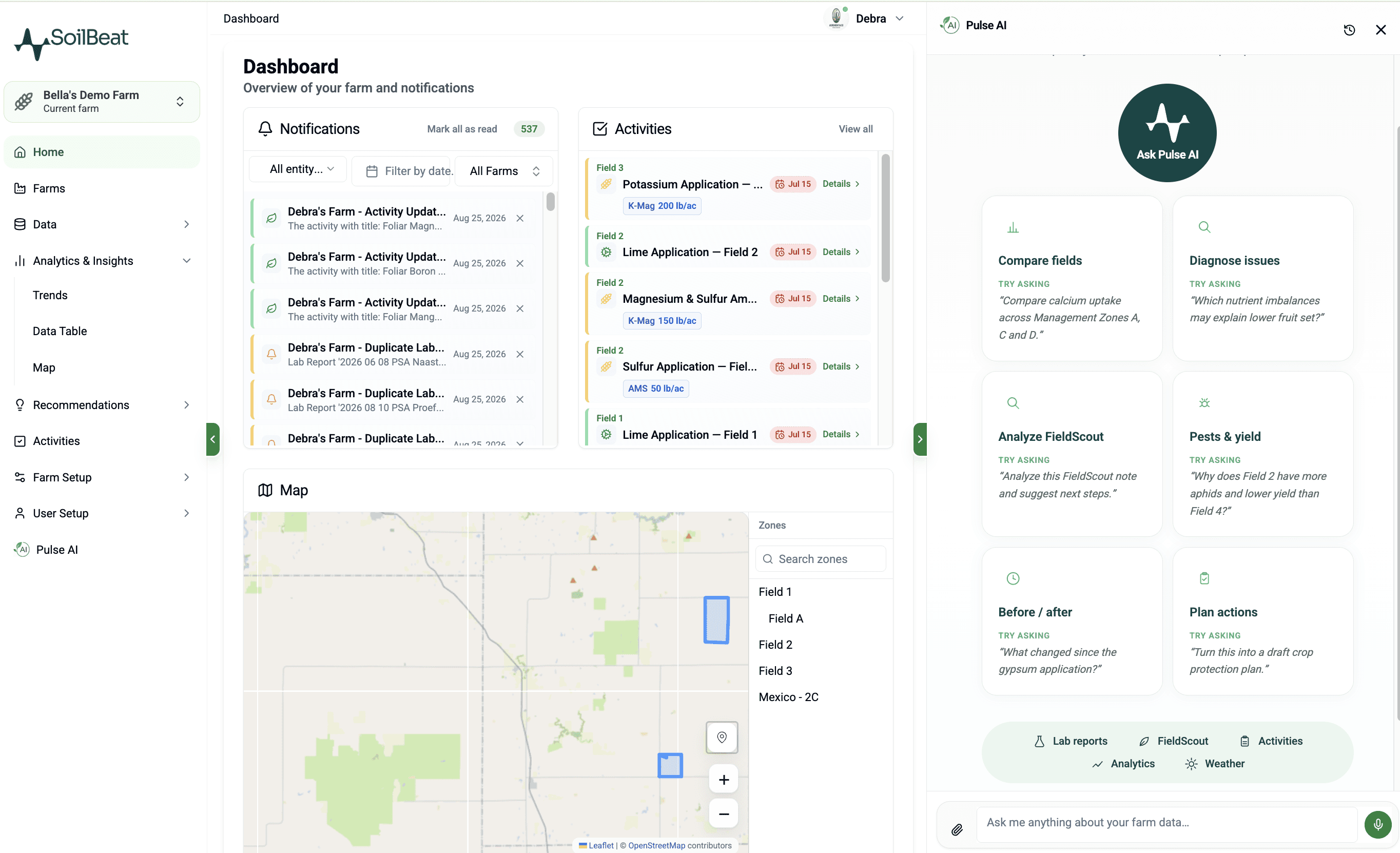
Bring soil, plant tissue and sap measurements into a structured agronomic record with field observations and activities.
Review possible nutrient interactions alongside soil chemistry, plant nutrient status and management history.
Compare sampling dates while accounting for method and depth changes. Connect verified limitations to a plan and follow-up results.
Keep methods, units and reference ranges with the result wherever supported. An Olsen result must not automatically be interpreted against a Mehlich 3 calibration.
Laboratories may use different extractants, detection procedures and interpretation ranges. A high Mehlich 3 result and a low Olsen result need not conflict. Check methods, units, sampling variability and reference systems before comparing classifications.
Empirical equations exist for particular soils and procedures, but there is no universal conversion. Consistent testing is preferable. If a method change is unavoidable, locally validated conversion data or parallel laboratory analysis may help establish comparability.
It can add information about labile carbon, nitrogen cycling and potential microbial activity when those measurements help answer a management question. It complements locally validated nutrient testing rather than automatically replacing it.
Circular chromatography produces visual patterns from soluble soil constituents moving through treated paper. It does not provide standardised quantitative nutrient, microbial biomass or diversity measurements. Claims about diagnostic colours or rings require independent validation. It should not replace chemical and biological testing.
The interval depends on the crop, soil and management question. Routine fertility testing every two to four years may suit many field crops. Intensive horticulture may need annual or more frequent checks. Nitrate, salinity and soluble nutrients can require seasonal monitoring. Keep season, depth and procedures consistent when tracking trends.
No single base saturation ratio optimises every soil and crop. Consider absolute nutrient sufficiency, CEC, structure, pH and crop response. A ratio differing from a proposed ideal is not, by itself, a reason to apply an amendment.
Soil analysis describes nutrient supply and soil conditions, but uptake also depends on roots, weather, irrigation and crop stage. Plant tissue or sap measurements, field observations and crop performance provide complementary evidence.
Understand the method. Interpret the balance. Connect your soil results to the crop and the decisions that follow.
Interpret results using the relevant laboratory method, validated reference values and crop and soil conditions. Nutrient interactions and soil health indicators inform investigation; they do not independently establish fertiliser requirements.