THE SOILBEAT PLATFORM

Features built aroundreal agronomic decisions.

SoilBeat connects agronomic data, analytics, decision logic, recommendations and field execution in one workflow. Explore the capabilities — and the different recommendation types built for different questions.

Add product screenshotFramer image control · Contain
EXPLORE THE PLATFORM

One connected system. From data to action.

The pieces work together: bring evidence together, understand what is changing, choose the right recommendation approach, review it and connect it to what happens in the field.

01 · DATA HUB

Bring soil, plant, water and field evidence together.

Turn reports and field information from different sources into structured agronomic data that can be compared and connected to the right farm, crop and management zone.

Import PDF, CSV and XLS lab reports from multiple sources.

Structure soil, plant sap, tissue, water, silage, manure and fungi results.

Normalise nutrients and units for comparison.

Connect samples to farms, fields, crops and management zones.

Keep observations, activities, yields and growing history with the record.

Maintain personalised fertiliser and crop-protection product libraries.

Add product screenshotFramer image control · Contain
Data Hub · reports, samples, observations and farm context
02 · ANALYTICS

See change, relationships and context — not isolated test results.

Compare measurements over time and against field events so you can investigate what changed and where attention is needed.

Customise nutrient graphs and comparisons.

Compare nutrients by crop, zone, test type and date.

Track plant-sap results over time.

Place lab results alongside fertilisation and field events.

Use connected observations and history when interpreting results.

Investigate patterns with Pulse across connected data.

Add product screenshotFramer image control · Contain
Analytics · trends, comparisons and field events
03 · RECOMMENDATION ENGINE

Choose the recommendation that matches the question.

SoilBeat is not one generic AI recommendation. Different agronomic questions need different evidence, logic and outputs. Start from the goal, then build the recommendation around the relevant data.

Goal-specific recommendation templates.

Evidence selected from the connected farm record.

Deterministic agronomic calculations where required.

AI-assisted interpretation and drafting.

Editable products, rates, timing and wording.

Human review, approval and publishing before advice reaches the grower.

Add product screenshotFramer image control · Contain
Recommendation Engine · goal → evidence → logic → review → publish
RECOMMENDATION TYPES

Different questions need different recommendations.

The recommendation type determines the question, evidence, agronomic logic and practical output. It is not simply a different prompt.

01Recommendation

PlantSap

ANSWERS

What is happening in the plant now, and what needs correcting?

USES

Young + old leaf sap results, crop stage, observations and history.

OUTPUTIn-season nutrient correction plan
02Recommendation

SoilBalance Fertilisation

ANSWERS

How should soil nutrient balance be addressed across the season?

USES

pH, base saturation, mineral balance, crop needs and history.

OUTPUTWhole-season balanced fertilisation plan
03Recommendation

Soil Fertilisation

ANSWERS

What base fertilisation does this field need?

USES

Soil test, crop needs and yield targets.

OUTPUTBase fertilisation recommendation
04Recommendation

Manure Planning

ANSWERS

How can available manure be used appropriately?

USES

Manure nutrient value, field need, timing and application limits.

OUTPUTManure application plan
05Recommendation

Nitrogen Reduction

ANSWERS

Where can synthetic N be reduced without simply reducing yield ambition?

USES

Crop demand, existing nutrient supply, history and planned applications.

OUTPUTN reduction recommendation
06Recommendation

Water Efficiency

ANSWERS

What can improve uptake, retention and crop resilience?

USES

Water information, plant status, field context and management history.

OUTPUTWater-efficiency action plan
07Recommendation

Crop Protection

ANSWERS

What pest or disease problem needs attention, and what should happen next?

USES

FieldScout observations, photos/videos, crop context and history.

OUTPUTTargeted crop-protection recommendation
08Recommendation

Cost Savings

ANSWERS

Where can input spend be reduced while still addressing the agronomic need?

USES

Nutrient targets, product library, rates and product costs.

OUTPUTCost-aware product/rate recommendation
09Recommendation

General Advice

ANSWERS

What should we do about this specific agronomic problem?

USES

Selected evidence from the farm record and the advisor's question.

OUTPUTCustom recommendation report
04 · AGRONOMIC LOGIC

SoilBeat intelligence first. Your methodology can build on it.

The recommendation layer combines SoilBeat's agronomic intelligence with structured data. Where a specialist needs proprietary targets, rules or calculations, those can be added without turning everything into generic AI.

SoilBeat-authored agronomic logic.

Deterministic calculations for repeatable numbers and rules.

Agronomist-authored proprietary targets, norms and calculations.

AI pattern recognition across structured farm evidence.

Specialist recommendation modules for repeatable methodologies.

Human review remains part of the workflow.

Add product screenshotFramer image control · Contain
Agronomic Logic · rules + calculations + AI interpretation
05 · COLLABORATION & EXECUTION

Turn the recommendation into work.

A recommendation should not end as a PDF. Publish the prescription into the grower's workflow so the people responsible know what needs doing — and keep the result for the next decision.

Shared farm workspaces for agronomists and growers.

Publish fertilisation and crop-protection prescriptions into Activities.

Assign and track field work and follow-up.

Capture observations and field reality after recommendations.

Keep advice, action and history connected.

Support shared accounts and permissions.

Add product screenshotFramer image control · Contain
Collaboration & execution · recommendation → activity → follow-up
06 · PULSE AI

Ask questions across the farm record.

Pulse is the open-ended layer inside SoilBeat. Use it to investigate, compare and connect information you have already structured — then move from an answer toward a recommendation when useful.

Ask questions across lab reports, observations, activities and history.

Compare farms, fields, zones, crops and dates.

Investigate nutrient interactions and changes over time.

Connect field observations with measurements and interventions.

Use Pulse to explore before creating a structured recommendation.

Keep open-ended exploration separate from the controlled recommendation workflow.

Add product screenshotFramer image control · Contain
Pulse · investigate, compare and enquire across connected data
WHY THIS IS DIFFERENT

More than a prompt. A recommendation workflow.

Generic AI can help explore information. SoilBeat connects structured farm data, agronomic logic and a controlled recommendation process so the output can be reviewed, edited and turned into action.

GENERIC AI
PromptModelAnswer
SOILBEAT
Farm dataContextAgronomic logicRecommendationReviewActivity
EXPLORE SOILBEAT

Find the capabilities that fit the way you work.

Explore the platform, compare recommendation workflows or talk to us about a more specific setup.

Ask your farm data a question. Get an answer you can act on.

Pulse understands your context. Send a voice note, upload a file, or type a question to instantly uncover correlations, interpret tests, and take action.

Data Hub & Context

Recent Uploads

Soil_Test_Field3.pdf
Sap_Analysis_Oct.csv
PLFA_Biology_Report.pdf

Active Data Layers

Fieldscout Observations
Fertilizer Applications
Pulse AI Assistant

I've connected your lab reports, fieldscout notes, and activities. Select a prompt below to see how I can build plans and generate actions.

More than a chat. A complete agronomic assistant.

Pulse doesn't just return text. It generates UI, correlates separate data streams, and builds actionable plans.

Correlate Data Streams

Connect lab chemistry with physical field symptoms automatically.

Analysis Link

Sap Boron: 0.18 ppm

Severely Deficient (Target 0.7)

Fieldscout: Hollow Heart

Logged 2 days ago in Zone B

Generate Workflows

Turn an insight directly into a management zone or assigned task.

"Create a zone for the K-deficient area"
Low K Zone
Zone: NW Ridge Created

Instant Reporting

Generate audio voicenotes or text summaries to share with clients.

Generated Summary for Grower

Based on October Soil Test

0:45

Historical Memory

Recall past advice instantly. Never dig through old PDFs or emails to remember.

"What did I recommend last year for Field 3?"

On April 12, 2024, you recommended 85.8 kg/ha of Gypsum and 430 kg/ha of K-Mag for Field 3 to address low Calcium base saturation (62%).

Spring_2024_Plan.pdf

Cross-Field Benchmarks

Instantly compare specific nutrients across multiple zones.

"Compare P levels across all sandy soil fields."

Phosphorus (Plant Available) in Sandy Soils:

North Block Oct 12, 2024
18 ppm
Field 2 Oct 14, 2024
25 ppm
River Tract Oct 15, 2024
42 ppm

Measure ROI

Prove whether applications worked by comparing historical metrics.

"Did last year's compost improve organic matter?"

Yes. Following the 10 t/ha compost application in April 2023, Organic Matter in Field 1 showed significant improvement:

Before (Mar '23)2.1%
After (Oct '24)
2.8%

Pulse lives inside the SoilBeat platform.

A powerful AI needs a powerful foundation. SoilBeat gives you the tools to manage nutrients, reduce inputs, and prove what works across your entire operation.

Universal Data Hub

Upload any lab report. Our parser maps 597 nutrients across 100+ lab formats with 99% accuracy, standardizing soil, sap, tissue, and biology data in minutes—not hours.

FOLETTA_SoilAnalysis_C1.pdf
Parsed

Interactive Analytics

See what changed and why. Track 83+ nutrients on an interactive timeline alongside weather, field observations, and fertilizer applications to detect antagonisms.

Oct '23Gypsum AppliedMar '24

Fertilizer Calculator

Build costed field plans based on Albrecht soil balance principles. Automatically account for nitrogen credits and match nutrient gaps to crop demand using your inventory.

Urea (N 46%)
122 kg/ha
$222.46

One Source of Truth

No more emailing spreadsheets. Advisors and growers collaborate in one shared workspace. Log pests in FieldScout and build plans from a shared, living record.

Debra (Agronomist)Owner
Jurwin (Grower)Active
Farmer holding phone

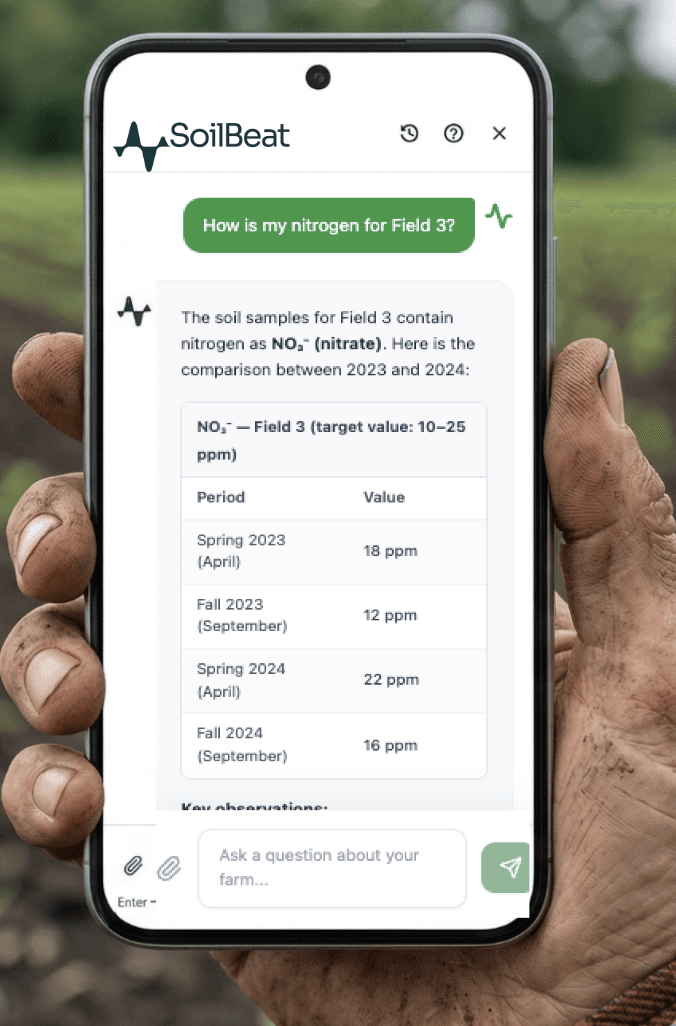
Answers in the field.
Where you need them.

Agronomy doesn't just happen at a desk. Pulse goes where you go, giving you the power of a complete data hub right from your pocket.

Voice-to-Action

Send a voice note from the tractor cab. Pulse transcribes it, extracts the data, and logs the activity automatically.

On-the-Spot Comparisons

Standing in Field 2? Ask how current nitrogen levels compare to last spring and get a formatted table instantly.

GPS-Aware Context

Create management zones or log field scout observations exactly where you are standing.

Visualize Trends & Context

See the full picture. Pulse correlates your lab tests alongside field observations and applied activities, giving you a complete timeline of your farm's health.

SoilBeat Logo
Agromallorca
Start
Betriebe
Daten
Analytik & Insights
Trends
Data Tabelle
PlantSap Insights
Nährstoffmanagement
Aktivitäten

Plant Sap → Zucchini → Invernadero 73

20.0k ppm10.0k ppm6.0k ppm1.4k ppm600.0 ppm200.0 ppm14.0 ppm6.0 ppm1.0 ppm

Report

Invernadero 73
Feb 10, 2026
Benjamin Epler
Activities
Observations
Nutrients
Aluminum (Al) Old Leaf
Aluminum (Al) Young Leaf
Sugar (C6H12O6) Young Leaf
Calcium (Ca) Old Leaf
Calcium (Ca) Young Leaf
Chloride (Cl) Old Leaf
Pulse
What did I recommend last year on field2?

Based on the document you've shared, here is the programme I recommended for Field 2:

Field 2 — Recommended Programme Summary

Overall conclusion: Field 2 is fundamentally balanced. The focus was on correcting early-season B and Mo deficiencies and avoiding chloride-bearing K sources.

🌸 Late February - March (before budbreak)

ProductRate
Chicken Manure300 kg/ha
Gypsum100 kg/ha
Sul-Po-Mag75 kg/ha
Molasses9.35 L/ha

Portfolio-Level Intelligence

Don't just analyze one field at a time. Ask Pulse to scan across all your clients, farms, and zones to instantly identify where your attention is needed most.

SoilBeat Logo
All Farms (Portfolio)
Home
Farms
Data
Analytics & Insights
Trends
Data Table
PlantSap Insights
Nutrient Planning
Activities
DA

Debra Aurich

Agronomist

Select a date range: Past 12 Months
142 samples found
Split Farms
Split Crops
Soil → All Crops → Portfolio
Farm / ZonePotassium (K) Base SaturationMagnesium (Mg) Base SaturationStatus
Foletta FarmsSite C12.89%22.0% Severe Imbalance
Smith FarmsZone 33.50%18.5% Warning
Green AcresNorth Block5.20%14.0% Optimal
Pulse
Which of my farms have a K:Mg imbalance right now?

Based on the latest soil and sap data across your portfolio, here are the zones with significant K:Mg imbalances:

1. Foletta Farms — Site C1

Soil K base saturation has dropped to 2.89%, while Mg has climbed to 22%. This creates a severe antagonism.

2. Smith Farms — Zone 3

Soil K is adequate (150 ppm), but Sap K is dropping sharply compared to Mg, indicating an uptake issue likely due to recent dry conditions.

Would you like me to draft a summary report for these growers or create a bulk task?

What else can you ask?

If it's in your data, Pulse can answer it or act on it.

"Compare my nitrogen levels across all fields."
"What is my biggest nutrient block now?"
"Which zones have the biggest nutrient imbalance right now?"
"Draft a task to adjust the P application rate based on this Haney test."
"What did we apply here last year when the leaves looked like this?"
"Are my young leaves showing deficiency?"
"Did the compost application actually raise organic matter?"
"Create a management zone where sap calcium is dropping."
"Which of my clients has the biggest K:Mg shift this season?"
"Summarize this 11-page AgSource lab PDF in 3 sentences."

Not ChatGPT. Not a search engine. Reliable augmentation.

Standard AI models guess based on the internet. Pulse acts as an expert assistant that calculates using your specific structured data, ensuring you and your agronomist share a trustworthy, data-backed baseline. It doesn't replace expertise—it scales it.

  • 597 nutrient mappings standardize every value. Context-aware unit conversions handle the difference between labs.
  • Correlates your realities. Pulse cross-references lab data, pest/disease fieldscout notes, and fertilization activities.
  • When Pulse says "your K dropped 15%", it's citing your test. It acts within your farm, generating tasks and management zones, not just text.
The Difference

Standard LLM

"Generally, potassium deficiency in crops can be caused by leaching in sandy soils or heavy crop removal..."

SoilBeat Pulse

"Field 3 is at the absolute bottom of its target range (120 ppm) with a base saturation of 2.89%. This is a 15% drop since your last sample in October."

★★★★★

"I need the best analytics for comparing and stacking data, and AI-driven analysis with recommendations for inputs and practices."

— Jack Wishbone

Crop Advisor, Wisconsin, USA

★★★★★

"Very important to get access to actionable, data-driven fertilization advice myself. Pulse makes it easy to understand my soil."

— Steve Hartington

Potato Farmer, Ohio, USA

Your soil test finally talks back.

Upload your latest lab report. Ask Pulse what it means.

No credit card required. Works with any lab.

1,432+ farms5,000+ reports processed100+ formats supported

BUILT FOR GROWTH

See What
Our Users Say.

Jack Wishbone

Agronomist, independent

I started to add lab reports to Chat and then Claude. It all looked super promising, but it frankly became a mess. I feel that with SoilBeat we get the best of both worlds; a platform that organises all my data, that enables me to collaborate and that provides me with AI horsepower to do better analytics.

Beyond just Chat

Pulse does not just answer. It acts.

General chatbots give you text. Pulse reads your structured data, runs calculations, and creates records inside SoilBeat — from the conversation.

Skills — Pulse takes action

Tell Pulse what to do, and it does it inside SoilBeat.

Analyze samples

Pulse compares your lab results against targets, identifies deficiencies, and surfaces nutrient interactions — structured as an attention table.

Create analytics filters

"Show me K trends for my potato fields" — Pulse applies the right filters directly in your Analytics view.

Create management zones

Securely migrate historical data and enjoy peace of mind with advanced data vaults.

Import fertilizers and crop protection from files

Upload a product list and Pulse parses and registers them into your catalog automatically.

Create activities and field scouts from conversation

"Log a foliar spray on Field 3 today" — Pulse creates the activity record with the right product, zone, and date.

Voice Recording

Record your notes, actions and observations in the field. Pulse converts speech to text and responds — no typing needed on mobile.

Tools — Pulse reads your data

Every answer draws from your live, structured SoilBeat records.

Management Zones

Reads and creates zones, subzones, and field boundaries.

Lab Reports

Accesses all lab data — soil, sap, tissue, PLFA, biology — with zone, crop, and date context.

Fertilizers & Crop Protection

Reads your product catalog and creates new entries from conversation or file uploads.

Activities & Field Scout

Reads scheduled tasks and field observations. Creates new entries from chat.

Farms, Crops & Harvests

Knows which farms, crop rotations, and harvest records belong to your account.

File Uploads in Chat

Drop a product list, crop rotation file, or lab report directly into the Pulse chat. It parses, structures, and creates the records for you.